



 Chat with AI
Exam 18: Ketones and Aldehydes

Exam 1: Introduction and Review127 Questions
Exam 2: Structure and Properties of Organic Molecules129 Questions
Exam 3: Structure and Stereochemistry of Alkanes129 Questions
Exam 4: The Study of Chemical Reactions128 Questions
Exam 5: Stereochemistry128 Questions
Exam 6: Alkyl Halides: Nucleophilic Substitution and Elimination132 Questions
Exam 7: Structure and Synthesis of Alkenes128 Questions
Exam 8: Reactions of Alkenes132 Questions
Exam 9: Alkynes124 Questions
Exam 10: Structure and Synthesis of Alcohols132 Questions
Exam 11: Reactions of Alcohols124 Questions
Exam 12: Infrared Spectroscopy and Mass Spectrometry120 Questions
Exam 13: Nuclear Magnetic Resonance Spectroscopy130 Questions
Exam 14: Ethers, Epoxides, and Thioethers127 Questions
Exam 15: Conjugated Systems, Orbital Symmetry, and Ultraviolet Spectroscopy130 Questions
Exam 16: Aromatic Compounds128 Questions
Exam 17: Reactions of Aromatic Compounds129 Questions
Exam 18: Ketones and Aldehydes132 Questions
Exam 19: Amines129 Questions
Exam 20: Carboxylic Acids125 Questions
Exam 21: Carboxylic Acid Derivatives128 Questions
Exam 22: Condensations and Alpha Substitutions of Carboxyl Compounds125 Questions
Exam 23: Carbohydrates and Nucleic Acids125 Questions
Exam 24: Amino Acids, Peptides, and Proteins127 Questions
Exam 25: Lipids127 Questions
Exam 26: Synthetic Polymers128 Questions
Select questions type


The positively polarized carbon atom of a carbonyl group acts as:
(Multiple Choice)
4.8/5  (82)
(82) 
What reagents can be used to convert 1-hexyne into 2-hexanone?
(Multiple Choice)
4.7/5 (74)
(74) Which series of reactions described below, if any, will result in the formation of 2-methylpentan-3-one starting with 1-propanol?
(Multiple Choice)
4.8/5 (79)
(79) 

Which of the following describes a synthesis of an aldehyde?
(Multiple Choice)
4.8/5 (66)
(66) Provide the necessary reagents to complete the following transformation. 
(Essay)
4.8/5 (72)
(72) Beginning with sodium acetylide (NaCCH), propose a three-step synthesis of hexanal.
(Essay)
4.9/5 (67)
(67) Name the compound generated when 1-methylcyclohexene is subjected to O3 followed by dimethyl sulfide.
(Short Answer)
4.7/5 (82)
(82) When H2NCH2CH2CH2CH2COCH3 is heated in the process of an acid catalyst, a reaction occurs. The product has the formula C6H11N. Provide the structure of this product.
(Essay)
5.0/5 (68)
(68) Provide the major organic product which results in the reaction shown below. 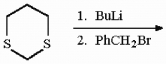
(Essay)
4.9/5 (73)
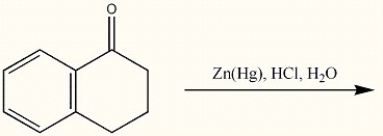
(73) 
What organic compound is generated when PhCOCl is treated with (CH3CH2CH2)2CuLi?
(Essay)
4.8/5 (78)
(78) Rank the following compounds in order of their propensity to become a hydrate in water (i.e., start with the least easy to hydrate: CH3COCH2CH3, H2CO, Cl3CCHO, and CH3CH2CHO.
(Essay)
4.8/5 (72)
(72) What compound is produced when 1,3-dithiane is subjected to the following sequence of reagents:
1. n-BuLi
2. (CH3)3CCH2CH2CH2I
3. HgCl2, H3O+?
(Essay)
4.9/5 (65)
(65) The strongest absorptions in the UV spectra of aldehydes and ketones are ones which result from ________ electronic transitions.
(Multiple Choice)
4.9/5 (76)
(76) Trioxane is a cyclic trimer of formaldehyde that can be converted to formaldehyde upon heating. Show this reaction.
(Essay)
4.8/5 (71)
(71) Provide the structure of the major organic product which results when benzaldehyde reacts with hydroxylamine in the presence of acid.
(Essay)
4.9/5 (82)
(82) 
Filters
- Essay(0)
- Multiple Choice(0)
- Short Answer(0)
- True False(0)
- Matching(0)