



 Chat with AI
Exam 21: Carboxylic Acid Derivatives

Exam 1: Introduction and Review127 Questions
Exam 2: Structure and Properties of Organic Molecules129 Questions
Exam 3: Structure and Stereochemistry of Alkanes129 Questions
Exam 4: The Study of Chemical Reactions128 Questions
Exam 5: Stereochemistry128 Questions
Exam 6: Alkyl Halides: Nucleophilic Substitution and Elimination132 Questions
Exam 7: Structure and Synthesis of Alkenes128 Questions
Exam 8: Reactions of Alkenes132 Questions
Exam 9: Alkynes124 Questions
Exam 10: Structure and Synthesis of Alcohols132 Questions
Exam 11: Reactions of Alcohols124 Questions
Exam 12: Infrared Spectroscopy and Mass Spectrometry120 Questions
Exam 13: Nuclear Magnetic Resonance Spectroscopy130 Questions
Exam 14: Ethers, Epoxides, and Thioethers127 Questions
Exam 15: Conjugated Systems, Orbital Symmetry, and Ultraviolet Spectroscopy130 Questions
Exam 16: Aromatic Compounds128 Questions
Exam 17: Reactions of Aromatic Compounds129 Questions
Exam 18: Ketones and Aldehydes132 Questions
Exam 19: Amines129 Questions
Exam 20: Carboxylic Acids125 Questions
Exam 21: Carboxylic Acid Derivatives128 Questions
Exam 22: Condensations and Alpha Substitutions of Carboxyl Compounds125 Questions
Exam 23: Carbohydrates and Nucleic Acids125 Questions
Exam 24: Amino Acids, Peptides, and Proteins127 Questions
Exam 25: Lipids127 Questions
Exam 26: Synthetic Polymers128 Questions
Select questions type




Typically, amides will hydrolyze under ________ conditions than esters.
(Multiple Choice)
4.8/5  (75)
(75) What is the common name for the following carboxylic acid derivative? 
(Multiple Choice)
4.8/5 (86)
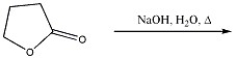
(86) 

Which of the following compounds is(are) hydrolyzed to butanoic acid upon heating in H2O, H2SO4?
(Multiple Choice)
5.0/5 (71)
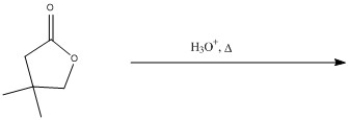
(71) 
How might one obtain a significant quantity of a lactone even when the formation reaction has a positive DG?
(Essay)
4.7/5 (85)
(85) 
Using ethanol as your only source of carbon compounds and using any other necessary inorganic reagents, propose a synthesis of acetonitrile.
(Essay)
4.8/5 (82)
(82) What reagent is used to convert pentanamide to 1-pentanamine?
(Multiple Choice)
4.8/5 (80)
(80) Using ethanol as your only source of carbon compounds and using any other necessary inorganic reagents, propose a synthesis of ethyl acetate.
(Essay)
4.7/5 (84)
(84) Which of the following are strongly hydrogen bonded in the liquid phase?
(Multiple Choice)
4.9/5 (83)
(83) Using the two key resonance structures for an ester, show how resonance stabilization is lost when an ester is attacked by a nucleophile.
(Essay)
4.8/5 (81)
(81) 
Filters
- Essay(0)
- Multiple Choice(0)
- Short Answer(0)
- True False(0)
- Matching(0)