



 Chat with AI
Exam 18: International Trade, Comparative Advantage, and Protectionism

Exam 1: The Scope and Method of Economics238 Questions
Exam 2: The Economic Problem: Scarcity and Choice220 Questions
Exam 3: Demand, Supply, and Market Equilibrium298 Questions
Exam 4: Demand and Supply Applications173 Questions
Exam 5: Introduction to Macroeconomics241 Questions
Exam 6: Measuring National Output and National Income292 Questions
Exam 7: Unemployment, Inflation, and Long-Run Growth297 Questions
Exam 8: Aggregate Expenditure and Equilibrium Output355 Questions
Exam 9: The Government and Fiscal Policy362 Questions
Exam 10: Money, the Federal Reserve, and the Interest Rate358 Questions
Exam 11: The Determination of Aggregate Output, the Price Level, and the Interest Rate243 Questions
Exam 12: Policy Effects and Cost Shocks in the Asad Model200 Questions
Exam 13: The Labor Market in the Macroeconomy287 Questions
Exam 14: Financial Crises, Stabilization, and Deficits260 Questions
Exam 15: Household and Firm Behavior in the Macroeconomy: a Further Look364 Questions
Exam 16: Long-Run Growth196 Questions
Exam 17: Alternative Views in Macroeconomics294 Questions
Exam 18: International Trade, Comparative Advantage, and Protectionism301 Questions
Exam 19: Open-Economy Macroeconomics: the Balance of Payments and Exchange Rates308 Questions
Exam 20: Economic Growth in Developing Economies133 Questions
Exam 21: Critical Thinking About Research105 Questions
Select questions type


Suppose that the United States and Italy both produce wine and shoes. In the United States, wine sells for $10 a bottle and shoes sell for $40 a pair. In Italy, wine sells for 15 euros a bottle and shoes sell for 20 euros a pair. Given this information, trade will flow in both directions if the price of a dollar is between
(Multiple Choice)
4.8/5  (77)
(77) Only those products in which a country has an absolute advantage will be competitive in world markets.
(True/False)
4.9/5 (84)
(84) When trade is free, patterns of trade and trade flows result from
(Multiple Choice)
4.7/5 (86)
(86) If the price of a car in the United States is $26,000, and the exchange rate between the dollar and the British pound rises from $1.50 to $2.00 per pound, then the price of the American car in Britain will
(Multiple Choice)
4.9/5 (89)
(89) The United States imports DVD recorders from China and China imports computer chips from the United States. If the theory of comparative advantage guides trade between the two countries, it must be true that
(Multiple Choice)
4.8/5 (83)
(83) Related to the Economics in Practice on page 349: If the candle makers in the petition were able to gain protection for their industry, the French economy would most likely
(Multiple Choice)
4.9/5 (80)
(80) Until the 1970s, the United States generally had a trade surplus.
(True/False)
4.7/5 (88)
(88) If Mexico has a comparative advantage in the production of oil compared to France, then
(Multiple Choice)
4.7/5 (81)
(81) Refer to the information provided in Figure 18.4 below to answer the questions that follow. 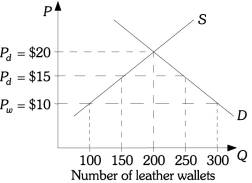 Figure 18.4
-Refer to Figure 18.4. The domestic price of a leather wallet is $20. With free trade the price of a leather wallet is $10 and after a tariff is imposed the price is $15. With free trade domestic production is
Figure 18.4
-Refer to Figure 18.4. The domestic price of a leather wallet is $20. With free trade the price of a leather wallet is $10 and after a tariff is imposed the price is $15. With free trade domestic production is (Multiple Choice)
4.7/5 (89)
(89) According to the theory of comparative advantage, a country should
(Multiple Choice)
4.9/5 (71)
(71) Refer to the information provided in Table 18.1 below to answer the questions that follow.
Table 18.1 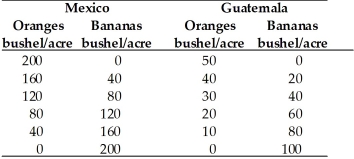 -Refer to Table 18.1. Mexico has
 (Multiple Choice)
4.9/5 (89)
(89) If a country's imports are greater than its exports, a country has a trade deficit.
(True/False)
4.8/5 (88)
(88) Thailand has a comparative advantage in rice and an absolute advantage in both rice and cell phones. Indonesia has a comparative advantage in cell phones. According to this scenario
(Multiple Choice)
5.0/5 (95)
(95) 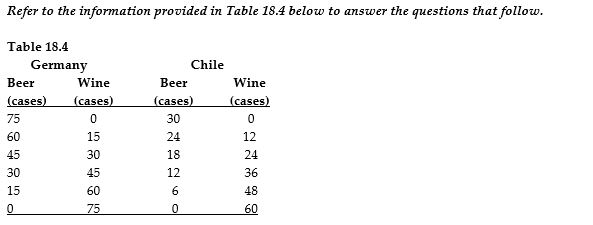 -Refer to Table 18.4. Chile should specialize in and export ________, and Germany should specialize in and export ________.
 (Multiple Choice)
4.9/5 (70)
(70) Every president who has held office since the General Agreement on Tariffs and Trade was signed has
(Multiple Choice)
4.9/5 (92)
(92) When trade is ________, patterns of trade and trade flows result from the independent decisions of thousands of importers and exporters, as well as millions of private households and firms.
(Multiple Choice)
4.9/5 (71)
(71) GATT is the international agreement signed by the United States and ________ other countries in 1947 to promote the liberalization of foreign trade.
(Multiple Choice)
4.8/5 (90)
(90) 
Filters
- Essay(0)
- Multiple Choice(0)
- Short Answer(0)
- True False(0)
- Matching(0)