



 Chat with AI
Exam 18: International Trade, Comparative Advantage, and Protectionism

Exam 1: The Scope and Method of Economics238 Questions
Exam 2: The Economic Problem: Scarcity and Choice220 Questions
Exam 3: Demand, Supply, and Market Equilibrium298 Questions
Exam 4: Demand and Supply Applications173 Questions
Exam 5: Introduction to Macroeconomics241 Questions
Exam 6: Measuring National Output and National Income292 Questions
Exam 7: Unemployment, Inflation, and Long-Run Growth297 Questions
Exam 8: Aggregate Expenditure and Equilibrium Output355 Questions
Exam 9: The Government and Fiscal Policy362 Questions
Exam 10: Money, the Federal Reserve, and the Interest Rate358 Questions
Exam 11: The Determination of Aggregate Output, the Price Level, and the Interest Rate243 Questions
Exam 12: Policy Effects and Cost Shocks in the Asad Model200 Questions
Exam 13: The Labor Market in the Macroeconomy287 Questions
Exam 14: Financial Crises, Stabilization, and Deficits260 Questions
Exam 15: Household and Firm Behavior in the Macroeconomy: a Further Look364 Questions
Exam 16: Long-Run Growth196 Questions
Exam 17: Alternative Views in Macroeconomics294 Questions
Exam 18: International Trade, Comparative Advantage, and Protectionism301 Questions
Exam 19: Open-Economy Macroeconomics: the Balance of Payments and Exchange Rates308 Questions
Exam 20: Economic Growth in Developing Economies133 Questions
Exam 21: Critical Thinking About Research105 Questions
Select questions type


Trade allows the people of a country to produce outside their production possibility curve.
(True/False)
4.7/5  (90)
(90) Suppose that the United States and Italy both produce wine and shoes. In the United States, wine sells for $10 a bottle and shoes sell for $40 a pair. In Italy, wine sells for 15 euros a bottle and shoes sell for 20 euros a pair. If the current exchange rate is 0.8 euro to the dollar, then
(Multiple Choice)
4.8/5 (90)
(90) Refer to the information provided in Figure 18.3 below to answer the questions that follow.  Figure 18.3
-Refer to Figure 18.3. The domestic price of shoes is $80. After trade the price of a pair of shoes is $60. After trade this country will ________ 300 pairs of shoes.
Figure 18.3
-Refer to Figure 18.3. The domestic price of shoes is $80. After trade the price of a pair of shoes is $60. After trade this country will ________ 300 pairs of shoes. (Multiple Choice)
4.8/5 (81)
(81) If Spain decreases subsidies to its olive growers, the price of olives in the U.S. will fall.
(True/False)
4.9/5 (75)
(75) If the exchange rate between the United States and Mexico changes from $1 = 100 pesos to $1 = 5 pesos, ceteris paribus,
(Multiple Choice)
4.8/5 (87)
(87) Which of the following can be considered a free-trade zone?
(Multiple Choice)
4.8/5 (81)
(81) ________ involves a country selling its exports at a price lower than its cost of production.
(Multiple Choice)
4.9/5 (79)
(79) Which of the following phenomena can be explained by the simple comparative advantage theory?
(Multiple Choice)
4.8/5 (73)
(73) If Brazil has a comparative advantage in the production of coffee compared to the United States, then
(Multiple Choice)
4.8/5 (75)
(75) According to ________, a country should specialize and export goods with the lowest opportunity cost.
(Multiple Choice)
4.9/5 (86)
(86) Refer to the information provided in Figure 18.2 below to answer the questions that follow. 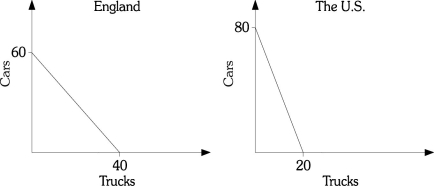 Figure 18.2
-Refer to Figure 18.2. The opportunity cost of a truck is ________ car(s) in the United States and ________ car(s) in England.
Figure 18.2
-Refer to Figure 18.2. The opportunity cost of a truck is ________ car(s) in the United States and ________ car(s) in England. (Multiple Choice)
4.8/5 (70)
(70) If the exchange rate between the United States and Mexico changes from $1 = 8 pesos to $1 = 9 pesos, then, ceteris paribus, the price of American goods in Mexico
(Multiple Choice)
4.7/5 (80)
(80) Refer to the information provided in Figure 18.4 below to answer the questions that follow. 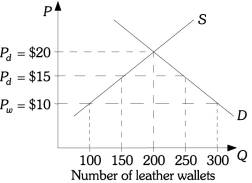 Figure 18.4
-Refer to Figure 18.4. The domestic price of a leather wallet is $20. With free trade the price of a leather wallet is $10 and after a tariff is imposed the price is $15. With free trade domestic consumption is
Figure 18.4
-Refer to Figure 18.4. The domestic price of a leather wallet is $20. With free trade the price of a leather wallet is $10 and after a tariff is imposed the price is $15. With free trade domestic consumption is (Multiple Choice)
4.9/5 (91)
(91) Refer to the information provided in Figure 18.4 below to answer the questions that follow. Figure 18.4
-Refer to Figure 18.4. The domestic price of a leather wallet is $20. With free trade the price of a leather wallet is $10 and after a tariff is imposed the price is $15. If there is free trade, this country will ________ 200 leather wallets.
Figure 18.4
-Refer to Figure 18.4. The domestic price of a leather wallet is $20. With free trade the price of a leather wallet is $10 and after a tariff is imposed the price is $15. If there is free trade, this country will ________ 200 leather wallets. (Multiple Choice)
4.8/5 (81)
(81) The free-trade agreement signed by Canada, Mexico, and the United States in 1992 is known as
(Multiple Choice)
4.8/5 (82)
(82) Refer to the information provided in Figure 18.1 below to answer the questions that follow. 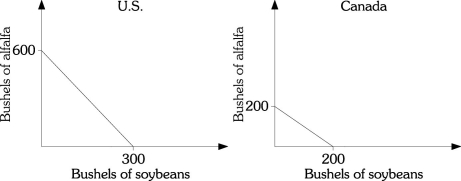 Figure 18.1
-Refer to Figure 18.1. Which of the following statements is true?
Figure 18.1
-Refer to Figure 18.1. Which of the following statements is true? (Multiple Choice)
4.9/5 (73)
(73) Country A would have an absolute advantage compared to Country B in the production of corn if
(Multiple Choice)
4.8/5 (80)
(80) When countries specialize in producing those goods in which they have ________, they maximize their combined output and allocate their resources more efficiently.
(Multiple Choice)
4.9/5 (86)
(86) 
Filters
- Essay(0)
- Multiple Choice(0)
- Short Answer(0)
- True False(0)
- Matching(0)