



 Chat with AI
Exam 18: International Trade, Comparative Advantage, and Protectionism

Exam 1: The Scope and Method of Economics238 Questions
Exam 2: The Economic Problem: Scarcity and Choice220 Questions
Exam 3: Demand, Supply, and Market Equilibrium298 Questions
Exam 4: Demand and Supply Applications173 Questions
Exam 5: Introduction to Macroeconomics241 Questions
Exam 6: Measuring National Output and National Income292 Questions
Exam 7: Unemployment, Inflation, and Long-Run Growth297 Questions
Exam 8: Aggregate Expenditure and Equilibrium Output355 Questions
Exam 9: The Government and Fiscal Policy362 Questions
Exam 10: Money, the Federal Reserve, and the Interest Rate358 Questions
Exam 11: The Determination of Aggregate Output, the Price Level, and the Interest Rate243 Questions
Exam 12: Policy Effects and Cost Shocks in the Asad Model200 Questions
Exam 13: The Labor Market in the Macroeconomy287 Questions
Exam 14: Financial Crises, Stabilization, and Deficits260 Questions
Exam 15: Household and Firm Behavior in the Macroeconomy: a Further Look364 Questions
Exam 16: Long-Run Growth196 Questions
Exam 17: Alternative Views in Macroeconomics294 Questions
Exam 18: International Trade, Comparative Advantage, and Protectionism301 Questions
Exam 19: Open-Economy Macroeconomics: the Balance of Payments and Exchange Rates308 Questions
Exam 20: Economic Growth in Developing Economies133 Questions
Exam 21: Critical Thinking About Research105 Questions
Select questions type


Refer to the information provided in Table 18.1 below to answer the questions that follow.
Table 18.1 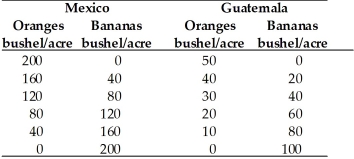 -Refer to Table 18.1. In Guatemala, the opportunity cost of 1 bushel of bananas is
 (Multiple Choice)
4.7/5  (86)
(86) An argument in favor of free trade is that trade barriers prevent a nation from reaping the benefits of specialization.
(True/False)
5.0/5 (75)
(75) If the slopes of the production possibility frontiers involving sugar and rice in countries A and B are equal,
(Multiple Choice)
4.9/5 (68)
(68) A tariff imposed on imported wine will cause the domestic ________ of wine to increase and the domestic ________ of wine to increase.
(Multiple Choice)
4.8/5 (88)
(88) Refer to the information provided in Figure 18.4 below to answer the questions that follow. 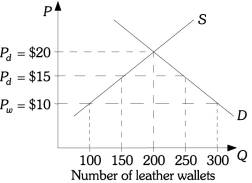 Figure 18.4
-Refer to Figure 18.4. The domestic price of a leather wallet is $20. With free trade the price of a leather wallet is $10 and after a tariff is imposed the price is $15. After the tariff is imposed, tariff revenue in this country will be
Figure 18.4
-Refer to Figure 18.4. The domestic price of a leather wallet is $20. With free trade the price of a leather wallet is $10 and after a tariff is imposed the price is $15. After the tariff is imposed, tariff revenue in this country will be (Multiple Choice)
4.9/5 (83)
(83) If you are traveling in China and you purchase a meal that costs 140 yuan and the current exchange rate is 7 yuan to the dollar, then the price of the meal in U.S. currency is
(Multiple Choice)
4.9/5 (83)
(83) Refer to the information provided in Table 18.5 below to answer the questions that follow. Cashews are measured in bushels and tea is measured in pounds (lbs.)
Table 18.5  -Refer to Table 18.5. In India, the opportunity cost of
 (Multiple Choice)
4.9/5 (74)
(74) Refer to the information provided in Figure 18.1 below to answer the questions that follow. 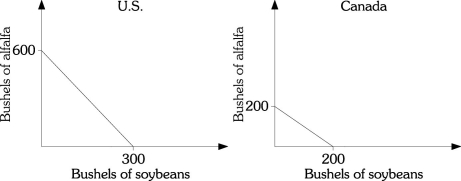 Figure 18.1
-Refer to Figure 18.1. The opportunity cost of producing a bushel of soybeans in the Canada is
Figure 18.1
-Refer to Figure 18.1. The opportunity cost of producing a bushel of soybeans in the Canada is (Multiple Choice)
5.0/5 (74)
(74) Government payments made to ________ firms in order to encourage ________ are called subsidies.
(Multiple Choice)
4.9/5 (80)
(80) Refer to the information provided in Figure 18.2 below to answer the questions that follow. 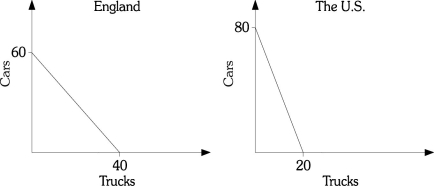 Figure 18.2
-Refer to Figure 18.2. The opportunity cost of 1 ________ is 0.25 ________ in the United States and 0.67 ________ in England.
Figure 18.2
-Refer to Figure 18.2. The opportunity cost of 1 ________ is 0.25 ________ in the United States and 0.67 ________ in England. (Multiple Choice)
4.8/5 (78)
(78) The average tariff on imports into the United States is less than 5 percent.
(True/False)
4.9/5 (80)
(80) Suppose a U.S. dollar exchanges for 0.8 euros, then each euro is worth
(Multiple Choice)
5.0/5 (74)
(74) Dumping refers to a country selling its exports at a price lower than its selling price at home.
(True/False)
4.9/5 (75)
(75) If the price of a truck in the United States is $25,000, and the exchange rate between the dollar and the euro falls from $1.50 to $1.30 per euro, then the price of the American truck in the EU will
(Multiple Choice)
4.9/5 (83)
(83) 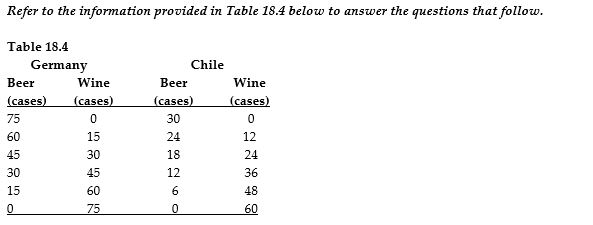 -Refer to Table 18.4. In Germany, the opportunity cost of 1 case of beer is
 (Multiple Choice)
4.9/5 (70)
(70) If the exchange rate between the United States and Portugal changes from $1 = 1 euro to $1 = 2 euros, then holding everything else constant, the price of U.S. goods in Portugal will decrease.
(True/False)
4.9/5 (67)
(67) Suppose that the United States and Spain both produce cognac and handbags. In the United States, cognac sells for $20 a bottle and handbags sell for $80. In Spain, cognac sells for 30 euros a bottle and handbags sell for 40 euros. Given this information, trade will flow in both directions if the price of a dollar is between
(Multiple Choice)
4.7/5 (94)
(94) Trade allows the people of a country to consume outside their production possibility curve.
(True/False)
4.9/5 (88)
(88) Related to the Economics in Practice on page 343: Trade ________ comparative advantage of countries and ________ the efficiency of firms.
(Multiple Choice)
4.8/5 (73)
(73) 
Filters
- Essay(0)
- Multiple Choice(0)
- Short Answer(0)
- True False(0)
- Matching(0)