



 Chat with AI
Exam 18: International Trade, Comparative Advantage, and Protectionism

Exam 1: The Scope and Method of Economics238 Questions
Exam 2: The Economic Problem: Scarcity and Choice220 Questions
Exam 3: Demand, Supply, and Market Equilibrium298 Questions
Exam 4: Demand and Supply Applications173 Questions
Exam 5: Introduction to Macroeconomics241 Questions
Exam 6: Measuring National Output and National Income292 Questions
Exam 7: Unemployment, Inflation, and Long-Run Growth297 Questions
Exam 8: Aggregate Expenditure and Equilibrium Output355 Questions
Exam 9: The Government and Fiscal Policy362 Questions
Exam 10: Money, the Federal Reserve, and the Interest Rate358 Questions
Exam 11: The Determination of Aggregate Output, the Price Level, and the Interest Rate243 Questions
Exam 12: Policy Effects and Cost Shocks in the Asad Model200 Questions
Exam 13: The Labor Market in the Macroeconomy287 Questions
Exam 14: Financial Crises, Stabilization, and Deficits260 Questions
Exam 15: Household and Firm Behavior in the Macroeconomy: a Further Look364 Questions
Exam 16: Long-Run Growth196 Questions
Exam 17: Alternative Views in Macroeconomics294 Questions
Exam 18: International Trade, Comparative Advantage, and Protectionism301 Questions
Exam 19: Open-Economy Macroeconomics: the Balance of Payments and Exchange Rates308 Questions
Exam 20: Economic Growth in Developing Economies133 Questions
Exam 21: Critical Thinking About Research105 Questions
Select questions type


Refer to the information provided in Figure 18.2 below to answer the questions that follow. 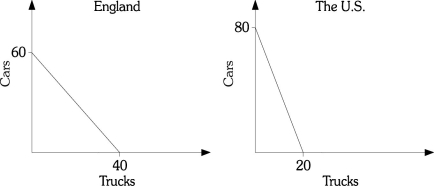 Figure 18.2
-Refer to Figure 18.2. the U.S. has
Figure 18.2
-Refer to Figure 18.2. the U.S. has (Multiple Choice)
4.9/5  (88)
(88) Refer to the information provided in Table 18.1 below to answer the questions that follow.
Table 18.1 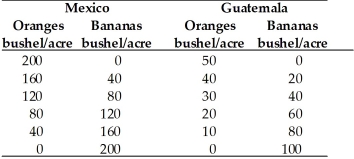 -Refer to Table 18.1. Guatemala has
 (Multiple Choice)
4.8/5 (92)
(92) In 2003, the WTO ruled that U.S. tariffs on ________ were unfair and allowed retaliatory tariffs on U.S. products.
(Multiple Choice)
4.7/5 (79)
(79) Refer to the information provided in Figure 18.3 below to answer the questions that follow.  Figure 18.3
-Refer to Figure 18.3. The domestic price of shoes is $80. After trade the price of a pair of shoes is $60. After trade this country will import
Figure 18.3
-Refer to Figure 18.3. The domestic price of shoes is $80. After trade the price of a pair of shoes is $60. After trade this country will import (Multiple Choice)
4.9/5 (77)
(77) If the opportunity cost of corn to wheat is 3:1 in the United States and 5:1 in France, both countries would benefit from trade if the actual terms of trade between corn and wheat were 4:1.
(True/False)
4.7/5 (85)
(85) In general, for any two countries, there are many exchange rates that will lead to gains from trade, based on comparative advantage.
(True/False)
4.9/5 (85)
(85) A country enjoys a comparative advantage in the production of a good if that good can be produced at a lower cost in terms of other goods.
(True/False)
4.8/5 (84)
(84) Refer to the information provided in Figure 18.5 below to answer the questions that follow.  Figure 18.5
-Refer to Figure 18.5. The domestic price of oil is $130 per barrel, and the world price of oil is $120 per barrel. If the domestic government imposes a tariff of $________ per barrel, it will eliminate all oil imports and achieve tariff revenues of $________.
Figure 18.5
-Refer to Figure 18.5. The domestic price of oil is $130 per barrel, and the world price of oil is $120 per barrel. If the domestic government imposes a tariff of $________ per barrel, it will eliminate all oil imports and achieve tariff revenues of $________. (Multiple Choice)
4.8/5 (76)
(76) In the year 1976, the United States switched from running a trade ________ to running a trade ________.
(Multiple Choice)
4.8/5 (89)
(89) It costs a television manufacturer $1,000 to produce a plasma television. This manufacturer sells these televisions abroad for $750. This is an example of
(Multiple Choice)
4.9/5 (64)
(64) Over time, the general movement in the United States has been toward
(Multiple Choice)
4.9/5 (80)
(80) Refer to the information provided in Table 18.2 below to answer the questions that follow.
Table 18.2 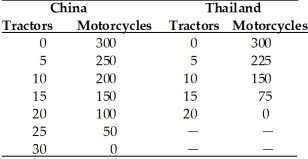 -Refer to Table 18.2. Which terms of trade benefits both countries?
 (Multiple Choice)
4.8/5 (69)
(69) The Heckscher-Ohlin theorem explains why the U.S. both imports and exports cars.
(True/False)
4.9/5 (63)
(63) For any pair of nations and goods, if each country has a comparative advantage in the production of one product, it is reasonable to expect that specialization and trade will benefit both countries.
(True/False)
4.8/5 (84)
(84) If the United States decreases the tariff on imported tuna steaks, this will
(Multiple Choice)
4.8/5 (72)
(72) The pharmaceutical industry depends on highly trained workers, who are abundantly available in India. The automobile industry depends on the availability of a large stock of physical capital with which the United States is well endowed. According to Heckscher-Ohlin theorem
(Multiple Choice)
4.8/5 (80)
(80) The advantage in the production of a product enjoyed by one country over another when it uses fewer resources to produce that product than the other country does is
(Multiple Choice)
4.8/5 (65)
(65) Refer to the information provided in Figure 18.1 below to answer the questions that follow. 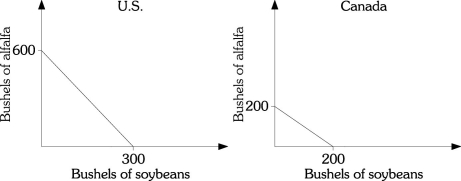 Figure 18.1
-Refer to Figure 18.1. The opportunity cost of producing a bushel of soybeans in the United States is
Figure 18.1
-Refer to Figure 18.1. The opportunity cost of producing a bushel of soybeans in the United States is (Multiple Choice)
4.9/5 (74)
(74) 
Filters
- Essay(0)
- Multiple Choice(0)
- Short Answer(0)
- True False(0)
- Matching(0)