



 Chat with AI
Exam 18: International Trade, Comparative Advantage, and Protectionism

Exam 1: The Scope and Method of Economics238 Questions
Exam 2: The Economic Problem: Scarcity and Choice220 Questions
Exam 3: Demand, Supply, and Market Equilibrium298 Questions
Exam 4: Demand and Supply Applications173 Questions
Exam 5: Introduction to Macroeconomics241 Questions
Exam 6: Measuring National Output and National Income292 Questions
Exam 7: Unemployment, Inflation, and Long-Run Growth297 Questions
Exam 8: Aggregate Expenditure and Equilibrium Output355 Questions
Exam 9: The Government and Fiscal Policy362 Questions
Exam 10: Money, the Federal Reserve, and the Interest Rate358 Questions
Exam 11: The Determination of Aggregate Output, the Price Level, and the Interest Rate243 Questions
Exam 12: Policy Effects and Cost Shocks in the Asad Model200 Questions
Exam 13: The Labor Market in the Macroeconomy287 Questions
Exam 14: Financial Crises, Stabilization, and Deficits260 Questions
Exam 15: Household and Firm Behavior in the Macroeconomy: a Further Look364 Questions
Exam 16: Long-Run Growth196 Questions
Exam 17: Alternative Views in Macroeconomics294 Questions
Exam 18: International Trade, Comparative Advantage, and Protectionism301 Questions
Exam 19: Open-Economy Macroeconomics: the Balance of Payments and Exchange Rates308 Questions
Exam 20: Economic Growth in Developing Economies133 Questions
Exam 21: Critical Thinking About Research105 Questions
Select questions type


If the exchange rate between the United States and Greece changes from $1 = 1 euro to $1 = 2 euros, then holding everything else constant, the price of U.S. goods in Greece will increase.
(True/False)
4.9/5  (86)
(86) Refer to the information provided in Table 18.5 below to answer the questions that follow. Cashews are measured in bushels and tea is measured in pounds (lbs.)
Table 18.5  -Refer to Table 18.5. The most that Vietnam will be willing to pay for a bushel of cashews is
 (Multiple Choice)
4.9/5 (88)
(88) Refer to the information provided in Figure 18.4 below to answer the questions that follow. 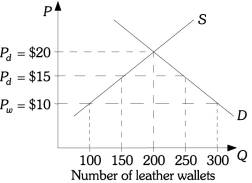 Figure 18.4
-Refer to Figure 18.4. The domestic price of a leather wallet is $20. With free trade the price of a leather wallet is $10 and after a tariff is imposed the price is $15. After the tariff is imposed,
Figure 18.4
-Refer to Figure 18.4. The domestic price of a leather wallet is $20. With free trade the price of a leather wallet is $10 and after a tariff is imposed the price is $15. After the tariff is imposed, (Multiple Choice)
4.8/5 (83)
(83) Refer to the information provided in Table 18.2 below to answer the questions that follow.
Table 18.2 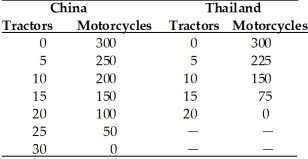 -Refer to Table 18.2. If both countries specialize and trade with each other, Thailand will export ________ and China will import ________.
 (Multiple Choice)
4.8/5 (82)
(82) ________ looks to relative factor endowments to explain trade flows.
(Multiple Choice)
4.9/5 (79)
(79) Initially trade between the United States and Canada is balanced. Then, if a change in the exchange rate reduces the U.S. dollar price of Canadian goods, ceteris paribus, we would expect
(Multiple Choice)
4.8/5 (79)
(79) Refer to the information provided in Table 18.2 below to answer the questions that follow.
Table 18.2
-Refer to Table 18.2. The most that China will be willing to pay for a motorcycle is
-Refer to Table 18.2. The most that China will be willing to pay for a motorcycle is (Multiple Choice)
4.9/5 (66)
(66) Refer to the information provided in Figure 18.1 below to answer the questions that follow. 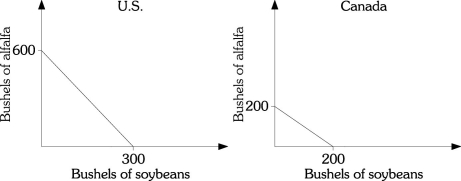 Figure 18.1
-Refer to Figure 18.1. The opportunity cost of producing a bushel of alfalfa in the United States is
Figure 18.1
-Refer to Figure 18.1. The opportunity cost of producing a bushel of alfalfa in the United States is (Multiple Choice)
4.8/5 (73)
(73) Refer to the information provided in Table 18.6 below to answer the questions that follow.
Table 18.6  -Refer to Table 18.6. Trade will flow in both directions between countries only if the price of the euro is between
 (Multiple Choice)
4.7/5 (84)
(84) 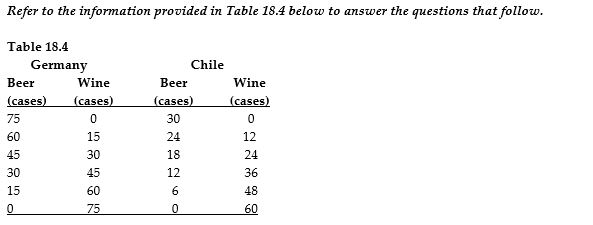 -Refer to Table 18.4. The opportunity cost of producing a case of beer in Germany is
 (Multiple Choice)
5.0/5 (73)
(73) According to comparative advantage, trade between two countries
(Multiple Choice)
4.9/5 (86)
(86) A significant portion of actual world trade patterns results from
(Multiple Choice)
4.9/5 (67)
(67) A country is said to have an absolute advantage over another country in the production of a product if it uses more resources to produce that product than the other country does.
(True/False)
4.9/5 (76)
(76) Refer to the information provided in Table 18.3 below to answer the questions that follow.
Table 18.3  -Refer to Table 18.3. If the exchange rate is $1 = 1 euro, then
 (Multiple Choice)
4.8/5 (90)
(90) Suppose a U.S. dollar exchanges for 2 British pounds, then each pound is worth
(Multiple Choice)
4.9/5 (85)
(85) If the price of a car in the United States is $22,000, and the exchange rate between the dollar and the Japanese yen falls from 125 yen to 105 yen per dollar, then the price of the American car in Japan will
(Multiple Choice)
4.8/5 (78)
(78) Refer to the information provided in Table 18.5 below to answer the questions that follow. Cashews are measured in bushels and tea is measured in pounds (lbs.)
Table 18.5
-Refer to Table 18.5. ________ has a comparative advantage in tea and ________ has an absolute advantage in tea.
-Refer to Table 18.5. ________ has a comparative advantage in tea and ________ has an absolute advantage in tea. (Multiple Choice)
4.9/5 (86)
(86) 
Filters
- Essay(0)
- Multiple Choice(0)
- Short Answer(0)
- True False(0)
- Matching(0)