



 Chat with AI
Exam 18: International Trade, Comparative Advantage, and Protectionism

Exam 1: The Scope and Method of Economics238 Questions
Exam 2: The Economic Problem: Scarcity and Choice220 Questions
Exam 3: Demand, Supply, and Market Equilibrium298 Questions
Exam 4: Demand and Supply Applications173 Questions
Exam 5: Introduction to Macroeconomics241 Questions
Exam 6: Measuring National Output and National Income292 Questions
Exam 7: Unemployment, Inflation, and Long-Run Growth297 Questions
Exam 8: Aggregate Expenditure and Equilibrium Output355 Questions
Exam 9: The Government and Fiscal Policy362 Questions
Exam 10: Money, the Federal Reserve, and the Interest Rate358 Questions
Exam 11: The Determination of Aggregate Output, the Price Level, and the Interest Rate243 Questions
Exam 12: Policy Effects and Cost Shocks in the Asad Model200 Questions
Exam 13: The Labor Market in the Macroeconomy287 Questions
Exam 14: Financial Crises, Stabilization, and Deficits260 Questions
Exam 15: Household and Firm Behavior in the Macroeconomy: a Further Look364 Questions
Exam 16: Long-Run Growth196 Questions
Exam 17: Alternative Views in Macroeconomics294 Questions
Exam 18: International Trade, Comparative Advantage, and Protectionism301 Questions
Exam 19: Open-Economy Macroeconomics: the Balance of Payments and Exchange Rates308 Questions
Exam 20: Economic Growth in Developing Economies133 Questions
Exam 21: Critical Thinking About Research105 Questions
Select questions type


The software industry depends on highly trained workers, who are abundantly available in Country A. The heavy equipment industry depends on the availability of a large stock of physical capital with which Country B is well endowed. According to Heckscher-Ohlin theorem
(Multiple Choice)
4.8/5  (75)
(75) Suppose that Greece and Portugal are both engaged in the production of grapes and figs, and that Greece has an absolute advantage in the production of both goods. If Portugal has a lower opportunity cost for producing figs, then
(Multiple Choice)
4.9/5 (82)
(82) If a nation has most-favored-nation status conferred on it, then exports from that country
(Multiple Choice)
4.8/5 (88)
(88) An example of a(n) ________ comparative advantage is that some U.S. consumers prefer German beer over American beer because German beer has a reputation for tasting better.
(Multiple Choice)
4.9/5 (72)
(72) If you are traveling in Thailand and you purchase a meal that costs 1,400 baht and the current exchange rate is 35 baht to the dollar, then the price of the meal in U.S. currency is
(Multiple Choice)
4.8/5 (87)
(87) If the exchange rate between the United States and Japan changes from $1 = 100 yen to $1 = 110 yen, then, ceteris paribus, the price of American goods in Japan
(Multiple Choice)
4.8/5 (84)
(84) Refer to the information provided in Table 18.5 below to answer the questions that follow. Cashews are measured in bushels and tea is measured in pounds (lbs.)
Table 18.5  -Refer to Table 18.5. Which terms of trade benefits both countries?
 (Multiple Choice)
4.9/5 (92)
(92) Refer to the information provided in Figure 18.5 below to answer the questions that follow.  Figure 18.5
-Refer to Figure 18.5. The domestic price of oil is $130 per barrel. This country imports 14 million barrels if the world price of oil is $________.
Figure 18.5
-Refer to Figure 18.5. The domestic price of oil is $130 per barrel. This country imports 14 million barrels if the world price of oil is $________. (Multiple Choice)
4.8/5 (86)
(86) Refer to the information provided in Table 18.2 below to answer the questions that follow.
Table 18.2 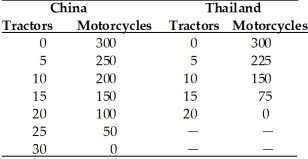 -Refer to Table 18.2. In Thailand, the opportunity cost of
 (Multiple Choice)
4.8/5 (76)
(76) Refer to the information provided in Figure 18.4 below to answer the questions that follow. 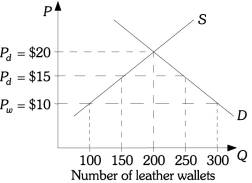 Figure 18.4
-Refer to Figure 18.4. The domestic price of a leather wallet is $20. With free trade the price of a leather wallet is $10 and after a tariff is imposed the price is $15. After the tariff is imposed, this country will ________ 250 leather wallets.
Figure 18.4
-Refer to Figure 18.4. The domestic price of a leather wallet is $20. With free trade the price of a leather wallet is $10 and after a tariff is imposed the price is $15. After the tariff is imposed, this country will ________ 250 leather wallets. (Multiple Choice)
4.9/5 (89)
(89) Related to the Economics in Practice on page 344: When a country lifts a quota, imports to that country generally ________ and the price of the affected product in that country generally ________.
(Multiple Choice)
4.7/5 (71)
(71) The Smoot-Hawley tariff set off an international trade war in the
(Multiple Choice)
4.7/5 (71)
(71) Refer to the information provided in Figure 18.4 below to answer the questions that follow. Figure 18.4
-Refer to Figure 18.4. The domestic price of a leather wallet is $20. With free trade the price of a leather wallet is $10 and after a tariff is imposed the price is $15. After the tariff is imposed, domestic consumption of domestically produced wallets will be ________ wallets and domestic consumption of imported wallets will be ________ wallets.
Figure 18.4
-Refer to Figure 18.4. The domestic price of a leather wallet is $20. With free trade the price of a leather wallet is $10 and after a tariff is imposed the price is $15. After the tariff is imposed, domestic consumption of domestically produced wallets will be ________ wallets and domestic consumption of imported wallets will be ________ wallets. (Multiple Choice)
4.8/5 (81)
(81) 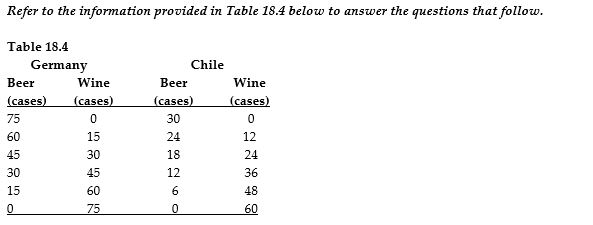 -Refer to Table 18.4. In Chile, the opportunity cost of 1 case of wine is
 (Multiple Choice)
4.7/5 (71)
(71) Initially trade between Australia and the United States is balanced. Then, if a change in the exchange rate increases the U.S. dollar price of Australian goods, ceteris paribus, we would expect
(Multiple Choice)
4.9/5 (77)
(77) It is a valid argument that industries need to be protected from foreign competition because foreign wages are substantially lower than wages paid to U.S. workers.
(True/False)
4.9/5 (81)
(81) China has a comparative advantage in textiles and an absolute advantage in both textiles and radios. Japan has a comparative advantage in radios. According to this scenario
(Multiple Choice)
4.8/5 (74)
(74) 
Filters
- Essay(0)
- Multiple Choice(0)
- Short Answer(0)
- True False(0)
- Matching(0)