



 Chat with AI
Exam 18: International Trade, Comparative Advantage, and Protectionism

Exam 1: The Scope and Method of Economics238 Questions
Exam 2: The Economic Problem: Scarcity and Choice220 Questions
Exam 3: Demand, Supply, and Market Equilibrium298 Questions
Exam 4: Demand and Supply Applications173 Questions
Exam 5: Introduction to Macroeconomics241 Questions
Exam 6: Measuring National Output and National Income292 Questions
Exam 7: Unemployment, Inflation, and Long-Run Growth297 Questions
Exam 8: Aggregate Expenditure and Equilibrium Output355 Questions
Exam 9: The Government and Fiscal Policy362 Questions
Exam 10: Money, the Federal Reserve, and the Interest Rate358 Questions
Exam 11: The Determination of Aggregate Output, the Price Level, and the Interest Rate243 Questions
Exam 12: Policy Effects and Cost Shocks in the Asad Model200 Questions
Exam 13: The Labor Market in the Macroeconomy287 Questions
Exam 14: Financial Crises, Stabilization, and Deficits260 Questions
Exam 15: Household and Firm Behavior in the Macroeconomy: a Further Look364 Questions
Exam 16: Long-Run Growth196 Questions
Exam 17: Alternative Views in Macroeconomics294 Questions
Exam 18: International Trade, Comparative Advantage, and Protectionism301 Questions
Exam 19: Open-Economy Macroeconomics: the Balance of Payments and Exchange Rates308 Questions
Exam 20: Economic Growth in Developing Economies133 Questions
Exam 21: Critical Thinking About Research105 Questions
Select questions type


If Russia has a comparative advantage in the production of wheat and China has a comparative advantage in the production of textiles, then
(Multiple Choice)
4.8/5  (83)
(83) Refer to the information provided in Figure 18.2 below to answer the questions that follow. 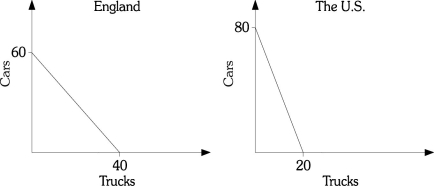 Figure 18.2
-Refer to Figure 18.2. England has an absolute advantage in producing
Figure 18.2
-Refer to Figure 18.2. England has an absolute advantage in producing (Multiple Choice)
4.9/5 (79)
(79) A quota imposed on imported steel will cause the domestic ________ of steel to increase and the domestic ________ of steel to increase.
(Multiple Choice)
4.7/5 (85)
(85) Refer to the information provided in Figure 18.4 below to answer the questions that follow. 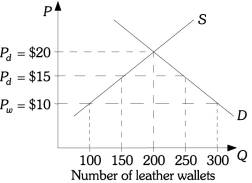 Figure 18.4
-Refer to Figure 18.4. The domestic price of a leather wallet is $20. With free trade the price of a leather wallet is $10 and after a tariff is imposed the price is $15. After the tariff is imposed, ________ revenue in this country will be $500.
Figure 18.4
-Refer to Figure 18.4. The domestic price of a leather wallet is $20. With free trade the price of a leather wallet is $10 and after a tariff is imposed the price is $15. After the tariff is imposed, ________ revenue in this country will be $500. (Multiple Choice)
4.7/5 (80)
(80) 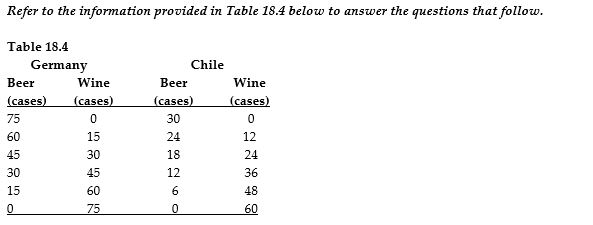 -Refer to Table 18.4. Germany has
Refer to the information provided in Figure 18.1 below to answer the questions that follow. 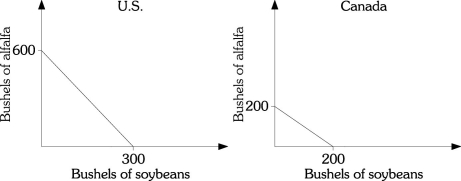 Figure 18.1
-Refer to Figure 18.1. The opportunity cost of producing a bushel of alfalfa in the United States is
Figure 18.1
-Refer to Figure 18.1. The opportunity cost of producing a bushel of alfalfa in the United States is (Multiple Choice)
4.8/5 (89)
(89) If the price of a truck in the United States is $18,000, and the exchange rate between the dollar and the Argentine peso falls from 10 pesos to 8 pesos per dollar, then the price of the American truck in Argentina will
(Multiple Choice)
4.9/5 (75)
(75) An example of a(n) ________ comparative advantage is U.S. consumers buying automobiles produced in Japan because Japanese companies have a reputation for producing a higher-quality automobile than those produced in the United States.
(Multiple Choice)
4.7/5 (78)
(78) Refer to the information provided in Figure 18.4 below to answer the questions that follow. Figure 18.4
-Refer to Figure 18.4. The domestic price of a leather wallet is $20. With free trade the price of a leather wallet is $10 and after a tariff is imposed the price is $15. With the tariff domestic production is
Figure 18.4
-Refer to Figure 18.4. The domestic price of a leather wallet is $20. With free trade the price of a leather wallet is $10 and after a tariff is imposed the price is $15. With the tariff domestic production is (Multiple Choice)
4.8/5 (78)
(78) The main advantage of ________ is the ability to move out beyond previous resource and production constraints.
(Multiple Choice)
4.9/5 (78)
(78) Refer to the information provided in Table 18.2 below to answer the questions that follow.
Table 18.2 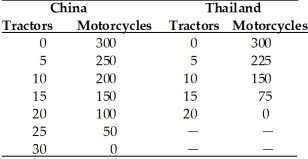 -Refer to Table 18.2. In China, the opportunity cost of
 (Multiple Choice)
4.9/5 (81)
(81) The idea of the U.S.-Canadian Free-Trade Agreement that removed all barriers to trade including tariffs and quotas between the United States and Canada by 1998 was to
(Multiple Choice)
4.9/5 (78)
(78) If the slopes of the ________ involving corn and wheat in the United States and Canada are equal, specialization does not benefit either country.
(Multiple Choice)
5.0/5 (92)
(92) If the opportunity cost of corn to wheat is 3:1 in the United States and 5:1 in France, only France would benefit from trade if the actual terms of trade between corn and wheat were 7:1.
(True/False)
4.8/5 (78)
(78) Refer to the information provided in Figure 18.5 below to answer the questions that follow.  Figure 18.5
-Refer to Figure 18.5. The domestic price of oil is $130 per barrel, and the world price of oil is $120 per barrel. If the domestic government imposes a tariff of $10 per barrel, it will
Figure 18.5
-Refer to Figure 18.5. The domestic price of oil is $130 per barrel, and the world price of oil is $120 per barrel. If the domestic government imposes a tariff of $10 per barrel, it will (Multiple Choice)
4.9/5 (74)
(74) ________ portion of actual world trade patterns results from different factor endowments between countries.
(Multiple Choice)
4.9/5 (92)
(92) 
Filters
- Essay(0)
- Multiple Choice(0)
- Short Answer(0)
- True False(0)
- Matching(0)