



 Chat with AI
Exam 7: Thermochemistry

Exam 1: Matter - Its Properties and Measurement94 Questions
Exam 2: Atoms and the Atomic Theory100 Questions
Exam 3: Chemical Compounds100 Questions
Exam 4: Chemical Reactions100 Questions
Exam 5: Introduction to Reactions in Aqueous Solutions97 Questions
Exam 6: Gases100 Questions
Exam 7: Thermochemistry101 Questions
Exam 8: Electrons in Atoms100 Questions
Exam 9: The Periodic Table and Some Atomic Properties96 Questions
Exam 10: Chemical Bonding I: Basic Concepts97 Questions
Exam 11: Chemical Bonding II: Additional Aspects97 Questions
Exam 12: Intermolecular Forces: Liquids and Solids102 Questions
Exam 13: Solutions and Their Physical Properties100 Questions
Exam 14: Chemical Kinetics92 Questions
Exam 15: Principles of Chemical Equilibrium99 Questions
Exam 16: Acids and Bases100 Questions
Exam 17: Additional Aspects of Acid-Base Equilibria99 Questions
Exam 18: Solubility and Complex-Ion Equilibria95 Questions
Exam 19: Spontaneous Change: Entropy and Free Energy101 Questions
Exam 20: Electrochemistry103 Questions
Exam 21: Main Group Elements I: Groups 1, 2, 13, and 14116 Questions
Exam 22: Main Group Elements II: Groups 18, 17, 16, 15, and Hydrogen100 Questions
Exam 23: The Transition Elements102 Questions
Exam 24: Complex Ions and Coordination Compounds100 Questions
Exam 25: Nuclear Chemistry 1-41100 Questions
Exam 26: Structures of Organic Compounds96 Questions
Exam 27: Reactions of Organic Compounds94 Questions
Exam 28: Chemistry of the Living State99 Questions
Select questions type


The heat of combustion of methane is -50.38 kJ/mol. How many moles of methane must be burned to produce 137 kJ of heat?
(Multiple Choice)
4.9/5  (60)
(60) A certain reaction releases 10.1 kJ at constant volume and at constant pressure releases 8.4 kJ. What is △U for the reaction?
(Multiple Choice)
4.9/5 (86)
(86) The standard heat of formation of solid ammonium bromide is -270.8 kJ/mol. Write the chemical equation for the reaction to which this value applies.
(Short Answer)
4.9/5 (67)
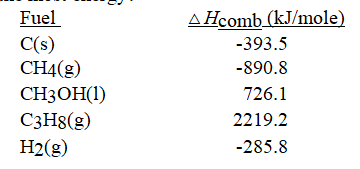
(67) The heat of combustion of several fuels are listed in the table below. On a per gram basis, which fuel releases the most energy?
(Multiple Choice)
4.7/5 (74)
(74) 100.0 g of Cu (specific heat = 0.385 J/g °C) at 100.0°C is added to 140.0 mL of H2O (specific heat = 4.184 J/g °C) at 25.0°C. What is the final temperature of the mixture?
(Multiple Choice)
4.8/5 (96)
(96) The final temperature when 150 mL of water at 90.0°C is added to 100.0 mL of water at 30.0°C is around ________.
(Multiple Choice)
4.8/5 (71)
(71) Lead, water, sulfur, and arsenic have specific heats of 0.128, 4.18, 0.706, and 0.329 J g-1°C-1, respectively. Which of the following would need the smallest quantity of heat to change the temperature of 5 g by 10°C?
(Multiple Choice)
4.9/5 (84)
(84) What is the final temperature in the bomb calorimeter if 1.785 grams of benzoic acid (HC7H5O2) is combusted in a calorimeter with a heat capacity of 5.02 kJ/°C and initial temperature of 24.62 °C? The heat of combustion of benzoic acid is -26.42 kJ/g.
(Multiple Choice)
4.8/5 (73)
(73) For the reaction H2(g) + 1/2 O2(g) → H2O(g) ΔH° = -241.8 kJ/mol, what mass of H2(g) is required to liberate 1.00 × 10³ kJ of heat?
(Multiple Choice)
4.9/5 (68)
(68) The complete combustion of propane, C3H8(g), is represented by the equation: C3H8(g) + 5 O2(g) → 3 CO2(g) + 4 H2O(l) ΔH° = -2220 kJ
How much heat is evolved in the complete combustion of 20.0 L C3H8(g) at STP?
(Multiple Choice)
4.8/5 (69)
(69) The standard enthalpy of formation for CuSO4 ∙ 5H2O(s) is -2278.0 kJ/mole at 25°C. The chemical equation to which this value applies is:
(Multiple Choice)
4.8/5 (90)
(90) The maximum amount of work is provided by a reversible process because equilibrium between the system and the surroundings is always maintained.
(True/False)
4.9/5 (81)
(81) Cyclohexanol, C6H12O, has a heat of combustion of -890.7 kcal/mol. A sample containing only 0.708 g of cyclohexanol undergoes complete combustion in a bomb calorimeter that has a heat capacity of 2.70 kcal/°C. What is the final temperature if the initial water temperature is 27.0°C?
(Multiple Choice)
4.8/5 (89)
(89) The standard enthalpy of formation of NiSO4(s) at 25 °C is -872.9 kJ/mole. The chemical equation to which this value applies is:
(Multiple Choice)
4.9/5 (77)
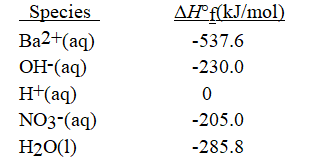
(77) What is the enthalpy of reaction for the neutralization reaction occurring between dilute Ba(OH)2(aq) and dilute HNO3(aq)? Values of ΔH°f from data tables are given below. Hint: Balance the equation so the coefficients are the lowest possible set of whole numbers.
(Multiple Choice)
4.7/5 (72)
(72) To have a standard enthalpy of formation referenced to 0 J/mol, the substance must: I) be a simple substance (chemical element)
II) be in its most stable form
III) be under 1 atm of pressure
IV) have a concentration of 1.0000 M
(Multiple Choice)
4.7/5 (78)
(78) Compute ΔH°rxn for the following reaction. The value of ΔH°f in kJ/mol is given below each species:
PCl5(g) + 4 H2O(l) → H3PO4(s) + 5 HCl(g)
-398.9 -285.9 -1281.1 -92.30
(Multiple Choice)
4.9/5 (67)
(67) An expansion of gas by a system means that the internal energy of the system increases.
(True/False)
4.8/5 (89)
(89) Calculate the amount of heat absorbed by a 40.0 g sample of water at 21°C when the temperature is raised to 35°C.
(Multiple Choice)
5.0/5 (93)
(93) 
Filters
- Essay(0)
- Multiple Choice(0)
- Short Answer(0)
- True False(0)
- Matching(0)