



 Chat with AI
Exam 19: Spontaneous Change: Entropy and Free Energy

Exam 1: Matter - Its Properties and Measurement94 Questions
Exam 2: Atoms and the Atomic Theory100 Questions
Exam 3: Chemical Compounds100 Questions
Exam 4: Chemical Reactions100 Questions
Exam 5: Introduction to Reactions in Aqueous Solutions97 Questions
Exam 6: Gases100 Questions
Exam 7: Thermochemistry101 Questions
Exam 8: Electrons in Atoms100 Questions
Exam 9: The Periodic Table and Some Atomic Properties96 Questions
Exam 10: Chemical Bonding I: Basic Concepts97 Questions
Exam 11: Chemical Bonding II: Additional Aspects97 Questions
Exam 12: Intermolecular Forces: Liquids and Solids102 Questions
Exam 13: Solutions and Their Physical Properties100 Questions
Exam 14: Chemical Kinetics92 Questions
Exam 15: Principles of Chemical Equilibrium99 Questions
Exam 16: Acids and Bases100 Questions
Exam 17: Additional Aspects of Acid-Base Equilibria99 Questions
Exam 18: Solubility and Complex-Ion Equilibria95 Questions
Exam 19: Spontaneous Change: Entropy and Free Energy101 Questions
Exam 20: Electrochemistry103 Questions
Exam 21: Main Group Elements I: Groups 1, 2, 13, and 14116 Questions
Exam 22: Main Group Elements II: Groups 18, 17, 16, 15, and Hydrogen100 Questions
Exam 23: The Transition Elements102 Questions
Exam 24: Complex Ions and Coordination Compounds100 Questions
Exam 25: Nuclear Chemistry 1-41100 Questions
Exam 26: Structures of Organic Compounds96 Questions
Exam 27: Reactions of Organic Compounds94 Questions
Exam 28: Chemistry of the Living State99 Questions
Select questions type


Which of the following combinations of signs for ΔH and ΔS will always result in a reaction being nonspontaneous?

Free
(Multiple Choice)
4.9/5  (75)
(75) Correct Answer: Verified
A
Predict whether ΔS is positive or negative for the following process: H2O(g) → H2O(s)
Free
(Multiple Choice)
4.9/5 (69)
(69) Correct Answer:Verified
VerifiedA
Predict whether ΔS is positive or negative for the following process: H2(g) + 1/2 O2(g) → H2O(g)
Free
(Multiple Choice)
4.7/5 (76)
(76) Correct Answer:Verified
VerifiedA
Which of the following quantities is generally independent of temperature? I) ΔH
II) ΔS
III) ΔG
(Multiple Choice)
5.0/5 (69)
(69) Consider the reaction:
N2O4(g) → 2 NO2(g) Keq = 0.1134 at 20 °C. ΔH°rxn = 58.03 kJ/mol
What is ΔG° for this reaction at 20 °C?
(Multiple Choice)
4.9/5 (78)
(78) For CdO(s) + SO3(g) → CdSO4(s) ΔH° = -279.4 kJ/mol, and ΔS° = -118.4 J/mol-deg. What is ΔG° in kJ/mol at 127 K?
(Multiple Choice)
4.8/5 (75)
(75) Consider the reaction:
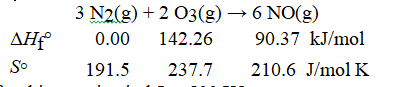 What is ΔG°rxn for this reaction in kJ at 500 K?
 (Multiple Choice)
4.7/5 (86)
(86) For the reaction, CO(g) + 2H2(g) → CH3OH(g) S° (J/mol K) 197.6 130.6 239.7
What is ΔS°rxn?
(Multiple Choice)
4.9/5 (63)
(63) Consider the endothermic reaction: N2(g) + O2(g) → 2 NO(g), ΔH° = 192.5 kJ/mol
At 2000 K the equilibrium constant is 5.0 × 10⁻⁴. At 2500 K the value of the equilibrium constant:
(Multiple Choice)
4.9/5 (89)
(89) Consider the reaction: H2X(g) → HX(g) + X(g)
ΔH°rxn = 18.4 kJ/mol ΔS°rxn = 23.1 J/mol-K
What is Keq for this reaction at 525 K?
(Multiple Choice)
4.7/5 (76)
(76) What is ΔG°rxn?
CO(g) + 2 H2(g) → CH3OH(g) ΔGf° (J/mol K) -137.2 0 -162.0
(Multiple Choice)
4.8/5 (78)
(78) Indicate the statement(s) which are true for the process: Al+3(aq) + 3 OH-(aq) → Al(OH)3(s)
If it occurs in a closed container.
I. ΔS increases because the final molecule is more complicated.
II. Entropy decreases because the product is in the solid phase.
III. The two ions achieve a high degree of order as they crystalize, therefore ΔS is positive.
IV. Entropy of the system is unchanged because the system is sealed and at a constant temperature.
(Multiple Choice)
4.8/5 (68)
(68) If a process is spontaneous, the reverse process is nonspontaneous.
(True/False)
4.7/5 (88)
(88) For the vaporization of water in an open system at 25°C and 1 atm, which of the following is correct?
(Multiple Choice)
4.8/5 (78)
(78) For Cl2O(g) + 3/2 O2(g) → 2 ClO2 △H° = 126 kJ/mol, and ΔS° = -74.9 J/(mol∙deg) at 377°C. What is Keq?
(Multiple Choice)
4.9/5 (88)
(88) For an exothermic reaction to be nonspontaneous at high temperatures, the enthalpy must be ________ while the entropy is ________.
(Multiple Choice)
4.9/5 (78)
(78) What is ΔH° for a reaction that has Kp = 1.456 at 273 K and Kp = 14.2 at 298 K?
(Multiple Choice)
4.9/5 (73)
(73) What is ΔG°rxn?
CaCO3(s) → CaO(s) + CO2(g)
ΔGf° -1128 -604 -394.4
(J/mol K)
(Multiple Choice)
4.8/5 (73)
(73) 
Filters
- Essay(0)
- Multiple Choice(0)
- Short Answer(0)
- True False(0)
- Matching(0)