



 Chat with AI
Exam 19: Spontaneous Change: Entropy and Free Energy

Exam 1: Matter - Its Properties and Measurement94 Questions
Exam 2: Atoms and the Atomic Theory100 Questions
Exam 3: Chemical Compounds100 Questions
Exam 4: Chemical Reactions100 Questions
Exam 5: Introduction to Reactions in Aqueous Solutions97 Questions
Exam 6: Gases100 Questions
Exam 7: Thermochemistry101 Questions
Exam 8: Electrons in Atoms100 Questions
Exam 9: The Periodic Table and Some Atomic Properties96 Questions
Exam 10: Chemical Bonding I: Basic Concepts97 Questions
Exam 11: Chemical Bonding II: Additional Aspects97 Questions
Exam 12: Intermolecular Forces: Liquids and Solids102 Questions
Exam 13: Solutions and Their Physical Properties100 Questions
Exam 14: Chemical Kinetics92 Questions
Exam 15: Principles of Chemical Equilibrium99 Questions
Exam 16: Acids and Bases100 Questions
Exam 17: Additional Aspects of Acid-Base Equilibria99 Questions
Exam 18: Solubility and Complex-Ion Equilibria95 Questions
Exam 19: Spontaneous Change: Entropy and Free Energy101 Questions
Exam 20: Electrochemistry103 Questions
Exam 21: Main Group Elements I: Groups 1, 2, 13, and 14116 Questions
Exam 22: Main Group Elements II: Groups 18, 17, 16, 15, and Hydrogen100 Questions
Exam 23: The Transition Elements102 Questions
Exam 24: Complex Ions and Coordination Compounds100 Questions
Exam 25: Nuclear Chemistry 1-41100 Questions
Exam 26: Structures of Organic Compounds96 Questions
Exam 27: Reactions of Organic Compounds94 Questions
Exam 28: Chemistry of the Living State99 Questions
Select questions type


Which of the following best expresses the increased degree of randomness associated with melting and sublimation, respectively?
(Multiple Choice)
4.8/5  (75)
(75) Calculate the entropy change for methanol at its normal boiling point of 64.5°C. ΔH° = 38.0 kJ/mol.
(Multiple Choice)
4.9/5 (82)
(82) The equilibrium constant for the reaction below is 7.2 x 10⁻⁴ at 298 K and 1 atm. HNO2(aq) + H2O(l) ⇌ NO2-(aq) + H3O+(aq)
When [HNO2(aq)] = 1.0 M and [NO2-(aq)] = [H3O+(aq)] = 1.0 x 10⁻⁵ M, calculate ΔG.
(Multiple Choice)
4.8/5 (71)
(71) Which of the following statements are true?
I. Liquids have more entropy than their solids.
II. Solutions have more entropy than the solids dissolved.
III. Gases and their liquids have equal entropy.
IV. Gases have less entropy than their solids.
V. Entropy of a substance increases as its temperature increases.
(Multiple Choice)
4.8/5 (84)
(84) Order the following by increasing entropy. CO(g), COCl2(g), CO2(g), CaO(s)
(Multiple Choice)
4.9/5 (83)
(83) A nonspontaneous reaction can be made to occur by coupling it with a spontaneous reaction to form an overall spontaneous reaction.
(True/False)
5.0/5 (76)
(76) For the reaction PCl5(g) → PCl3(g) + Cl2(g) at 298 K, Keq = 1.87 × 10⁻⁷, ΔS° = 181.92 J/mol K. Compute ΔH° for this reaction.
(Multiple Choice)
4.9/5 (74)
(74) Consider the following reaction.
S2Cl2(g) + 2 OCl2(g) → 2 SOCl2(g) + Cl2(g)
ΔG°f -32 97.9 -320 0.0 kJ/mol
What is ΔG° for this reaction in kJ?
(Multiple Choice)
4.9/5 (72)
(72) What is ΔG° at 25°C?
CO(g) + 2 H2(g) → CH3OH(g) ΔH° = -90.7 kJ ΔS° = -221 J/K
(Multiple Choice)
4.9/5 (86)
(86) What is ΔG° at 25°C? N2O4(g) → 2 NO2(g) ΔH° = 58.03 kJ ΔS° = 176.7 J/K
(Multiple Choice)
4.7/5 (73)
(73) For the reaction I2(s) + Cl2(g) → 2 ICl(g) ΔH = 36 kJ and ΔS = 158.8 J/K at 25°C. Calculate the temperature at which Keq is 4.0 × 10³.
(Multiple Choice)
4.7/5 (79)
(79) The maximum quantity of energy available for useful work is:
(Multiple Choice)
4.8/5 (84)
(84) Consider the following reaction:
4 NH3(g) + 7 O2(g) → 4 NO2(g) + 6 H2O (l) ΔG°f -16.7 0.0 51.8 -237.2 kJ/mol
What is Keq for this reaction at 25 °C?
(Multiple Choice)
4.9/5 (83)
(83) For the reaction PCl5(g) → PCl3(g) + Cl2(g) at 298 K, Keq = 1.87 × 10⁻⁷, ΔS° = 181.92 J/mol K, what is Keq at 200 K if ΔH° = 92.6 kJ/mol?
(Multiple Choice)
4.9/5 (85)
(85) Predict whether ΔS is positive or negative for the following process: 2 Cl2O7(g) → 2 Cl2(g) + 7 O2(g)
(Multiple Choice)
4.9/5 (89)
(89) Consider the following reaction:
4 NH3(g) + 7 O2(g) → 4 NO2(g) + 6 H2O (l) ΔG°f -16.7 0.0 51.8 -237.2 kJ/mol
What is ΔG° for this reaction in kJ?
(Multiple Choice)
4.9/5 (81)
(81) The following reaction is endothermic. 2NH3(g) → N2(g) + 3H2(g)
This means the reaction:
(Multiple Choice)
4.9/5 (72)
(72) Calculate ΔG° for the reaction Cu(s) + H2O(g) → CuO(s) + H2(g) at 500K. 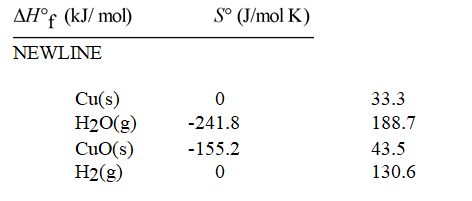
(Multiple Choice)
4.8/5 (82)
(82) 
Filters
- Essay(0)
- Multiple Choice(0)
- Short Answer(0)
- True False(0)
- Matching(0)