



 Chat with AI
Exam 13: Solutions and Their Physical Properties

Exam 1: Matter - Its Properties and Measurement94 Questions
Exam 2: Atoms and the Atomic Theory100 Questions
Exam 3: Chemical Compounds100 Questions
Exam 4: Chemical Reactions100 Questions
Exam 5: Introduction to Reactions in Aqueous Solutions97 Questions
Exam 6: Gases100 Questions
Exam 7: Thermochemistry101 Questions
Exam 8: Electrons in Atoms100 Questions
Exam 9: The Periodic Table and Some Atomic Properties96 Questions
Exam 10: Chemical Bonding I: Basic Concepts97 Questions
Exam 11: Chemical Bonding II: Additional Aspects97 Questions
Exam 12: Intermolecular Forces: Liquids and Solids102 Questions
Exam 13: Solutions and Their Physical Properties100 Questions
Exam 14: Chemical Kinetics92 Questions
Exam 15: Principles of Chemical Equilibrium99 Questions
Exam 16: Acids and Bases100 Questions
Exam 17: Additional Aspects of Acid-Base Equilibria99 Questions
Exam 18: Solubility and Complex-Ion Equilibria95 Questions
Exam 19: Spontaneous Change: Entropy and Free Energy101 Questions
Exam 20: Electrochemistry103 Questions
Exam 21: Main Group Elements I: Groups 1, 2, 13, and 14116 Questions
Exam 22: Main Group Elements II: Groups 18, 17, 16, 15, and Hydrogen100 Questions
Exam 23: The Transition Elements102 Questions
Exam 24: Complex Ions and Coordination Compounds100 Questions
Exam 25: Nuclear Chemistry 1-41100 Questions
Exam 26: Structures of Organic Compounds96 Questions
Exam 27: Reactions of Organic Compounds94 Questions
Exam 28: Chemistry of the Living State99 Questions
Select questions type


Solutions are made that contain 0.1 moles of each of the following compounds below in 100 g of H2O. Choose the compound whose solution will have the lowest freezing point.

Free
(Multiple Choice)
4.8/5  (91)
(91) Correct Answer: Verified
A
Liquid Q is a polar solvent and liquid R is a nonpolar solvent. On the basis of this information, you would expect:
Free
(Multiple Choice)
4.9/5 (66)
(66) Correct Answer:Verified
VerifiedD
What is the correct value for the weight of Na3PO4 needed to make 100 mL of a 0.50 molar solution?
Free
(Multiple Choice)
5.0/5 (78)
(78) Correct Answer:Verified
VerifiedB
The stronger the forces between solute and solvent molecules, the more exothermic the solution process.
(True/False)
5.0/5 (75)
(75) Molality is independent of temperature, molarity is dependent on temperature.
(True/False)
4.8/5 (86)
(86) The vapor pressures of pure hexane and pure heptane at 25°C are 151.4 mmHg and 45.62 mmHg respectively. A solution contains 0.800 mol fraction n-hexane and 0.200 mol fraction n-heptane. What is the composition of the vapor in equilibrium with this solution at 25°C?
(Multiple Choice)
4.9/5 (84)
(84) 252 mL of 3.00 M H2SO4 are added to 1.50 L of 0.500 M H2SO4. What is the concentration of the resulting solution?
(Multiple Choice)
4.9/5 (83)
(83) Exactly 375.0 mg of an unknown protein is dissolved in enough water to give 50.00 mL of solution and the osmotic pressure determined as 3.25 mmHg at 298 K. Estimate the molar mass of this protein.
(Multiple Choice)
4.8/5 (88)
(88) 0.0800 g of a compound with the empirical formula C2H2N is dissolved in 10.00 g benzene. The resulting solution freezes at 4.99°C. Benzene freezes at 5.48°C and has a freezing point depression constant of Kf = 4.90°C/m. What is the molecular formula of the compound?
(Multiple Choice)
4.9/5 (79)
(79) Which of the following organic substances is most readily soluble in water? 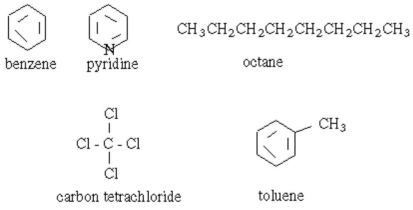
(Multiple Choice)
4.8/5 (91)
(91) An isotonic solution will produce an osmotic pressure of 7.84 atm measured against pure water at human body temperature (37.0°C). How many grams of sodium chloride must be dissolved in a liter of water to produce an isotonic solution?
(Multiple Choice)
4.9/5 (65)
(65) Henry's Law constants for aqueous solutions at 25°C are 8.20 × 10⁻⁷ molal/mmHg for N2 and 1.62 × 10⁻⁶ molal/mmHg for O2. Determine the solubility of oxygen in water under an atmospheric pressure of 760 mmHg, assuming that air is 80% N2 and 20% O2.
(Multiple Choice)
4.8/5 (73)
(73) A solution containing 3.24 g of sulfur in 40 g of benzene boils 0.81°C above the boiling point of pure benzene. Determine the number of S atoms in one molecule of dissolved sulfur. Kb for benzene is 2.53°C m-1.
(Multiple Choice)
4.7/5 (64)
(64) Determine the osmotic pressure at 25 °C of an aqueous solution that is 0.028 M NaNO3.
(Multiple Choice)
4.8/5 (79)
(79) A solution composed of 5 moles of acetone (CH3COCH3, P°A = 324 mmHg) and 5 moles of chloroform (CHCl3, P°C = 274 mmHg) has a vapor pressure of 236 mmHg. Which one of the following statements is completely true about this solution?
(Multiple Choice)
4.8/5 (78)
(78) What is the osmotic pressure in mmHg of 6.00 L of a 0.108 M solution at 30°C if three moles of ions are produced in aqueous solution for every mole of solute dissolved?
(Multiple Choice)
4.8/5 (74)
(74) 
Filters
- Essay(0)
- Multiple Choice(0)
- Short Answer(0)
- True False(0)
- Matching(0)