



 Chat with AI
Exam 13: Solutions and Their Physical Properties

Exam 1: Matter - Its Properties and Measurement94 Questions
Exam 2: Atoms and the Atomic Theory100 Questions
Exam 3: Chemical Compounds100 Questions
Exam 4: Chemical Reactions100 Questions
Exam 5: Introduction to Reactions in Aqueous Solutions97 Questions
Exam 6: Gases100 Questions
Exam 7: Thermochemistry101 Questions
Exam 8: Electrons in Atoms100 Questions
Exam 9: The Periodic Table and Some Atomic Properties96 Questions
Exam 10: Chemical Bonding I: Basic Concepts97 Questions
Exam 11: Chemical Bonding II: Additional Aspects97 Questions
Exam 12: Intermolecular Forces: Liquids and Solids102 Questions
Exam 13: Solutions and Their Physical Properties100 Questions
Exam 14: Chemical Kinetics92 Questions
Exam 15: Principles of Chemical Equilibrium99 Questions
Exam 16: Acids and Bases100 Questions
Exam 17: Additional Aspects of Acid-Base Equilibria99 Questions
Exam 18: Solubility and Complex-Ion Equilibria95 Questions
Exam 19: Spontaneous Change: Entropy and Free Energy101 Questions
Exam 20: Electrochemistry103 Questions
Exam 21: Main Group Elements I: Groups 1, 2, 13, and 14116 Questions
Exam 22: Main Group Elements II: Groups 18, 17, 16, 15, and Hydrogen100 Questions
Exam 23: The Transition Elements102 Questions
Exam 24: Complex Ions and Coordination Compounds100 Questions
Exam 25: Nuclear Chemistry 1-41100 Questions
Exam 26: Structures of Organic Compounds96 Questions
Exam 27: Reactions of Organic Compounds94 Questions
Exam 28: Chemistry of the Living State99 Questions
Select questions type


The freezing point of pure benzene was measured as 5.49°C. With the same benzene and the same equipment, the freezing point of a solution containing 6.60 g of an unknown molecular compound in 140 g of benzene was found to be 2.35°C. The cryoscopic constant, Kf, for benzene is 5.12 deg-kg/mol. Calculate the mole weight of the unknown.
(Multiple Choice)
4.9/5  (79)
(79) What is the mass/vol % ethanol in an ethanol-water solution with a density of 0.875 g/mL and containing 65.0% ethanol by volume? The density of pure ethanol is 0.789 g/mL.
(Multiple Choice)
4.9/5 (86)
(86) Moles of solute per liter of solution is the definition of ________.
(Multiple Choice)
4.9/5 (82)
(82) Which of the following is a correct statement about azeotropes?
(Multiple Choice)
4.7/5 (80)
(80) Solutions are made that contain 0.10 moles of each of the following compounds in 100 g of H2O. Choose the compound whose solution will have the highest freezing point.
(Multiple Choice)
4.8/5 (84)
(84) An unknown compound is composed of 65.44% C, 29.07% O, and 5.49% H. A sample weighing 5.34 g, when dissolved in 60.00 g H2O, lowers the freezing point to -0.600°C. What is the molecular formula of the compound? (Kf for water = 1.86°C/m; C = 12.0, O = 16.0, H = 1.0 g/mol).
(Multiple Choice)
4.9/5 (76)
(76) The solubilities of ammonium bromide, NH4Br, in water at 0°C, 20°C, and 80°C are as follows: 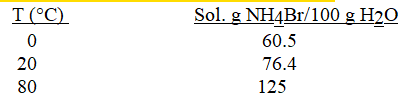 Which of the following fractional crystallization schemes would produce the highest percent yield for the recrystallization of ammonium bromide?
 (Multiple Choice)
4.8/5 (68)
(68) 100 mL of LiNO3, 0.241 M is mixed with 240 mL of 0.618 M Ca(NO3)2. What is the final concentration of NO3- in the solution?
(Multiple Choice)
4.8/5 (80)
(80) Commercial perchloric acid is 70.0% by mass, HClO4(aq), and has a density of 1.67 g/mL. Calculate the mole fraction of perchloric acid in the solution.
(Multiple Choice)
5.0/5 (86)
(86) The van't Hoff factor is due to ions being attracted to each other enough that they don't react as individual molecules.
(True/False)
5.0/5 (96)
(96) Arrange the following three water solutions (all 250 cm3 in volume) according to decreasing osmotic pressure at 273 K: 5 g of C2H5OH, 5 g C6H12O6 ,and 5 g C12H22O11.
(Multiple Choice)
4.8/5 (81)
(81) Commercial perchloric acid is 70.0% by mass, HClO4(aq), and has a density of 1.67 g/mL. Calculate the molarity of perchloric acid in the solution.
(Multiple Choice)
4.7/5 (70)
(70) The vapor pressures of pure propyl alcohol and isopropyl alcohol are 21.0 mmHg and 45.2 mmHg, respectively, at 25°C. What is the composition of the vapor in equilibrium with a propyl alcohol - isopropyl alcohol solution in which the mole fraction of propyl alcohol is 0.250?
(Multiple Choice)
4.8/5 (64)
(64) A crystal is placed into a solution and the solution seems to solidify while getting much warmer at the same time. The solution must have been:
(Multiple Choice)
4.7/5 (82)
(82) The vapor pressures of pure propyl alcohol and isopropyl alcohol are 21.0 mmHg and 45.2 mmHg, respectively, at 25°C. Calculate the partial pressure of isopropyl alcohol above a solution in which the mole fraction of propyl alcohol is 0.250.
(Multiple Choice)
4.7/5 (83)
(83) The freezing point of a solution made by dissolving 8.9 g of MgCl2 in 98 g H2O is -4.3°C. Kf for water is 1.86°C m-1. The van't Hoff i factor for this solution is ________.
(Multiple Choice)
4.8/5 (78)
(78) A solution prepared by dissolving 4.00 g KCl in 36.0 g H2O is said to be:
(Multiple Choice)
4.8/5 (84)
(84) A solution component present in lesser quantity than the solvent is called ________.
(Multiple Choice)
4.8/5 (79)
(79) The solubility of ammonium permanganate is 7.90 g/100 mL of water. 29.0 grams of ammonium permanganate are placed in a container and 220 mL of water is added. The liquid is allowed to stand in contact with the solid until equilibrium is achieved and then the liquid is poured off. What is the weight of solid left?
(Multiple Choice)
4.9/5 (82)
(82) Two solutions contain the same amount of water as a solvent. One solution contains 0.5 mol glucose (C6H12O6) while the other one contains 0.2 mol of CaCl2 . If the freezing points of both solutions are the same, determine the van't Hoff i factor for CaCl2 solution.
(Multiple Choice)
4.9/5 (84)
(84) 
Filters
- Essay(0)
- Multiple Choice(0)
- Short Answer(0)
- True False(0)
- Matching(0)