



 Chat with AI
Exam 14: Chemical Kinetics

Exam 1: Matter - Its Properties and Measurement94 Questions
Exam 2: Atoms and the Atomic Theory100 Questions
Exam 3: Chemical Compounds100 Questions
Exam 4: Chemical Reactions100 Questions
Exam 5: Introduction to Reactions in Aqueous Solutions97 Questions
Exam 6: Gases100 Questions
Exam 7: Thermochemistry101 Questions
Exam 8: Electrons in Atoms100 Questions
Exam 9: The Periodic Table and Some Atomic Properties96 Questions
Exam 10: Chemical Bonding I: Basic Concepts97 Questions
Exam 11: Chemical Bonding II: Additional Aspects97 Questions
Exam 12: Intermolecular Forces: Liquids and Solids102 Questions
Exam 13: Solutions and Their Physical Properties100 Questions
Exam 14: Chemical Kinetics92 Questions
Exam 15: Principles of Chemical Equilibrium99 Questions
Exam 16: Acids and Bases100 Questions
Exam 17: Additional Aspects of Acid-Base Equilibria99 Questions
Exam 18: Solubility and Complex-Ion Equilibria95 Questions
Exam 19: Spontaneous Change: Entropy and Free Energy101 Questions
Exam 20: Electrochemistry103 Questions
Exam 21: Main Group Elements I: Groups 1, 2, 13, and 14116 Questions
Exam 22: Main Group Elements II: Groups 18, 17, 16, 15, and Hydrogen100 Questions
Exam 23: The Transition Elements102 Questions
Exam 24: Complex Ions and Coordination Compounds100 Questions
Exam 25: Nuclear Chemistry 1-41100 Questions
Exam 26: Structures of Organic Compounds96 Questions
Exam 27: Reactions of Organic Compounds94 Questions
Exam 28: Chemistry of the Living State99 Questions
Select questions type


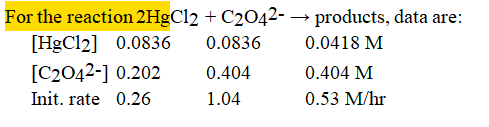 The rate law is Rate = [HgCl2]x[C2O42-]y. Thus:
Free
(Multiple Choice)
4.8/5  (96)
(96) Correct Answer: Verified
C
If a catalyst is added to a reaction:
I. the value of k is increased
II. the value of k is decreased
III. the rate is increased
IV. the rate is decreased
V. neither rate nor the constant are changed, only the order
Free
(Multiple Choice)
4.9/5 (87)
(87) Correct Answer:Verified
VerifiedD
In the first-order, reaction A → products, [A] = 0.400 M initially and 0.250 M after 15.0 min, what is the half-life of the reaction?
Free
(Multiple Choice)
4.8/5 (80)
(80) Correct Answer:Verified
VerifiedA
For the reaction: C2H4Br2 + 3 KI → C2H4 + 2 KBr + KI3, when the rate of reaction is 2.0 × 10⁻⁵, what is the rate of disappearance of KI?
(Multiple Choice)
4.8/5 (72)
(72) The rate constant at 160 °C for the first order decomposition of ore is 0.032/min. The half-life of the reaction is ________.
(Multiple Choice)
4.9/5 (78)
(78) What is the order of reaction for the following reaction: Rate = k[A]-1/2 [B]1/2 ?
(Multiple Choice)
4.8/5 (92)
(92) What is the main difference between a Pt catalyst and an enzyme catalyst?
(Multiple Choice)
5.0/5 (82)
(82) In the reaction C4H9Cl(aq) + H2O(l) → C4H9OH(aq) + HCl(aq) the concentration of the reactant changes from 0.0562 M to 0.0431 M in 85 sec. What is the average rate of decomposition over this interval?
(Multiple Choice)
4.8/5 (79)
(79) According to the collision theory in gaseous molecules, collision frequency is ________ and reaction is ________ because ________.
(Multiple Choice)
4.9/5 (80)
(80) In the Arrhenius equation, ln k = -Ea/RT + ln A, the symbol A denotes:
(Multiple Choice)
4.8/5 (71)
(71) Which of the following has no effect on the rate of a reaction?
(Multiple Choice)
4.8/5 (74)
(74) For the reaction: C2H4Br2 + 3 KI → C2H4 + 2 KBr + KI3, when the rate of reaction is 2.0 × 10⁻⁵, what is the rate of appearance of KBr?
(Multiple Choice)
4.7/5 (66)
(66) In the first-order, reaction A → products, [A] = 0.400 M initially and 0.250 M after 15.0 min, at what time will [A] = 0.200 M?
(Multiple Choice)
4.8/5 (75)
(75) In the first order reaction A → products, [A] = 0.400 M initially and 0.250 M after 15.0 min, what will [A] be after 175 min?
(Multiple Choice)
4.8/5 (80)
(80) Which is a plausible mechanism for the following reaction if the rate law is Rate = k[O3]2/[O2]? 2O3 → 3O2
(Multiple Choice)
4.8/5 (82)
(82) What is the rate law for the following reaction and its mechanism?
2HgCl2 + C2O42- → 2Cl- + 2CO2 + Hg2Cl2 (overall reaction)
HgCl2 + C2O42- ⇌ HgCl2C2O42- (Fast)
HgCl2C2O42- + C2O42- → Hg + 2C2O4Cl2- (Slow)
Hg + HgCl2 → Hg2Cl2 (Fast)
2C2O4Cl2- → C2O42- +2Cl- + 2CO2 (Fast)
(Multiple Choice)
4.8/5 (83)
(83) What is the rate law for the following mechanism? N2O + NO → N2ONO (Slow)
N2ONO → N2 + NO2 (Fast)
(Multiple Choice)
4.9/5 (81)
(81) For the reaction: 2N2O5(g) → 4NO2(g) + O2(g) the rate law is:  = k[N2O5] At 300 K, the half-life is 2.50 × 10⁴ seconds and the activation energy is 103.3 kJ/mol. What is the rate constant at 310 K?
 (Multiple Choice)
4.9/5 (82)
(82) 
Filters
- Essay(0)
- Multiple Choice(0)
- Short Answer(0)
- True False(0)
- Matching(0)