



 Chat with AI
Exam 14: Chemical Kinetics

Exam 1: Matter - Its Properties and Measurement94 Questions
Exam 2: Atoms and the Atomic Theory100 Questions
Exam 3: Chemical Compounds100 Questions
Exam 4: Chemical Reactions100 Questions
Exam 5: Introduction to Reactions in Aqueous Solutions97 Questions
Exam 6: Gases100 Questions
Exam 7: Thermochemistry101 Questions
Exam 8: Electrons in Atoms100 Questions
Exam 9: The Periodic Table and Some Atomic Properties96 Questions
Exam 10: Chemical Bonding I: Basic Concepts97 Questions
Exam 11: Chemical Bonding II: Additional Aspects97 Questions
Exam 12: Intermolecular Forces: Liquids and Solids102 Questions
Exam 13: Solutions and Their Physical Properties100 Questions
Exam 14: Chemical Kinetics92 Questions
Exam 15: Principles of Chemical Equilibrium99 Questions
Exam 16: Acids and Bases100 Questions
Exam 17: Additional Aspects of Acid-Base Equilibria99 Questions
Exam 18: Solubility and Complex-Ion Equilibria95 Questions
Exam 19: Spontaneous Change: Entropy and Free Energy101 Questions
Exam 20: Electrochemistry103 Questions
Exam 21: Main Group Elements I: Groups 1, 2, 13, and 14116 Questions
Exam 22: Main Group Elements II: Groups 18, 17, 16, 15, and Hydrogen100 Questions
Exam 23: The Transition Elements102 Questions
Exam 24: Complex Ions and Coordination Compounds100 Questions
Exam 25: Nuclear Chemistry 1-41100 Questions
Exam 26: Structures of Organic Compounds96 Questions
Exam 27: Reactions of Organic Compounds94 Questions
Exam 28: Chemistry of the Living State99 Questions
Select questions type


The rate data from a chemical reaction shows that doubling the concentration of A with the concentration of B remaining constant causes the rate to increase by a factor of four. What is the reaction order for [A]?
(Multiple Choice)
4.9/5  (79)
(79) Substance A decomposes by a first-order reaction. Starting initially with [A] = 2.00 M, after 150 min [A] = 0.50 M. For this reaction what is t1/2?
(Multiple Choice)
4.9/5 (74)
(74) In the Arrhenius equation, ln k = -Ea/RT + ln A, the symbol A denotes the initial concentration of A.
(True/False)
4.8/5 (76)
(76) For the reaction: C2H4Br2 + 3KI → C2H4 + 2KBr + KI3 Initial rate data at 60°C are:
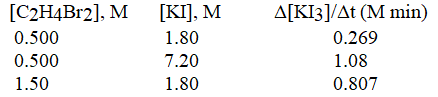 The rate law is ________.
 (Multiple Choice)
4.8/5 (70)
(70) For the second order reaction A → products, the following data are obtained:
[A] = 3.024 M, t = 0 min
[A] = 2.935 M, t = 1.0 min
[A] = 2.852 M, t = 2.0 min
What is the rate constant, k?
(Multiple Choice)
4.7/5 (88)
(88) Given the following initial rate data, calculate the specific rate constant. 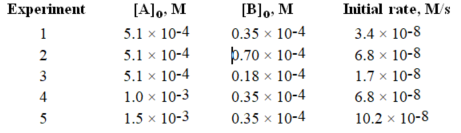
(Multiple Choice)
4.7/5 (70)
(70) Given the following initial rate data, write the rate law expression.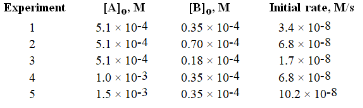
(Multiple Choice)
4.9/5 (70)
(70) For the second-order reaction A → products, the following data are obtained: [A] = 1.512 M, t = 0 min
[A] = 1.490 M, t = 1.0 min
[A] = 1.469 M, t = 2.0 min
What is the initial rate of the reaction in the experiment?
(Multiple Choice)
4.8/5 (87)
(87) The rate constant for a first-order reaction is k = 0.00073 s-1. Determine the percent of reactant that has decomposed after 500 s.
(Multiple Choice)
4.8/5 (85)
(85) For the second-order reaction A → products, the following data are obtained: [A] = 3.024 M, t = 0 min
[A] = 2.935 M, t = 1.0 min
[A] = 2.852 M, t = 2.0 min
What is the initial rate of the reaction?
(Multiple Choice)
4.8/5 (79)
(79) A heterogeneous catalyst is a catalyst that is in two phases of matter.
(True/False)
5.0/5 (86)
(86) For the reaction: 2N2O5(g) → 4NO2(g) + O2(g) the rate law is:  = k[N2O5] At 300 K, the half-life is 2.50 × 10⁴ seconds and the activation energy is 103.3 kJ/mol. What is the rate constant at 350 K?
 (Multiple Choice)
4.9/5 (88)
(88) 
Filters
- Essay(0)
- Multiple Choice(0)
- Short Answer(0)
- True False(0)
- Matching(0)