



 Chat with AI
Exam 14: Chemical Kinetics

Exam 1: Matter - Its Properties and Measurement94 Questions
Exam 2: Atoms and the Atomic Theory100 Questions
Exam 3: Chemical Compounds100 Questions
Exam 4: Chemical Reactions100 Questions
Exam 5: Introduction to Reactions in Aqueous Solutions97 Questions
Exam 6: Gases100 Questions
Exam 7: Thermochemistry101 Questions
Exam 8: Electrons in Atoms100 Questions
Exam 9: The Periodic Table and Some Atomic Properties96 Questions
Exam 10: Chemical Bonding I: Basic Concepts97 Questions
Exam 11: Chemical Bonding II: Additional Aspects97 Questions
Exam 12: Intermolecular Forces: Liquids and Solids102 Questions
Exam 13: Solutions and Their Physical Properties100 Questions
Exam 14: Chemical Kinetics92 Questions
Exam 15: Principles of Chemical Equilibrium99 Questions
Exam 16: Acids and Bases100 Questions
Exam 17: Additional Aspects of Acid-Base Equilibria99 Questions
Exam 18: Solubility and Complex-Ion Equilibria95 Questions
Exam 19: Spontaneous Change: Entropy and Free Energy101 Questions
Exam 20: Electrochemistry103 Questions
Exam 21: Main Group Elements I: Groups 1, 2, 13, and 14116 Questions
Exam 22: Main Group Elements II: Groups 18, 17, 16, 15, and Hydrogen100 Questions
Exam 23: The Transition Elements102 Questions
Exam 24: Complex Ions and Coordination Compounds100 Questions
Exam 25: Nuclear Chemistry 1-41100 Questions
Exam 26: Structures of Organic Compounds96 Questions
Exam 27: Reactions of Organic Compounds94 Questions
Exam 28: Chemistry of the Living State99 Questions
Select questions type


For the reaction: 2N2O5(g) → 4NO2(g) + O2(g) the rate law is:  = k[N2O5] At 300 K, the half-life is 2.50 × 10⁴ seconds and the activation energy is 103.3 kJ/mol O2. At the time when N2O5 is being consumed at a rate of -1.2 × 10⁻⁴ M/s, what is the rate at which NO2 is being formed?
 (Multiple Choice)
4.9/5  (85)
(85) If a reaction is first order with a rate constant of 5.48 × 10⁻²/sec, how long is required for 3/4 of the initial concentration of reactant to be used up?
(Multiple Choice)
4.9/5 (81)
(81) In the first-order, reaction A → products, [A] = 0.400 M initially and 0.250 M after 15.0 min, what is the value of the rate constant, k?
(Multiple Choice)
4.8/5 (82)
(82) If a reaction has a rate equation of rate = k[A][B][C] then it is:
(Multiple Choice)
4.8/5 (80)
(80) The reaction 2H2 + NO → H2O + 1/2N2 is first order in H2 and second order in NO. The rate law is ________.
(Multiple Choice)
4.9/5 (83)
(83) For a reaction with a second order rate constant, what is the correct unit?
(Multiple Choice)
4.9/5 (65)
(65) The reaction A + B → C + D is second order in A and zero order in B. The value of k is 0.012 M-1 min-1. What is the rate of this reaction when [A] = 0.125 M and [B] = 0.435 M?
(Multiple Choice)
4.9/5 (87)
(87) In a second order reaction:
I. the sum of the exponents in the rate law is equal to two.
II. at least one of the exponents in the rate law is a two.
III. the half-life is not constant.
IV. the half-life is constant.
V. k can be expressed as M-2s-1 or M-2min-1.
(Multiple Choice)
4.8/5 (79)
(79) What is the rate constant at 305 K for the reaction: 2N2O5 → 2N2O4 + O2,
If k = 3.46 × 10⁻⁵ s-1 at 298 K and Ea = 106 kJ/mol?
(Multiple Choice)
4.8/5 (84)
(84) For the reaction: C2H4Br2 + 3 KI → C2H4 + 2 KBr + KI3, when the rate of reaction is 2.0 × 10⁻⁵, what is the rate of appearance of C2H4?
(Multiple Choice)
4.7/5 (58)
(58) The reaction has the rate law Rate = k[A][B]2. Which will cause the rate to increase the most?
(Multiple Choice)
4.8/5 (73)
(73) Which of the following situations involves a heterogeneous catalysis?
(Multiple Choice)
4.9/5 (79)
(79) For the reaction: 2N2O5(g) → 4NO2(g) + O2(g) the rate law is:  = k[N2O5] At 300 K, the half-life is 2.50 × 10⁴ seconds and the activation energy is 103.3 kJ/mol. At what temperature is the half-life 400. seconds?
 (Multiple Choice)
4.8/5 (86)
(86) The first-order reaction A → Products has a half-life, t1/2, of 55.0 min at 25°C and 6.8 min at 100°C. What is the activation energy for this reaction?
(Multiple Choice)
4.8/5 (84)
(84) 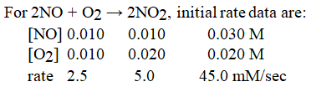 The rate law is Rate = k[NO]x[O2]y:
If increasing the concentration of A in a chemical reaction causes no increase in the rate of the reaction, then we may say the reaction rate is first order in [A].
(True/False)
4.8/5 (75)
(75) 
Filters
- Essay(0)
- Multiple Choice(0)
- Short Answer(0)
- True False(0)
- Matching(0)