



 Chat with AI
Exam 14: Chemical Kinetics

Exam 1: Matter - Its Properties and Measurement94 Questions
Exam 2: Atoms and the Atomic Theory100 Questions
Exam 3: Chemical Compounds100 Questions
Exam 4: Chemical Reactions100 Questions
Exam 5: Introduction to Reactions in Aqueous Solutions97 Questions
Exam 6: Gases100 Questions
Exam 7: Thermochemistry101 Questions
Exam 8: Electrons in Atoms100 Questions
Exam 9: The Periodic Table and Some Atomic Properties96 Questions
Exam 10: Chemical Bonding I: Basic Concepts97 Questions
Exam 11: Chemical Bonding II: Additional Aspects97 Questions
Exam 12: Intermolecular Forces: Liquids and Solids102 Questions
Exam 13: Solutions and Their Physical Properties100 Questions
Exam 14: Chemical Kinetics92 Questions
Exam 15: Principles of Chemical Equilibrium99 Questions
Exam 16: Acids and Bases100 Questions
Exam 17: Additional Aspects of Acid-Base Equilibria99 Questions
Exam 18: Solubility and Complex-Ion Equilibria95 Questions
Exam 19: Spontaneous Change: Entropy and Free Energy101 Questions
Exam 20: Electrochemistry103 Questions
Exam 21: Main Group Elements I: Groups 1, 2, 13, and 14116 Questions
Exam 22: Main Group Elements II: Groups 18, 17, 16, 15, and Hydrogen100 Questions
Exam 23: The Transition Elements102 Questions
Exam 24: Complex Ions and Coordination Compounds100 Questions
Exam 25: Nuclear Chemistry 1-41100 Questions
Exam 26: Structures of Organic Compounds96 Questions
Exam 27: Reactions of Organic Compounds94 Questions
Exam 28: Chemistry of the Living State99 Questions
Select questions type


For a reaction with a second order rate constant, the correct unit is M ∙ time-1.
(True/False)
5.0/5  (81)
(81) Why is rate = k[HgCl2] 2[C2O42-] not the rate law for the following mechanism? 2HgCl2 + C2O42- → 2Cl- + 2CO2 + Hg2Cl2 (overall reaction)
HgCl2 + C2O42- ⇌ HgCl2C2O42- (Fast)
HgCl2C2O42- + C2O42- → Hg + 2C2O4Cl2- (Slow)
Hg + HgCl2 → Hg2Cl2 (Fast)
2C2O4Cl2- → C2O42- + 2Cl- + 2CO2 (Fast)
(Multiple Choice)
4.9/5 (74)
(74) If the half-life of a reaction depends on the concentration of the reactant, then the reaction cannot be ________ order.
(Multiple Choice)
4.9/5 (70)
(70) Data for the reaction A + B → C are given below. Find the rate constant for this system.
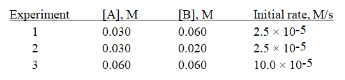
(Multiple Choice)
4.8/5 (79)
(79) The first order reaction A → products has t1/2 = 150 sec. What percent of the sample remains unreacted after 300 sec?
(Multiple Choice)
4.7/5 (85)
(85) For the reaction: 2N2O5(g) → 4NO2(g) + O2(g) the rate law is:  = k[N2O5] At 300 K, the half-life is 2.50 × 10⁴ seconds and the activation energy is 103.3 kJ/mol. What is the half-life at 310 K?
 (Multiple Choice)
4.9/5 (82)
(82) Which of the following lowers the activation energy of a reaction?
(Multiple Choice)
4.8/5 (75)
(75) For the reaction: 2N2O5(g) → 4NO2(g) + O2(g) at the time when N2O5 is being consumed at a rate of -1.2 × 10⁻⁴ M/s, what is the rate at which O2 is being formed?
(Multiple Choice)
4.8/5 (75)
(75) In the Arrhenius equation, ln k = -Ea/RT + ln A, the symbol A is a constant that represents the frequency of collisions with the proper orientation and other steric conditions favorable for a reaction.
(True/False)
4.9/5 (73)
(73) Which of the following statements is true about the reaction 2A → B + C which is first order in A and first order overall?
(Multiple Choice)
4.7/5 (81)
(81) If the half-life of a reactant is independent of its initial concentration, the reaction order is 0.
(True/False)
4.9/5 (84)
(84) Which of the following is FALSE for a second order reaction?
(Multiple Choice)
5.0/5 (80)
(80) If increasing the concentration of A in a chemical reaction causes no increase in the rate of the reaction, then we may say:
(Multiple Choice)
4.9/5 (85)
(85) A catalyst:
I. lowers activation energy
II. provides an alternate reaction pathway
III. is consumed in the reaction and therefore does not appear
In the chemical equation of each mechanism
IV. speeds a reaction
V. is heterogeneous if it is in a different phase than the reactants
(Multiple Choice)
4.9/5 (86)
(86) 
Filters
- Essay(0)
- Multiple Choice(0)
- Short Answer(0)
- True False(0)
- Matching(0)