



 Chat with AI
Exam 19: Spontaneous Change: Entropy and Free Energy

Exam 1: Matter - Its Properties and Measurement94 Questions
Exam 2: Atoms and the Atomic Theory100 Questions
Exam 3: Chemical Compounds100 Questions
Exam 4: Chemical Reactions100 Questions
Exam 5: Introduction to Reactions in Aqueous Solutions97 Questions
Exam 6: Gases100 Questions
Exam 7: Thermochemistry101 Questions
Exam 8: Electrons in Atoms100 Questions
Exam 9: The Periodic Table and Some Atomic Properties96 Questions
Exam 10: Chemical Bonding I: Basic Concepts97 Questions
Exam 11: Chemical Bonding II: Additional Aspects97 Questions
Exam 12: Intermolecular Forces: Liquids and Solids102 Questions
Exam 13: Solutions and Their Physical Properties100 Questions
Exam 14: Chemical Kinetics92 Questions
Exam 15: Principles of Chemical Equilibrium99 Questions
Exam 16: Acids and Bases100 Questions
Exam 17: Additional Aspects of Acid-Base Equilibria99 Questions
Exam 18: Solubility and Complex-Ion Equilibria95 Questions
Exam 19: Spontaneous Change: Entropy and Free Energy101 Questions
Exam 20: Electrochemistry103 Questions
Exam 21: Main Group Elements I: Groups 1, 2, 13, and 14116 Questions
Exam 22: Main Group Elements II: Groups 18, 17, 16, 15, and Hydrogen100 Questions
Exam 23: The Transition Elements102 Questions
Exam 24: Complex Ions and Coordination Compounds100 Questions
Exam 25: Nuclear Chemistry 1-41100 Questions
Exam 26: Structures of Organic Compounds96 Questions
Exam 27: Reactions of Organic Compounds94 Questions
Exam 28: Chemistry of the Living State99 Questions
Select questions type


Consider the reaction:
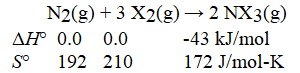 What is ΔG° for this reaction at 591 K? Is the reaction spontaneous at 591 K?
 (Multiple Choice)
4.9/5  (86)
(86) For the reaction SO2(g) + Cl2(g) → SO2Cl2(g) Keq = 0.377 at 25°C, what is ΔG° for the reaction?
(Multiple Choice)
5.0/5 (89)
(89) Calculate the temperature for which Keq for a reaction is 1.04 × 10³ where ΔH° = -83.2 kJ/mol and ΔS° = -246 J/mol ∙ K.
(Multiple Choice)
4.8/5 (83)
(83) Entropy is related to the way in which the energy of a system is distributed among the available microscopic energy levels.
(True/False)
4.9/5 (81)
(81) A spontaneous process will occur only if a some external action is continually applied.
(True/False)
4.8/5 (80)
(80) For the reaction PCl5(g) → PCl3(g) + Cl2(g) at 298 K, Keq = 1.87 × 10⁻⁷, ΔS° = 1.8192 J/(mol ∙K), what is ΔG° and is the reaction spontaneous?
(Multiple Choice)
5.0/5 (84)
(84) Consider the following reaction: C3H4(g) + 2 H2(g) → C3H8(g) S° 266.9 130.6 269.9 J/mol∙deg
What is ΔS° in J/mol∙deg?
(Multiple Choice)
5.0/5 (69)
(69) Consider the reaction: AB(g) → A(g) + B(g) (Keq = 0.729 at 20°C ΔH° = 45.9 kJ/mol)
What is Keq for this reaction at 425 K?
(Multiple Choice)
4.8/5 (80)
(80) Consider the following reaction:
S2Cl2(g) + 2 OCl2(g) → 2 SOCl2(g) + Cl2(g)
ΔG°f -32 97.9 -320 0.0 kJ/mol
What is Keq for this reaction at 25 °C?
(Multiple Choice)
4.8/5 (89)
(89) What is ΔG°rxn? N2O4(g) → 2 NO2(g) ΔGf° (J/mol K) 97.8 51.3
(Multiple Choice)
4.9/5 (69)
(69) Which of the following quantities for an element has a value of zero in the standard state? I) ΔH°f
II) ΔG°f
III) S°
(Multiple Choice)
4.9/5 (85)
(85) For the reaction: CO(g) + 2 H2(g) → CH3OH(g) Kp = 91.4 at 350 K and Kp = 2.05 × 10⁻⁴ at 298 K.
What is the value of ΔH°?
(Multiple Choice)
4.9/5 (87)
(87) Consider the reaction of 25.0 mL of 0.20 M AgNO3(aq) with 25.0 mL of 0.20 M NaBr(aq) to form AgBr(s) at 25°C. What is ΔG for this reaction? The Ksp of AgBr is 5.0 x 10⁻¹³ at 25°C.
(Multiple Choice)
4.8/5 (70)
(70) Choose the correct statements concerning entropy. I) As two gasses mix, ΔS is positive.
II) Entropy is a thermodynamic property related to the degree of disorder.
III) As temperature in a gas decreases, ΔS is positive.
IV) Molecules in the liquid state have higher entropy than molecules in the gaseous state.
(Multiple Choice)
4.8/5 (74)
(74) 
Filters
- Essay(0)
- Multiple Choice(0)
- Short Answer(0)
- True False(0)
- Matching(0)