



 Chat with AI
Exam 26: Saving, Investment, and the Financial System

Exam 1: Ten Principles of Economics439 Questions
Exam 2: Thinking Like an Economist617 Questions
Exam 3: Interdependence and the Gains From Trade527 Questions
Exam 4: The Market Forces of Supply and Demand697 Questions
Exam 5: Elasticity and Its Application594 Questions
Exam 6: Supply, Demand, and Government Policies645 Questions
Exam 7: Consumers, Producers, and the Efficiency of Markets549 Questions
Exam 8: Application: the Costs of Taxation513 Questions
Exam 9: Application: International Trade492 Questions
Exam 10: Externalities524 Questions
Exam 11: Public Goods and Common Resources433 Questions
Exam 12: The Design of the Tax System549 Questions
Exam 13: The Costs of Production420 Questions
Exam 14: Firms in Competitive Markets543 Questions
Exam 15: Monopoly637 Questions
Exam 16: Monopolistic Competition580 Questions
Exam 17: Oligopoly488 Questions
Exam 18: The Markets for the Factors of Production564 Questions
Exam 19: Earnings and Discrimination490 Questions
Exam 20: Income Inequality and Poverty455 Questions
Exam 21: The Theory of Consumer Choice431 Questions
Exam 22: Frontiers of Microeconomics440 Questions
Exam 23: Measuring a Nations Income520 Questions
Exam 24: Measuring the Cost of Living529 Questions
Exam 25: Production and Growth505 Questions
Exam 26: Saving, Investment, and the Financial System564 Questions
Exam 27: The Basic Tools of Finance500 Questions
Exam 28: Unemployment678 Questions
Exam 29: The Monetary System515 Questions
Exam 30: Money Growth and Inflation481 Questions
Exam 31: Open-Economy Macroeconomics: Basic Concepts522 Questions
Exam 32: A Macroeconomic Theory of the Open Economy475 Questions
Exam 33: Aggregate Demand and Aggregate Supply562 Questions
Exam 34: The Influence of Monetary and Fiscal Policy on Aggregate Demand508 Questions
Exam 35: The Short-Run Trade-Off Between Inflation and Unemployment491 Questions
Exam 36: Six Debates Over Macroeconomic Policy372 Questions
Select questions type


Larry buys stock in A to Z Express Company. Curly Corporation builds a new factory. Whose transaction would be an act of investment in the language of macroeconomics?
(Multiple Choice)
4.9/5  (73)
(73) Consider three different closed economies with the following national income statistics. Country A has taxes of $40 billion, transfers of $20 billion, and government expenditures on goods and services of $30 billion. County B has private savings of $60 billion, and investment expenditures of $40 billion. Country C has GDP of $300 billion, investment of $90, consumption of $180 billion, taxes of $60 billion and transfers of $20 billion. From this information, we know that
(Multiple Choice)
4.9/5 (75)
(75) If the tax revenue of the federal government is less than its spending, then the federal government necessarily
(Multiple Choice)
4.9/5 (85)
(85) For an imaginary economy, when the real interest rate is 5 percent, the quantity of loanable funds demanded is $1,000 and the quantity of loanable funds supplied is $1,000. Currently, the nominal interest rate is 9 percent and the inflation rate is 2 percent. Currently,
(Multiple Choice)
4.7/5 (83)
(83) When a corporation experiences financial problems, bondholders are paid before stockholders.
(True/False)
5.0/5 (72)
(72) Which of the following events could explain a decrease in interest rates together with an increase in investment?
(Multiple Choice)
4.8/5 (90)
(90) The single most important piece of information about a stock is its
(Multiple Choice)
4.8/5 (86)
(86) In the small closed economy of San Lorena, the currency is the denar. Statistics for last year show that private saving was 60 billion denars, taxes were 80 billion denars, government purchases of goods and services were 70 billion denars, there were no transfer payments by the government, and GDP was 400 billion denars. What were consumption and investment in San Lorena?
(Multiple Choice)
4.8/5 (83)
(83) For an imaginary economy, when the real interest rate is 5 percent, the quantity of loanable funds demanded is $100,000 and the quantity of loanable funds supplied is $100,000. Currently, the nominal interest rate is 6 percent and the inflation rate is 2 percent. Currently,
(Multiple Choice)
4.9/5 (85)
(85) When tax code changes increase saving incentives, the interest rate will and investment will .
(Short Answer)
4.9/5 (87)
(87) The indirect provision of funds by savers to borrowers is accomplished by
(Multiple Choice)
5.0/5 (89)
(89) A certificate of indebtedness that specifies the obligations of the borrower to the holder is called a
(Multiple Choice)
4.7/5 (79)
(79) Higher education subsidies in the form of the federal government's student loan program
(Multiple Choice)
4.7/5 (84)
(84) Mandy purchases 68.2 shares of a mutual fund for $1,500. Cassie's purchase of these shares contributes $1,500 to which magnitude in the identity Y = C + I + G?
(Multiple Choice)
4.9/5 (75)
(75) Table 26-3. The following table presents information about a closed economy whose market for loanable funds is in equilibrium. 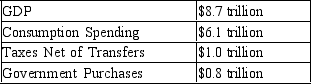 -Refer to Table 26-3. Determine the quantity of loanable funds demanded.
 (Multiple Choice)
4.9/5 (84)
(84) An increase in the demand for loanable funds increases the equilibrium interest rate and increases the equilibrium level of saving.
(True/False)
4.9/5 (69)
(69) If there is a shortage in the market for loanable funds, what happens to desired saving and desired investment as the interest rate moves to its equilibrium value?
(Multiple Choice)
4.8/5 (75)
(75) If Canada goes from a large budget deficit to a small budget deficit, it will
(Multiple Choice)
4.8/5 (73)
(73) 
Filters
- Essay(0)
- Multiple Choice(0)
- Short Answer(0)
- True False(0)
- Matching(0)