



 Chat with AI
Exam 26: Saving, Investment, and the Financial System

Exam 1: Ten Principles of Economics439 Questions
Exam 2: Thinking Like an Economist617 Questions
Exam 3: Interdependence and the Gains From Trade527 Questions
Exam 4: The Market Forces of Supply and Demand697 Questions
Exam 5: Elasticity and Its Application594 Questions
Exam 6: Supply, Demand, and Government Policies645 Questions
Exam 7: Consumers, Producers, and the Efficiency of Markets549 Questions
Exam 8: Application: the Costs of Taxation513 Questions
Exam 9: Application: International Trade492 Questions
Exam 10: Externalities524 Questions
Exam 11: Public Goods and Common Resources433 Questions
Exam 12: The Design of the Tax System549 Questions
Exam 13: The Costs of Production420 Questions
Exam 14: Firms in Competitive Markets543 Questions
Exam 15: Monopoly637 Questions
Exam 16: Monopolistic Competition580 Questions
Exam 17: Oligopoly488 Questions
Exam 18: The Markets for the Factors of Production564 Questions
Exam 19: Earnings and Discrimination490 Questions
Exam 20: Income Inequality and Poverty455 Questions
Exam 21: The Theory of Consumer Choice431 Questions
Exam 22: Frontiers of Microeconomics440 Questions
Exam 23: Measuring a Nations Income520 Questions
Exam 24: Measuring the Cost of Living529 Questions
Exam 25: Production and Growth505 Questions
Exam 26: Saving, Investment, and the Financial System564 Questions
Exam 27: The Basic Tools of Finance500 Questions
Exam 28: Unemployment678 Questions
Exam 29: The Monetary System515 Questions
Exam 30: Money Growth and Inflation481 Questions
Exam 31: Open-Economy Macroeconomics: Basic Concepts522 Questions
Exam 32: A Macroeconomic Theory of the Open Economy475 Questions
Exam 33: Aggregate Demand and Aggregate Supply562 Questions
Exam 34: The Influence of Monetary and Fiscal Policy on Aggregate Demand508 Questions
Exam 35: The Short-Run Trade-Off Between Inflation and Unemployment491 Questions
Exam 36: Six Debates Over Macroeconomic Policy372 Questions
Select questions type


National saving is the sum of and . In a closed economy it is equal to in equilibrium.
(Essay)
4.7/5  (84)
(84) A corporation's earnings are the amount of revenue it receives for the sale of its products
(Multiple Choice)
4.8/5 (82)
(82) If the nominal interest rate is 7 percent and the real interest rate is 2 percent, then what is the inflation rate?
(Multiple Choice)
4.8/5 (82)
(82) If federal tax rates increased, what would happen to the interest rate on municipal bonds?
(Short Answer)
4.7/5 (72)
(72) Table 26-1  -Refer to Table 26-1. Assume that the closing price was also the average price at which each stock transaction took place. What was the total dollar volume of Graco stock traded that day?
 (Multiple Choice)
4.8/5 (82)
(82) Which of the following would necessarily increase the equilibrium interest rate?
(Multiple Choice)
4.8/5 (84)
(84) Suppose a country had a smaller increase in debt in 2011 than it had in 2010. Then other things the same, we would expect
(Multiple Choice)
4.7/5 (82)
(82) The term crowding out refers to decreases in the interest rate caused by government budget surpluses.
(True/False)
4.9/5 (86)
(86) If the nominal interest rate is 2.5 percent and the inflation rate is 2 percent, what is the real interest rate?
(Multiple Choice)
4.8/5 (67)
(67) Suppose that in a closed economy GDP is 11,000, consumption is 7,500, and taxes are 500. What value of government purchases would make national savings equal to 2,000 and at that value would the government have a deficit or surplus?
(Multiple Choice)
4.8/5 (93)
(93) Figure 26-2. The figure depicts a supply-of-loanable-funds curve and two demand-for-loanable-funds curves. 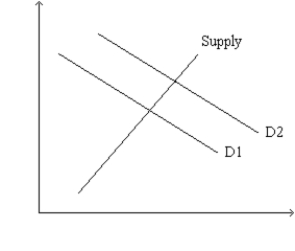 -Refer to Figure 26-2. Which of the following events would shift the demand curve from D1 to D2?
 (Multiple Choice)
4.9/5 (88)
(88) We would expect the interest rate on Bond A to be higher than the interest rate on Bond B if the two bonds have identical characteristics except that
(Multiple Choice)
4.9/5 (87)
(87) Suppose government expenditures on goods and services and net taxes both decrease, and expenditures fall by more than net taxes. The effects of these changes on the budget deficit cause
(Multiple Choice)
4.8/5 (75)
(75) Table 26-2  -Refer to Table 26-2. For which stock(s) is(are) the P/E ratio less than what is historically typical?
 (Multiple Choice)
4.7/5 (75)
(75) 
Filters
- Essay(0)
- Multiple Choice(0)
- Short Answer(0)
- True False(0)
- Matching(0)