



 Chat with AI
Exam 26: Saving, Investment, and the Financial System

Exam 1: Ten Principles of Economics439 Questions
Exam 2: Thinking Like an Economist617 Questions
Exam 3: Interdependence and the Gains From Trade527 Questions
Exam 4: The Market Forces of Supply and Demand697 Questions
Exam 5: Elasticity and Its Application594 Questions
Exam 6: Supply, Demand, and Government Policies645 Questions
Exam 7: Consumers, Producers, and the Efficiency of Markets549 Questions
Exam 8: Application: the Costs of Taxation513 Questions
Exam 9: Application: International Trade492 Questions
Exam 10: Externalities524 Questions
Exam 11: Public Goods and Common Resources433 Questions
Exam 12: The Design of the Tax System549 Questions
Exam 13: The Costs of Production420 Questions
Exam 14: Firms in Competitive Markets543 Questions
Exam 15: Monopoly637 Questions
Exam 16: Monopolistic Competition580 Questions
Exam 17: Oligopoly488 Questions
Exam 18: The Markets for the Factors of Production564 Questions
Exam 19: Earnings and Discrimination490 Questions
Exam 20: Income Inequality and Poverty455 Questions
Exam 21: The Theory of Consumer Choice431 Questions
Exam 22: Frontiers of Microeconomics440 Questions
Exam 23: Measuring a Nations Income520 Questions
Exam 24: Measuring the Cost of Living529 Questions
Exam 25: Production and Growth505 Questions
Exam 26: Saving, Investment, and the Financial System564 Questions
Exam 27: The Basic Tools of Finance500 Questions
Exam 28: Unemployment678 Questions
Exam 29: The Monetary System515 Questions
Exam 30: Money Growth and Inflation481 Questions
Exam 31: Open-Economy Macroeconomics: Basic Concepts522 Questions
Exam 32: A Macroeconomic Theory of the Open Economy475 Questions
Exam 33: Aggregate Demand and Aggregate Supply562 Questions
Exam 34: The Influence of Monetary and Fiscal Policy on Aggregate Demand508 Questions
Exam 35: The Short-Run Trade-Off Between Inflation and Unemployment491 Questions
Exam 36: Six Debates Over Macroeconomic Policy372 Questions
Select questions type


An increase in the budget deficit shifts the demand for loanable funds to the right.
(True/False)
4.9/5  (85)
(85) Suppose the government were to replace the income tax with a consumption tax so that interest on savings was not taxed. The result would be that the interest rate
(Multiple Choice)
4.9/5 (80)
(80) Figure 26-1. The figure depicts a demand-for-loanable-funds curve and two supply-of-loanable-funds curves. 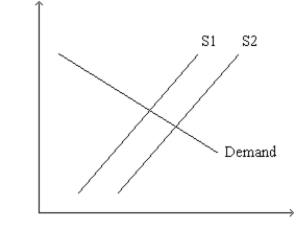 -Refer to Figure 26-1. What is measured along the vertical axis of the graph?
 (Multiple Choice)
4.8/5 (71)
(71) What would happen in the market for loanable funds if the government were to decrease the tax rate on interest income?
(Multiple Choice)
4.9/5 (89)
(89) If the nominal interest rate is 3 percent and the inflation rate is 4 percent, then the real interest rate is
(Multiple Choice)
4.8/5 (82)
(82) The country of Yokovia does not trade with any other country. Its GDP is $20 billion. Its government collects $2 billion in taxes. Consumption equals $15 billion and investment equals $2 billion. What is public saving in Yokovia, and what is the value of the goods and services purchased by the government of Yokovia?
(Multiple Choice)
4.8/5 (75)
(75) If Huedepool Beer runs into financial difficulty, the stockholders as
(Multiple Choice)
4.8/5 (89)
(89) We interpret the term loanable funds to mean the flow of resources available to fund private investment.
(True/False)
4.9/5 (72)
(72) What would happen in the market for loanable funds if the government were to increase the tax on interest income?
(Multiple Choice)
4.9/5 (74)
(74) Suppose a country has a larger increase in debt in 2014 than it had in 2013. Then other things the same,
(Multiple Choice)
4.8/5 (69)
(69) As chief financial officer you sell newly issued bonds on behalf of your firm. Your firm is
(Multiple Choice)
4.9/5 (77)
(77) Suppose the Congress and president decreased the maximum annual contributions limits to retirement accounts and at the same time reduced the budget deficit. What would happen to the interest rate?
(Multiple Choice)
4.8/5 (68)
(68) Jim buys a $1000 bond from ABC Company. ABC Company uses the $1000 to purchase a new piece of machinery. Whose spending would be an act of investment in the language of macroeconomics?
(Multiple Choice)
4.8/5 (87)
(87) Other things the same, the higher the rate of saving and investment in a country, the higher will be the standard of living in the future.
(True/False)
4.9/5 (81)
(81) Which government policy raises the interest rate and raises investment spending?
(Short Answer)
4.8/5 (72)
(72) A government budget deficit affects the supply of loanable funds, rather than the demand for loanable funds, because
(Multiple Choice)
4.8/5 (86)
(86) Morgan, a financial advisor, has told her clients the following things. Which of her statements is not correct?
(Multiple Choice)
4.9/5 (83)
(83) 
Filters
- Essay(0)
- Multiple Choice(0)
- Short Answer(0)
- True False(0)
- Matching(0)