



 Chat with AI
Exam 16: Monopolistic Competition

Exam 1: Ten Principles of Economics439 Questions
Exam 2: Thinking Like an Economist617 Questions
Exam 3: Interdependence and the Gains From Trade527 Questions
Exam 4: The Market Forces of Supply and Demand697 Questions
Exam 5: Elasticity and Its Application594 Questions
Exam 6: Supply, Demand, and Government Policies645 Questions
Exam 7: Consumers, Producers, and the Efficiency of Markets549 Questions
Exam 8: Application: the Costs of Taxation513 Questions
Exam 9: Application: International Trade492 Questions
Exam 10: Externalities524 Questions
Exam 11: Public Goods and Common Resources433 Questions
Exam 12: The Design of the Tax System549 Questions
Exam 13: The Costs of Production420 Questions
Exam 14: Firms in Competitive Markets543 Questions
Exam 15: Monopoly637 Questions
Exam 16: Monopolistic Competition580 Questions
Exam 17: Oligopoly488 Questions
Exam 18: The Markets for the Factors of Production564 Questions
Exam 19: Earnings and Discrimination490 Questions
Exam 20: Income Inequality and Poverty455 Questions
Exam 21: The Theory of Consumer Choice431 Questions
Exam 22: Frontiers of Microeconomics440 Questions
Exam 23: Measuring a Nations Income520 Questions
Exam 24: Measuring the Cost of Living529 Questions
Exam 25: Production and Growth505 Questions
Exam 26: Saving, Investment, and the Financial System564 Questions
Exam 27: The Basic Tools of Finance500 Questions
Exam 28: Unemployment678 Questions
Exam 29: The Monetary System515 Questions
Exam 30: Money Growth and Inflation481 Questions
Exam 31: Open-Economy Macroeconomics: Basic Concepts522 Questions
Exam 32: A Macroeconomic Theory of the Open Economy475 Questions
Exam 33: Aggregate Demand and Aggregate Supply562 Questions
Exam 34: The Influence of Monetary and Fiscal Policy on Aggregate Demand508 Questions
Exam 35: The Short-Run Trade-Off Between Inflation and Unemployment491 Questions
Exam 36: Six Debates Over Macroeconomic Policy372 Questions
Select questions type


Figure 16-4  -Refer to Figure 16-4. Assume the firm in the figure is currently producing 20 units of output and charging $925. The firm
 (Multiple Choice)
4.8/5  (85)
(85) Which of the following goods are likely to be sold in a monopolistically competitive market?
(Multiple Choice)
4.7/5 (80)
(80) Economists measure a market's domination by a small number of firms with a statistic called the
(Short Answer)
4.9/5 (77)
(77) Entry and exit drive each firm in a monopolistically competitive market to a point of tangency between its
(Multiple Choice)
4.7/5 (87)
(87) When a profit-maximizing firm in a monopolistically competitive market is producing the long-run equilibrium quantity,
(Multiple Choice)
4.9/5 (85)
(85) The government of Italy will not allow any Hard Rock Cafe restaurants to open in Italy. Defenders of the efficiency of brand-name markets would argue that this has hindered restaurant market efficiency in Italy.
(True/False)
4.8/5 (91)
(91) In a long-run equilibrium, a firm in a monopolistically competitive market operates
(Multiple Choice)
4.8/5 (74)
(74) Figure 16-5  -Refer to Figure 16-5. Panel a shows a profit-maximizing monopolistically competitive firm that is
 (Multiple Choice)
4.8/5 (85)
(85) Table 16-2
The following table shows the total output produced by the top six firms as well as the total industry output for each industry. 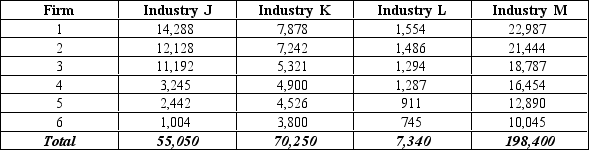 -Refer to Table 16-2. What is the concentration ratio for Industry M?
 (Multiple Choice)
4.8/5 (77)
(77) The traditional view of monopolistic competition holds that this type of industrial structure is inefficient because
(Multiple Choice)
4.9/5 (84)
(84) Figure 16-5
-Refer to Figure 16-5. Which of the graphs depicts a short-run equilibrium that will encourage the exit of some firms from a monopolistically competitive industry?
-Refer to Figure 16-5. Which of the graphs depicts a short-run equilibrium that will encourage the exit of some firms from a monopolistically competitive industry? (Multiple Choice)
4.7/5 (80)
(80) For a profit-maximizing monopolistically competitive firm, marginal revenue exceeds marginal cost in
(Multiple Choice)
4.9/5 (80)
(80) Professional organizations (for example, the American Medical Association and the American Bar Association) have been active advocates for regulation to restrict the right of professionals to advertise. Describe what economic incentives might exist for existing professionals to restrict advertising.
(Essay)
5.0/5 (81)
(81) Figure 16-3
This figure depicts a situation in a monopolistically competitive market.  -Refer to Figure 16-3. What is the profit-maximizing price, quantity, and resulting profit?
 (Multiple Choice)
4.8/5 (75)
(75) Figure 16-13  -Refer to Figure 16-13. Use the letters to identify the deadweight loss associated with this firm's profitmaximizing production.
 (Short Answer)
4.9/5 (85)
(85) Table 16-3
The following table shows the output produced by each of the top eight firms in four industries as well as the total industry output for those industries. 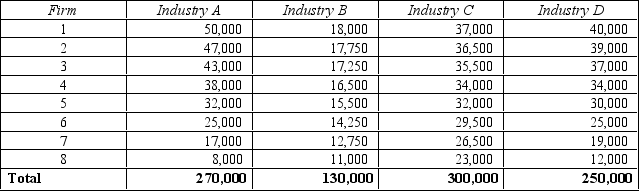 -Refer to Table 16-3. Which industry has the highest concentration ratio?
 (Multiple Choice)
4.8/5 (85)
(85) A monopolistically competitive market has characteristics that are similar to
(Multiple Choice)
4.9/5 (83)
(83) Figure 16-13
-Refer to Figure 16-13. Which letter represents the profit-maximizing quantity?
-Refer to Figure 16-13. Which letter represents the profit-maximizing quantity? (Short Answer)
5.0/5 (74)
(74) One key difference between an oligopoly market and a competitive market is that oligopolistic firms
(Multiple Choice)
4.8/5 (81)
(81) Scenario 16-4
Delish, a moderately priced restaurant, has recently announced intentions to open a restaurant in Boston, MA. Assume that the restaurant market in Boston is characterized by monopolistic competition.
-Refer to Scenario 16-4. As a result of the new restaurant, diners in Boston are likely to experience a
(Multiple Choice)
4.8/5 (82)
(82) 
Filters
- Essay(0)
- Multiple Choice(0)
- Short Answer(0)
- True False(0)
- Matching(0)