



 Chat with AI
Exam 16: Monopolistic Competition

Exam 1: Ten Principles of Economics439 Questions
Exam 2: Thinking Like an Economist617 Questions
Exam 3: Interdependence and the Gains From Trade527 Questions
Exam 4: The Market Forces of Supply and Demand697 Questions
Exam 5: Elasticity and Its Application594 Questions
Exam 6: Supply, Demand, and Government Policies645 Questions
Exam 7: Consumers, Producers, and the Efficiency of Markets549 Questions
Exam 8: Application: the Costs of Taxation513 Questions
Exam 9: Application: International Trade492 Questions
Exam 10: Externalities524 Questions
Exam 11: Public Goods and Common Resources433 Questions
Exam 12: The Design of the Tax System549 Questions
Exam 13: The Costs of Production420 Questions
Exam 14: Firms in Competitive Markets543 Questions
Exam 15: Monopoly637 Questions
Exam 16: Monopolistic Competition580 Questions
Exam 17: Oligopoly488 Questions
Exam 18: The Markets for the Factors of Production564 Questions
Exam 19: Earnings and Discrimination490 Questions
Exam 20: Income Inequality and Poverty455 Questions
Exam 21: The Theory of Consumer Choice431 Questions
Exam 22: Frontiers of Microeconomics440 Questions
Exam 23: Measuring a Nations Income520 Questions
Exam 24: Measuring the Cost of Living529 Questions
Exam 25: Production and Growth505 Questions
Exam 26: Saving, Investment, and the Financial System564 Questions
Exam 27: The Basic Tools of Finance500 Questions
Exam 28: Unemployment678 Questions
Exam 29: The Monetary System515 Questions
Exam 30: Money Growth and Inflation481 Questions
Exam 31: Open-Economy Macroeconomics: Basic Concepts522 Questions
Exam 32: A Macroeconomic Theory of the Open Economy475 Questions
Exam 33: Aggregate Demand and Aggregate Supply562 Questions
Exam 34: The Influence of Monetary and Fiscal Policy on Aggregate Demand508 Questions
Exam 35: The Short-Run Trade-Off Between Inflation and Unemployment491 Questions
Exam 36: Six Debates Over Macroeconomic Policy372 Questions
Select questions type


Figure 16-2. The figure is drawn for a monopolistically competitive firm.  -Refer to Figure 16-2. If the average total cost is $30 at the profitmaximizing quantity, then the firm's maximum profit is
 (Multiple Choice)
4.7/5  (82)
(82) The free entry and exit of firms in a monopolistically competitive market guarantees that
(Multiple Choice)
4.8/5 (68)
(68) A firm maximizes its profit by producing output up to the point where marginal revenue equals marginal cost
(Multiple Choice)
4.9/5 (76)
(76) Excess capacity characterizes firms in monopolistically competitive markets, even in situations of long-run equilibrium.
(True/False)
4.7/5 (88)
(88) Figure 16-13  -Refer to Figure 16-13. What is the first step in this industry's adjustment to long run equilibrium?
 (Short Answer)
4.9/5 (89)
(89) When a firm operates with excess capacity, it must be in a monopolistically competitive market.
(True/False)
4.7/5 (79)
(79) What is meant by the term "excess capacity" as it relates to monopolistically competitive firms?
(Essay)
4.7/5 (81)
(81) In monopolistically competitive markets, positive economic profits
(Multiple Choice)
4.9/5 (70)
(70) A new Mexican restaurant opens in the city of Manchester. The residents are happy about this new restaurant because they are experiencing what externality?
(Short Answer)
4.8/5 (98)
(98) Table 16-6
Beatrice's Birthday Cakes is one bakery among many in the market for birthday cakes. The following table presents cost and revenue data for birthday cakes at Beatrice's.  -Refer to Table 16-6. At the profitmaximizing quantity, what is Beatrice's total profit?
 (Multiple Choice)
4.8/5 (74)
(74) When a profit-maximizing firm in a monopolistically competitive market charges a price higher than marginal cost,
(Multiple Choice)
4.9/5 (83)
(83) Table 16-1
The following table shows the percentage of output supplied by the top eight firms in four different industries. 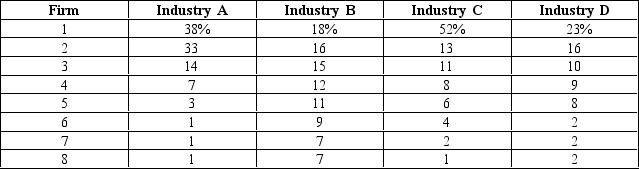 -Refer to Table 16-1. Which industry has the lowest concentration ratio?
 (Multiple Choice)
4.8/5 (79)
(79) Defenders of advertising argue that firms use advertising as a signal of quality, even if the advertising delivers little helpful information about the product.
(True/False)
4.8/5 (76)
(76) Which of the following industries has the lowest concentration ratio?
(Multiple Choice)
4.8/5 (79)
(79) If there are many firms participating in a market, the market is either
(Multiple Choice)
4.8/5 (82)
(82) Figure 16-14  -Refer to Figure 16-14. If this firm were operating in a perfectly competitive market, it would charge a price equal to point
 (Multiple Choice)
4.9/5 (78)
(78) Piper consumes Ragu spaghetti sauce exclusively. She claims that there is a clear taste difference and that competing brands of spaghetti sauce leave an unsavory taste in her mouth. However, in a blind taste test, Piper is found to prefer generic store-brand spaghetti sauce to Ragu spaghetti sauce eight out of ten times. The results of Piper's taste test would reinforce claims by critics of brand names that
(Multiple Choice)
4.8/5 (70)
(70) A profit-maximizing firm in a monopolistically competitive market is characterized by which of the following?
(Multiple Choice)
4.8/5 (84)
(84) 
Filters
- Essay(0)
- Multiple Choice(0)
- Short Answer(0)
- True False(0)
- Matching(0)