



 Chat with AI
Exam 16: Monopolistic Competition

Exam 1: Ten Principles of Economics439 Questions
Exam 2: Thinking Like an Economist617 Questions
Exam 3: Interdependence and the Gains From Trade527 Questions
Exam 4: The Market Forces of Supply and Demand697 Questions
Exam 5: Elasticity and Its Application594 Questions
Exam 6: Supply, Demand, and Government Policies645 Questions
Exam 7: Consumers, Producers, and the Efficiency of Markets549 Questions
Exam 8: Application: the Costs of Taxation513 Questions
Exam 9: Application: International Trade492 Questions
Exam 10: Externalities524 Questions
Exam 11: Public Goods and Common Resources433 Questions
Exam 12: The Design of the Tax System549 Questions
Exam 13: The Costs of Production420 Questions
Exam 14: Firms in Competitive Markets543 Questions
Exam 15: Monopoly637 Questions
Exam 16: Monopolistic Competition580 Questions
Exam 17: Oligopoly488 Questions
Exam 18: The Markets for the Factors of Production564 Questions
Exam 19: Earnings and Discrimination490 Questions
Exam 20: Income Inequality and Poverty455 Questions
Exam 21: The Theory of Consumer Choice431 Questions
Exam 22: Frontiers of Microeconomics440 Questions
Exam 23: Measuring a Nations Income520 Questions
Exam 24: Measuring the Cost of Living529 Questions
Exam 25: Production and Growth505 Questions
Exam 26: Saving, Investment, and the Financial System564 Questions
Exam 27: The Basic Tools of Finance500 Questions
Exam 28: Unemployment678 Questions
Exam 29: The Monetary System515 Questions
Exam 30: Money Growth and Inflation481 Questions
Exam 31: Open-Economy Macroeconomics: Basic Concepts522 Questions
Exam 32: A Macroeconomic Theory of the Open Economy475 Questions
Exam 33: Aggregate Demand and Aggregate Supply562 Questions
Exam 34: The Influence of Monetary and Fiscal Policy on Aggregate Demand508 Questions
Exam 35: The Short-Run Trade-Off Between Inflation and Unemployment491 Questions
Exam 36: Six Debates Over Macroeconomic Policy372 Questions
Select questions type


Figure 16-13 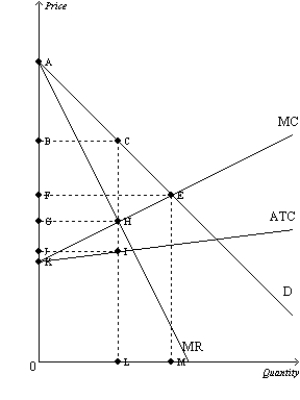 -Refer to Figure 16-13. Which of the following areas represents the profit for this profit maximizing monopolistically competitive firm?
 (Multiple Choice)
4.8/5  (82)
(82) The "monopoly" in monopolistically competitive markets is most likely a result of firms having some pricing power due to product differentiation.
(True/False)
4.9/5 (88)
(88) A monopolistically competitive firm is currently earning a positive economic profit. If other firms enter the market, we would expect that the added competition will cause this firm to adjust its output such that it
(Multiple Choice)
4.8/5 (89)
(89) When a profit-maximizing firm in a monopolistically competitive market is in long-run equilibrium, marginal cost must lie below average total cost.
(True/False)
4.9/5 (83)
(83) Which market structure(s) is(are) considered highly concentrated?
(Short Answer)
4.9/5 (83)
(83) Each firm in a monopolistically competitive industry faces a downward-sloping demand curve because
(Multiple Choice)
4.9/5 (81)
(81) Which of these types of firms can earn a positive economic profit in the long run?
(Multiple Choice)
4.8/5 (73)
(73) AllClean knows that it produces and sells very effective laundry detergent. NotQuiteWhite knows that it produces and sells ineffective laundry detergent. According to the signaling theory of advertising,
(Multiple Choice)
4.8/5 (77)
(77) A monopolistically competitive market could be considered inefficient because
(Multiple Choice)
4.8/5 (76)
(76) Table 16-7
A monopolistically competitive firm faces the following demand schedule for its product. In addition, the firm has total fixed costs equal to 20.  -Refer to Table 16-7. If the firm produces its profit-maximizing level of output and there is a constant marginal cost of $7 per unit, which of the following is correct?
 (Multiple Choice)
4.9/5 (74)
(74) Scenario 16-8
Burger Bonanza, a major national burger chain, recently decided to spend $4 million on an advertising campaign featuring a world famous actor to promote its new Bomber Burger.
-Refer to Scenario 16-8. What two benefits are conveyed by the brand name Burger Bonanza?
(Essay)
4.8/5 (82)
(82) When a new firm enters a monopolistically competitive market, the individual demand curves faced by all existing firms in that market will
(Multiple Choice)
4.8/5 (75)
(75) A monopolistically competitive market is like a competitive market in that
(Multiple Choice)
4.7/5 (87)
(87) Suppose that monopolistically competitive firms in a certain market are earning positive profits. In the transition from this initial situation to a long-run equilibrium,
(Multiple Choice)
4.9/5 (76)
(76) In a monopolistically competitive industry, a firm's demand curve also represent its
(Multiple Choice)
4.9/5 (86)
(86) Table 16-1
The following table shows the percentage of output supplied by the top eight firms in four different industries.  -Refer to Table 16-1. What is the concentration ratio in Industry B?
 (Multiple Choice)
5.0/5 (81)
(81) Joe's Juice Shop operates in a monopolistically competitive market. Joe's is currently producing where its average total cost is minimized. In the long run we would expect Joe's output to
(Multiple Choice)
4.9/5 (82)
(82) Monopolistic competition is considered inefficient because
(Multiple Choice)
5.0/5 (91)
(91) 
Filters
- Essay(0)
- Multiple Choice(0)
- Short Answer(0)
- True False(0)
- Matching(0)