



 Chat with AI
Exam 14: Firms in Competitive Markets

Exam 1: Ten Principles of Economics439 Questions
Exam 2: Thinking Like an Economist617 Questions
Exam 3: Interdependence and the Gains From Trade527 Questions
Exam 4: The Market Forces of Supply and Demand697 Questions
Exam 5: Elasticity and Its Application594 Questions
Exam 6: Supply, Demand, and Government Policies645 Questions
Exam 7: Consumers, Producers, and the Efficiency of Markets549 Questions
Exam 8: Application: the Costs of Taxation513 Questions
Exam 9: Application: International Trade492 Questions
Exam 10: Externalities524 Questions
Exam 11: Public Goods and Common Resources433 Questions
Exam 12: The Design of the Tax System549 Questions
Exam 13: The Costs of Production420 Questions
Exam 14: Firms in Competitive Markets543 Questions
Exam 15: Monopoly637 Questions
Exam 16: Monopolistic Competition580 Questions
Exam 17: Oligopoly488 Questions
Exam 18: The Markets for the Factors of Production564 Questions
Exam 19: Earnings and Discrimination490 Questions
Exam 20: Income Inequality and Poverty455 Questions
Exam 21: The Theory of Consumer Choice431 Questions
Exam 22: Frontiers of Microeconomics440 Questions
Exam 23: Measuring a Nations Income520 Questions
Exam 24: Measuring the Cost of Living529 Questions
Exam 25: Production and Growth505 Questions
Exam 26: Saving, Investment, and the Financial System564 Questions
Exam 27: The Basic Tools of Finance500 Questions
Exam 28: Unemployment678 Questions
Exam 29: The Monetary System515 Questions
Exam 30: Money Growth and Inflation481 Questions
Exam 31: Open-Economy Macroeconomics: Basic Concepts522 Questions
Exam 32: A Macroeconomic Theory of the Open Economy475 Questions
Exam 33: Aggregate Demand and Aggregate Supply562 Questions
Exam 34: The Influence of Monetary and Fiscal Policy on Aggregate Demand508 Questions
Exam 35: The Short-Run Trade-Off Between Inflation and Unemployment491 Questions
Exam 36: Six Debates Over Macroeconomic Policy372 Questions
Select questions type


In the short run, there are 500 identical firms in a competitive market. The firms do not use any resources that are available in limited quantities, and each of them has the following cost structure: 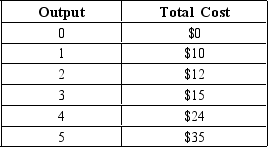 Which of the following is a point on the long-run supply curve?
 (Multiple Choice)
4.9/5  (80)
(80) Consider a firm operating in a competitive market. The firm is producing 40 units of output, has an average total cost of production equal to $5, and is earning $240 economic profit in the short run. What is the current market price?
(Multiple Choice)
4.8/5 (66)
(66) Table 14-14
The following table presents cost and revenue information for Bob's bakery production and sales.  -Refer to Table 14-14. Suppose that due to a decrease in the market demand for bread the market price of bread drops to $2.75. At this new price, if Bob produces and sells the profit-maximizing quantity, how much profit will he earn?
 (Multiple Choice)
4.9/5 (86)
(86) Which of the following statements regarding a competitive market is not correct?
(Multiple Choice)
4.9/5 (71)
(71) Table 14-9
Suppose that a firm in a competitive market faces the following revenues and costs:  -Refer to Table 14-9. In order to maximize profit, the firm will produce a level of output where marginal cost is equal to
 (Multiple Choice)
4.8/5 (83)
(83) The short-run market supply curve in a perfectly competitive industry
(Multiple Choice)
4.9/5 (81)
(81) Table 14-11
Suppose that a firm in a competitive market faces the following prices and costs:  -Refer to Table 14-11. In order to maximize profits, the firm should stop producing after it makes the
 (Multiple Choice)
4.7/5 (78)
(78) When fixed costs are ignored because they are irrelevant to a business's production decision, they are called
(Multiple Choice)
4.8/5 (75)
(75) Firms operating in perfectly competitive markets produce an output level where marginal revenue equals marginal cost.
(True/False)
4.9/5 (79)
(79) When total revenue is less than variable costs, a firm in a competitive market will
(Multiple Choice)
4.8/5 (83)
(83) As a general rule, when accountants calculate profit they account for explicit costs but usually ignore
(Multiple Choice)
4.9/5 (91)
(91) Robin owns a horse stables and riding academy and gives riding lessons for children at "pony camp." Her business operates in a competitive industry. Robin gives riding lessons to 20 children per month. Her monthly total revenue is $4,000. The marginal cost of pony camp is $100 per child. In order to maximize profits, Robin should
(Multiple Choice)
4.8/5 (84)
(84) Table 14-2
The table represents a demand curve faced by a firm in a competitive market.  -Refer to Table 14-2. For this firm, the average revenue from selling 3 units is
(Multiple Choice)
4.7/5 (76)
(76) In the long run, each firm in a competitive industry earns
(Multiple Choice)
4.9/5 (76)
(76) Figure 14-1
Suppose that a firm in a competitive market has the following cost curves:  -Refer to Figure 14-1. If the market price is $4.00, the firm will earn
 (Multiple Choice)
4.8/5 (80)
(80) Figure 14-3
Suppose a firm operating in a competitive market has the following cost curves:  -Refer to Figure 14-3. If the market price is $6, what is the firm's shortrun economic profit?
 (Multiple Choice)
4.8/5 (86)
(86) Phil sells duck calls in a perfectly competitive market. If duck calls sell for $10 each and average total cost per unit is $11 at the profit-maximizing output level, then in the long run
(Multiple Choice)
4.8/5 (75)
(75) Scenario 14-4
The information below applies to a competitive firm that sells its output for $40 per unit.
-When the firm produces and sells 150 units of output, its average total cost is $24.50.
-When the firm produces and sells 151 units of output, its average total cost is $24.55.
-Refer to Scenario 14-4. When the firm increases its output from 150 units to 151 units, its profit
(Multiple Choice)
4.8/5 (76)
(76) Figure 14-1
Suppose that a firm in a competitive market has the following cost curves:
-Refer to Figure 14-1. The firm will earn a positive economic profit in the short run if the market price is
-Refer to Figure 14-1. The firm will earn a positive economic profit in the short run if the market price is (Multiple Choice)
4.8/5 (78)
(78) A firm operating in a competitive market will stay in business in the short run so long as the market price exceeds the firm's average total cost; otherwise, the firm will shut down.
(True/False)
4.8/5 (81)
(81) 
Filters
- Essay(0)
- Multiple Choice(0)
- Short Answer(0)
- True False(0)
- Matching(0)