



 Chat with AI
Exam 16: The Monetary System

Exam 1: Ten Principles of Economics438 Questions
Exam 2: Thinking Like an Economist620 Questions
Exam 3: Interdependence and the Gains From Trade527 Questions
Exam 4: The Market Forces of Supply and Demand700 Questions
Exam 5: Elasticity and Its Application598 Questions
Exam 6: Supply, Demand, and Government Policies648 Questions
Exam 7: Consumers, Producers, and the Efficiency of Markets547 Questions
Exam 8: Application: the Costs of Taxation514 Questions
Exam 9: Application: International Trade496 Questions
Exam 10: Measuring a Nations Income522 Questions
Exam 11: Measuring the Cost of Living545 Questions
Exam 12: Production and Growth507 Questions
Exam 13: Saving, Investment, and the Financial System567 Questions
Exam 14: The Basic Tools of Finance513 Questions
Exam 15: Unemployment699 Questions
Exam 16: The Monetary System517 Questions
Exam 17: Money Growth and Inflation487 Questions
Exam 18: Open-Economy Macroeconomics: Basic Concepts522 Questions
Exam 19: A Macroeconomic Theory of the Open Economy484 Questions
Exam 20: Aggregate Demand and Aggregate Supply563 Questions
Exam 21: The Influence of Monetary and Fiscal Policy on Aggregate Demand511 Questions
Exam 22: The Short-Run Trade-Off Between Inflation and Unemployment516 Questions
Exam 23: Six Debates Over Macroeconomic Policy372 Questions
Select questions type


Who was reappointed Chair of the Board of Governors in 2009 by President Barrack Obama?
(Multiple Choice)
4.9/5  (70)
(70) Which of the following will not help to prevent bank runs?
(Multiple Choice)
4.8/5 (78)
(78) Sandra routinely uses currency to purchase her groceries. She is using money as a medium of exchange.
(True/False)
4.9/5 (76)
(76) Which of the following statements regarding the Federal Open Market Committee is correct?
(Multiple Choice)
4.8/5 (80)
(80) A bank operates with reserves of $100, loans of $300 and securities of $100. The bank's only liability is deposits of $400 since it has zero debt. Calculate the bank's leverage ratio.
(Essay)
4.9/5 (70)
(70) Other things the same if reserve requirements are decreased, the reserve ratio
(Multiple Choice)
4.8/5 (80)
(80) In a fractional-reserve banking system, a decrease in reserve requirements
(Multiple Choice)
4.8/5 (83)
(83) The reserve ratio is 10 percent, banks do not hold excess reserves, and people hold only deposits and no currency. When the Fed sells $20 million worth of bonds to the public, bank reserves
(Multiple Choice)
4.9/5 (87)
(87) Economists argue that the move from barter to money increased trade and production. How is this possible?
(Essay)
4.9/5 (83)
(83) Table 29-1.
The information in the table pertains to an imaginary economy.
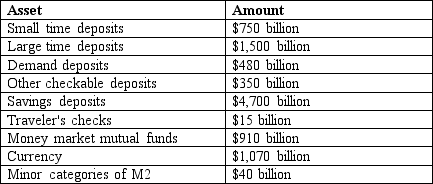 -Refer to Table 29-1. What is the value of M2 in billions of dollars?
 (Multiple Choice)
4.9/5 (78)
(78) A bank which must hold 100 percent reserves opens in an economy that had no banks and a currency of $150. If customers deposit $50 into the bank, what is the value of the money supply?
(Multiple Choice)
4.8/5 (78)
(78) If the public decides to hold less currency and more deposits in banks, bank reserves
(Multiple Choice)
4.9/5 (77)
(77) Table 29-5.
 -Refer to Table 29-5. If the bank faces a reserve requirement of 20 percent, then it
 (Multiple Choice)
4.8/5 (74)
(74) 
Filters
- Essay(0)
- Multiple Choice(0)
- Short Answer(0)
- True False(0)
- Matching(0)