



 Chat with AI
Exam 16: The Monetary System

Exam 1: Ten Principles of Economics438 Questions
Exam 2: Thinking Like an Economist620 Questions
Exam 3: Interdependence and the Gains From Trade527 Questions
Exam 4: The Market Forces of Supply and Demand700 Questions
Exam 5: Elasticity and Its Application598 Questions
Exam 6: Supply, Demand, and Government Policies648 Questions
Exam 7: Consumers, Producers, and the Efficiency of Markets547 Questions
Exam 8: Application: the Costs of Taxation514 Questions
Exam 9: Application: International Trade496 Questions
Exam 10: Measuring a Nations Income522 Questions
Exam 11: Measuring the Cost of Living545 Questions
Exam 12: Production and Growth507 Questions
Exam 13: Saving, Investment, and the Financial System567 Questions
Exam 14: The Basic Tools of Finance513 Questions
Exam 15: Unemployment699 Questions
Exam 16: The Monetary System517 Questions
Exam 17: Money Growth and Inflation487 Questions
Exam 18: Open-Economy Macroeconomics: Basic Concepts522 Questions
Exam 19: A Macroeconomic Theory of the Open Economy484 Questions
Exam 20: Aggregate Demand and Aggregate Supply563 Questions
Exam 21: The Influence of Monetary and Fiscal Policy on Aggregate Demand511 Questions
Exam 22: The Short-Run Trade-Off Between Inflation and Unemployment516 Questions
Exam 23: Six Debates Over Macroeconomic Policy372 Questions
Select questions type


The Soviet government in the 1980's never abandoned the ruble as the official currency. However, the people of Moscow preferred to accept
(Multiple Choice)
5.0/5  (78)
(78) If the reserve requirement is 10 percent, a bank desires to hold no excess reserves, and it receives a new deposit of $500, it
(Multiple Choice)
4.8/5 (79)
(79) If the reserve ratio is 4 percent, then $81,250 of new money can be generated by
(Multiple Choice)
4.8/5 (80)
(80) The manager of the bank where you work tells you that your bank has $6 million in excess reserves. She also tells you that the bank has $400 million in deposits and $362 million dollars in loans. Given this information you find that the reserve requirement must be
(Multiple Choice)
4.8/5 (82)
(82) Scenario 29-1.
The monetary policy of Namdian is determined by the Namdian Central Bank. The local currency is the dia. Namdian banks collectively hold 100 million dias of required reserves, 25 million dias of excess reserves, 250 million dias of Namdian Treasury Bonds, and their customers hold 1,000 million dias of deposits. Namdians prefer to use only demand deposits and so the money supply consists of demand deposits.
-Refer to Scenario 29-1. Assuming the only other item Namdian banks have on their balance sheets is loans, what is the value of existing loans made by Namdian banks?
(Multiple Choice)
4.8/5 (68)
(68) Suppose that in a country people gain more confidence in the banking system and so hold relatively less currency and more deposits. As a result, bank reserves will
(Multiple Choice)
4.8/5 (71)
(71) If the reserve ratio is 5 percent, then $500 of additional reserves can create up to
(Multiple Choice)
4.9/5 (78)
(78) Why is the Chairman of the Federal Reserve often referred to as the "second most powerful person in the United States?"
(Essay)
4.9/5 (80)
(80) Consider five high school students working on homework in study hall. 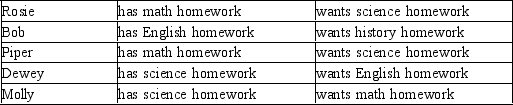 Which of the following pairs of students has a double coincidence of wants?
 (Multiple Choice)
4.9/5 (63)
(63) Consider five individuals with different occupations. 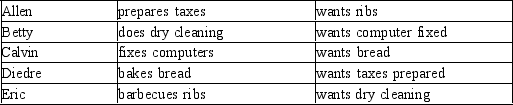 In a barter system which of the following pairs has a double coincidence of wants?
 (Multiple Choice)
4.8/5 (82)
(82) If people decide to hold less currency relative to deposits, the money supply
(Multiple Choice)
4.9/5 (73)
(73) Which of the following individuals serve a four-year term?
(Multiple Choice)
4.8/5 (74)
(74) At any given time, the voting members of the Federal Open Market Committee include
(Multiple Choice)
4.9/5 (76)
(76) 
Filters
- Essay(0)
- Multiple Choice(0)
- Short Answer(0)
- True False(0)
- Matching(0)