



 Chat with AI
Exam 16: The Monetary System

Exam 1: Ten Principles of Economics438 Questions
Exam 2: Thinking Like an Economist620 Questions
Exam 3: Interdependence and the Gains From Trade527 Questions
Exam 4: The Market Forces of Supply and Demand700 Questions
Exam 5: Elasticity and Its Application598 Questions
Exam 6: Supply, Demand, and Government Policies648 Questions
Exam 7: Consumers, Producers, and the Efficiency of Markets547 Questions
Exam 8: Application: the Costs of Taxation514 Questions
Exam 9: Application: International Trade496 Questions
Exam 10: Measuring a Nations Income522 Questions
Exam 11: Measuring the Cost of Living545 Questions
Exam 12: Production and Growth507 Questions
Exam 13: Saving, Investment, and the Financial System567 Questions
Exam 14: The Basic Tools of Finance513 Questions
Exam 15: Unemployment699 Questions
Exam 16: The Monetary System517 Questions
Exam 17: Money Growth and Inflation487 Questions
Exam 18: Open-Economy Macroeconomics: Basic Concepts522 Questions
Exam 19: A Macroeconomic Theory of the Open Economy484 Questions
Exam 20: Aggregate Demand and Aggregate Supply563 Questions
Exam 21: The Influence of Monetary and Fiscal Policy on Aggregate Demand511 Questions
Exam 22: The Short-Run Trade-Off Between Inflation and Unemployment516 Questions
Exam 23: Six Debates Over Macroeconomic Policy372 Questions
Select questions type


Scenario 29-1.
The monetary policy of Namdian is determined by the Namdian Central Bank. The local currency is the dia. Namdian banks collectively hold 100 million dias of required reserves, 25 million dias of excess reserves, 250 million dias of Namdian Treasury Bonds, and their customers hold 1,000 million dias of deposits. Namdians prefer to use only demand deposits and so the money supply consists of demand deposits.
-Refer to Scenario 29-1 . Suppose the Central Bank of Namdia purchases 25 million dias of Namdian Treasury Bonds from banks. Suppose also that both the reserve requirement and the percentage of deposits held as excess reserves stay the same. By how much would the money supply of Namdia change?
(Multiple Choice)
4.9/5  (81)
(81) One plausible explanation for the large amount of U.S. currency outstanding is that many dollars are held abroad.
(True/False)
4.9/5 (77)
(77) Table 29-1.
The information in the table pertains to an imaginary economy.
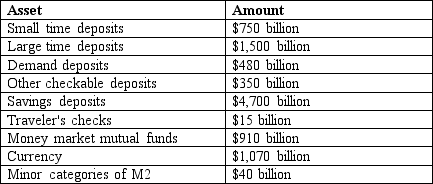 -Refer to Table 29-1. What is the value of M1 in billions of dollars?
 (Multiple Choice)
5.0/5 (74)
(74) If the public decides to hold more currency and fewer deposits in banks, bank reserves
(Multiple Choice)
5.0/5 (82)
(82) The manager of the bank where you work tells you that the bank has $300 million in deposits and $255 million dollars in loans. If the reserve requirement is 8.5 percent, how much is the bank holding in excess reserves?
(Multiple Choice)
4.8/5 (71)
(71) You use U.S. currency to pay the owner of a restaurant for a delicious meal. The currency
(Multiple Choice)
4.9/5 (70)
(70) The Federal Reserve was created in 1913 after a series of bank failures in 1907.
(True/False)
4.8/5 (88)
(88) Trace the effects on the money supply when the Fed decreases the discount rate.
(Essay)
4.9/5 (70)
(70) An increase in the money supply might indicate that the Fed had
(Multiple Choice)
4.9/5 (81)
(81) In the months of November and December, people in the United States hold a larger part of their money in the form of currency because they intend to shop and travel for the holidays. As a result, other things the same, the money supply increases.
(True/False)
4.9/5 (82)
(82) Prisoners sometimes determine a single good to be used as money. This good becomes
(Multiple Choice)
4.8/5 (93)
(93) Consider four survivors on an island.  Which of the following pairs of survivors has a double-coincidence of wants?
 (Multiple Choice)
4.8/5 (78)
(78) If the federal funds rate were below the level the Federal Reserve had targeted, the Fed could move the rate back towards its target by
(Multiple Choice)
4.9/5 (78)
(78) 
Filters
- Essay(0)
- Multiple Choice(0)
- Short Answer(0)
- True False(0)
- Matching(0)