



 Chat with AI
Exam 16: The Monetary System

Exam 1: Ten Principles of Economics438 Questions
Exam 2: Thinking Like an Economist620 Questions
Exam 3: Interdependence and the Gains From Trade527 Questions
Exam 4: The Market Forces of Supply and Demand700 Questions
Exam 5: Elasticity and Its Application598 Questions
Exam 6: Supply, Demand, and Government Policies648 Questions
Exam 7: Consumers, Producers, and the Efficiency of Markets547 Questions
Exam 8: Application: the Costs of Taxation514 Questions
Exam 9: Application: International Trade496 Questions
Exam 10: Measuring a Nations Income522 Questions
Exam 11: Measuring the Cost of Living545 Questions
Exam 12: Production and Growth507 Questions
Exam 13: Saving, Investment, and the Financial System567 Questions
Exam 14: The Basic Tools of Finance513 Questions
Exam 15: Unemployment699 Questions
Exam 16: The Monetary System517 Questions
Exam 17: Money Growth and Inflation487 Questions
Exam 18: Open-Economy Macroeconomics: Basic Concepts522 Questions
Exam 19: A Macroeconomic Theory of the Open Economy484 Questions
Exam 20: Aggregate Demand and Aggregate Supply563 Questions
Exam 21: The Influence of Monetary and Fiscal Policy on Aggregate Demand511 Questions
Exam 22: The Short-Run Trade-Off Between Inflation and Unemployment516 Questions
Exam 23: Six Debates Over Macroeconomic Policy372 Questions
Select questions type


If a bank desires to hold no excess reserves, the reserve requirement is 8 percent, and it receives a new deposit of $500,
(Multiple Choice)
4.9/5  (77)
(77) Table 29-9
Metropolis National Bank is currently holding 2% of its deposits as excess reserves.
 -Refer to Table 29-9. Metropolis National Bank is holding 2% of its deposits as excess reserves. Assume that no banks in the economy want to maintain holdings of excess reserves and that people only hold deposits and no currency. The Fed makes open market purchases of $10,000. The person who sold bonds to the Fed deposits all the funds in Metropolis National Bank. If the bank now loans out all its excess reserves, by how much will the money supply increase?
 (Multiple Choice)
4.8/5 (83)
(83) If the reserve ratio is 6 percent, then $9,000 of additional reserves can create up to
(Multiple Choice)
5.0/5 (79)
(79) Sam wants to trade eggs for sausage. Sally wants to trade sausage for eggs. Sam and Sally have a double- coincidence of wants.
(True/False)
4.8/5 (84)
(84) Table 29-4.
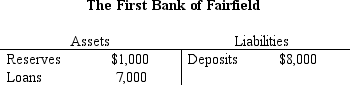 -Refer to Table 29-4. If $800 is deposited into the First Bank of Fairfield, and the bank takes no other actions, its
 (Multiple Choice)
4.9/5 (83)
(83) A bank's reserve ratio is 10 percent and the bank has $5,000 in deposits. Its reserves amount to
(Multiple Choice)
4.9/5 (84)
(84) Suppose the banking system currently has $400 billion in reserves, the reserve requirement is 8 percent, and excess reserves amount to $5 billion. What is the level of deposits?
(Multiple Choice)
4.8/5 (82)
(82) The interest rate charged by the Fed to member banks is called the .
(Essay)
4.7/5 (71)
(71) Suppose the banking system currently has $300 billion in reserves, the reserve requirement is 5 percent, and excess reserves are $30 billion. What is the level of loans?
(Multiple Choice)
4.9/5 (85)
(85) If an economy uses silver as money, then that economy's money
(Multiple Choice)
4.9/5 (84)
(84) In a fractional reserve economy where the required reserve ratio is 10%, must it be the case that an initial deposit of $100 increases the total money supply by $1,000? Explain.
(Essay)
4.8/5 (78)
(78) The Fed can decrease the money supply by conducting open-market
(Multiple Choice)
4.7/5 (74)
(74) 
Filters
- Essay(0)
- Multiple Choice(0)
- Short Answer(0)
- True False(0)
- Matching(0)