



 Chat with AI
Exam 16: The Monetary System

Exam 1: Ten Principles of Economics438 Questions
Exam 2: Thinking Like an Economist620 Questions
Exam 3: Interdependence and the Gains From Trade527 Questions
Exam 4: The Market Forces of Supply and Demand700 Questions
Exam 5: Elasticity and Its Application598 Questions
Exam 6: Supply, Demand, and Government Policies648 Questions
Exam 7: Consumers, Producers, and the Efficiency of Markets547 Questions
Exam 8: Application: the Costs of Taxation514 Questions
Exam 9: Application: International Trade496 Questions
Exam 10: Measuring a Nations Income522 Questions
Exam 11: Measuring the Cost of Living545 Questions
Exam 12: Production and Growth507 Questions
Exam 13: Saving, Investment, and the Financial System567 Questions
Exam 14: The Basic Tools of Finance513 Questions
Exam 15: Unemployment699 Questions
Exam 16: The Monetary System517 Questions
Exam 17: Money Growth and Inflation487 Questions
Exam 18: Open-Economy Macroeconomics: Basic Concepts522 Questions
Exam 19: A Macroeconomic Theory of the Open Economy484 Questions
Exam 20: Aggregate Demand and Aggregate Supply563 Questions
Exam 21: The Influence of Monetary and Fiscal Policy on Aggregate Demand511 Questions
Exam 22: The Short-Run Trade-Off Between Inflation and Unemployment516 Questions
Exam 23: Six Debates Over Macroeconomic Policy372 Questions
Select questions type


If you deposit $100 of currency into a demand deposit at a bank, this action by itself
(Multiple Choice)
4.9/5  (71)
(71) Table 29-4.
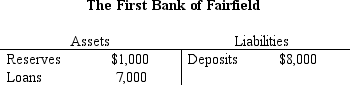 -Refer to Table 29-4. Starting from the situation as depicted by the T-account, if someone deposits $500 into the First Bank of Fairfield, and if the bank makes new loans so as to keep its reserve ratio unchanged, then the amount of new loans that it makes will be
 (Multiple Choice)
4.9/5 (82)
(82) When the Federal Reserve sells assets from its portfolio to the public with the intent of changing the money supply,
(Multiple Choice)
4.9/5 (90)
(90) The money multiplier equals 1/1 - R), where R represents the reserve ratio.
(True/False)
4.9/5 (76)
(76) The set of items that serve as media of exchange clearly includes
(Multiple Choice)
4.8/5 (73)
(73) According to economists, "money" means the same thing as "wealth".
(True/False)
4.9/5 (81)
(81) Table 29-9
Metropolis National Bank is currently holding 2% of its deposits as excess reserves.
 -Refer to Table 29-9. Metropolis National Bank is currently holding 2% of deposits as excess reserves. What is the reserve requirement?
 (Multiple Choice)
4.9/5 (75)
(75) Marc puts prices on surfboards and skateboards at his sporting goods store. He is using money as a unit of account.
(True/False)
4.9/5 (68)
(68) During recessions, banks typically choose to hold more excess reserves relative to their deposits. This action
(Multiple Choice)
4.9/5 (80)
(80) If the reserve ratio is 5 percent, then $1,000 of additional reserves can create up to
(Multiple Choice)
4.9/5 (77)
(77) Explain why banks can influence the money supply if the required reserve ratio is less than 100 percent.
(Essay)
4.8/5 (72)
(72) First National Bank FNB) has a reserve ratio of 20 percent, a required reserve ratio of 10 percent, and deposits of $1,000. If FNB receives an additional deposit of $100,
(Multiple Choice)
4.8/5 (81)
(81) 
Filters
- Essay(0)
- Multiple Choice(0)
- Short Answer(0)
- True False(0)
- Matching(0)