



 Chat with AI
Exam 16: The Monetary System

Exam 1: Ten Principles of Economics438 Questions
Exam 2: Thinking Like an Economist620 Questions
Exam 3: Interdependence and the Gains From Trade527 Questions
Exam 4: The Market Forces of Supply and Demand700 Questions
Exam 5: Elasticity and Its Application598 Questions
Exam 6: Supply, Demand, and Government Policies648 Questions
Exam 7: Consumers, Producers, and the Efficiency of Markets547 Questions
Exam 8: Application: the Costs of Taxation514 Questions
Exam 9: Application: International Trade496 Questions
Exam 10: Measuring a Nations Income522 Questions
Exam 11: Measuring the Cost of Living545 Questions
Exam 12: Production and Growth507 Questions
Exam 13: Saving, Investment, and the Financial System567 Questions
Exam 14: The Basic Tools of Finance513 Questions
Exam 15: Unemployment699 Questions
Exam 16: The Monetary System517 Questions
Exam 17: Money Growth and Inflation487 Questions
Exam 18: Open-Economy Macroeconomics: Basic Concepts522 Questions
Exam 19: A Macroeconomic Theory of the Open Economy484 Questions
Exam 20: Aggregate Demand and Aggregate Supply563 Questions
Exam 21: The Influence of Monetary and Fiscal Policy on Aggregate Demand511 Questions
Exam 22: The Short-Run Trade-Off Between Inflation and Unemployment516 Questions
Exam 23: Six Debates Over Macroeconomic Policy372 Questions
Select questions type


If the reserve ratio is 20 percent, then $100 of new reserves can generate
(Multiple Choice)
4.8/5  (79)
(79) The series of bank failures in 1907 occurred despite the creation of the Federal Reserve many years earlier.
(True/False)
5.0/5 (88)
(88) Which of the following can the Fed do to change the money supply?
(Multiple Choice)
4.9/5 (75)
(75) If the reserve ratio is 15 percent, and banks do not hold excess reserves, and people hold only deposits and no currency, then when the Fed sells $25.5 million worth of bonds to the public, bank reserves
(Multiple Choice)
4.9/5 (67)
(67) If the reserve ratio is 12.5 percent, then $2,000 of additional reserves can create up to
(Multiple Choice)
4.9/5 (74)
(74) Are credit cards and debit cards money? What's the difference between credit and debit cards?
(Essay)
4.8/5 (87)
(87) What is the change in the money supply when the Fed purchases $700 worth of bonds and the required reserve ratio is 14 percent assuming banks hold no excess reserves?
(Essay)
4.8/5 (84)
(84) Suppose banks decide to hold more excess reserves relative to deposits. Other things the same, this action will cause the
(Multiple Choice)
4.8/5 (77)
(77) Table 29-6.
 -Refer to Table 29-6. From the table it follows that the Bank of Pleasantville operates in a
 (Multiple Choice)
4.9/5 (72)
(72) The reserve requirement is 4 percent, banks hold no excess reserves and people hold no currency. If the Fed sells $10,000 worth of bonds, what happens to the money supply?
(Multiple Choice)
5.0/5 (76)
(76) If the reserve ratio is 10 percent, $1,400 of additional reserves can create up to
(Multiple Choice)
4.8/5 (70)
(70) Table 29-2.
The information in the table pertains to an imaginary economy.
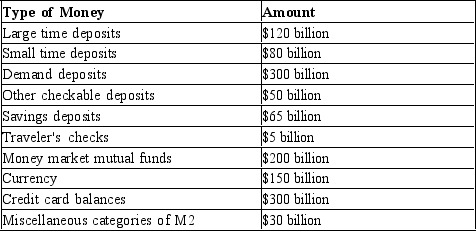 -Refer to Table 29-2. What is the M2 money supply?
 (Multiple Choice)
4.8/5 (102)
(102) Which of the following is both a store of value and regularly used as a medium of exchange?
(Multiple Choice)
5.0/5 (85)
(85) Consider the following traders who meet.  Which, if any, pairs of traders has a double coincidence of wants?
 (Multiple Choice)
4.7/5 (77)
(77) 
Filters
- Essay(0)
- Multiple Choice(0)
- Short Answer(0)
- True False(0)
- Matching(0)