



 Chat with AI
Exam 27: The Rise of Animal Diversity

Exam 1: Introduction: Evolution and the Foundations of Biology36 Questions
Exam 2: The Chemical Context of Life137 Questions
Exam 3: Carbon and the Molecular Diversity of Life136 Questions
Exam 4: A Tour of the Cell75 Questions
Exam 5: Membrane Transport and Cell Signaling97 Questions
Exam 6: An Introduction to Metabolism79 Questions
Exam 7: Cellular Respiration and Fermentation100 Questions
Exam 8: Photosynthesis72 Questions
Exam 9: The Cell Cycle56 Questions
Exam 10: Meiosis and Sexual Life Cycles62 Questions
Exam 11: Mendel and the Gene Idea63 Questions
Exam 12: The Chromosomal Basis of Inheritance46 Questions
Exam 13: The Molecular Basis of Inheritance67 Questions
Exam 14: Gene Expression: From Gene to Protein80 Questions
Exam 15: Regulation of Gene Expression50 Questions
Exam 16: Development, Stem Cells, and Cancer34 Questions
Exam 17: Viruses35 Questions
Exam 18: Genomes and Their Evolution29 Questions
Exam 19: Descent With Modification55 Questions
Exam 20: Phylogeny60 Questions
Exam 21: The Evolution of Populations70 Questions
Exam 22: The Origin of Species67 Questions
Exam 23: Broad Patterns of Evolution45 Questions
Exam 24: Early Life and the Diversification of Prokaryotes88 Questions
Exam 25: The Origin and Diversification of Eukaryotes71 Questions
Exam 26: The Colonization of Land by Plants and Fungi126 Questions
Exam 27: The Rise of Animal Diversity88 Questions
Exam 28: Plant Structure and Growth59 Questions
Exam 29: Resource Acquisition, Nutrition, and Transport in Vascular Plants110 Questions
Exam 30: Reproduction and Domestication of Flowering Plants67 Questions
Exam 31: Plant Responses to Internal and External Signals75 Questions
Exam 32: Homeostasis and Endocrine Signaling120 Questions
Exam 33: Animal Nutrition67 Questions
Exam 34: Circulation and Gas Exchange88 Questions
Exam 35: The Immune System91 Questions
Exam 36: Reproduction and Development118 Questions
Exam 37: Neurons, Synapses, and Signaling76 Questions
Exam 38: Nervous and Sensory Systems99 Questions
Exam 39: Motor Mechanisms and Behavior79 Questions
Exam 40: Population Ecology and the Distribution of Organisms93 Questions
Exam 41: Species Interactions60 Questions
Exam 42: Ecosystems and Energy90 Questions
Exam 43: Global Ecology and Conservation Biology72 Questions
Select questions type


The last common ancestor of all bilaterians is thought to have had four Hox genes (genes that regulate development of posterior-anterior axes and body segments). Most extant cnidarians have two Hox genes, except Nematostella, which has three Hox genes. On the basis of these observations, some have proposed that the ancestral cnidarians were originally bilateral and, in stages, lost Hox genes from their genomes. If true, this would mean that
(Multiple Choice)
4.8/5  (90)
(90) During chordate evolution, what is the sequence (from earliest to most recent) in which the following structures arose?
1) amniotic egg
2) paired fins
3) jaws
4) four-chambered heart
(Multiple Choice)
4.9/5 (72)
(72) Please use the following information to answer the question(s) below. 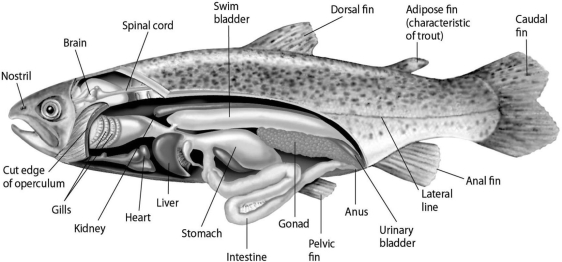 Figure 27.2
Fishes that have swim bladders can regulate their density and thus their buoyancy. There are two types of swim bladder: physostomous and physoclistous. The ancestral version is the physostomous version, in which the swim bladder is connected to the esophagus via a short tube (Figure 27.2). The fish fills this version by swimming to the surface, taking gulps of air, and directing them into the swim bladder. Air is removed from this version by "belching." The physoclistous version is more derived and has lost its connection to the esophagus. Instead, gas enters and leaves the swim bladder via special circulatory mechanisms within the wall of the swim bladder.
-The presence of a swim bladder allows the typical ray-finned fish to stop swimming and still
Figure 27.2
Fishes that have swim bladders can regulate their density and thus their buoyancy. There are two types of swim bladder: physostomous and physoclistous. The ancestral version is the physostomous version, in which the swim bladder is connected to the esophagus via a short tube (Figure 27.2). The fish fills this version by swimming to the surface, taking gulps of air, and directing them into the swim bladder. Air is removed from this version by "belching." The physoclistous version is more derived and has lost its connection to the esophagus. Instead, gas enters and leaves the swim bladder via special circulatory mechanisms within the wall of the swim bladder.
-The presence of a swim bladder allows the typical ray-finned fish to stop swimming and still (Multiple Choice)
4.7/5 (80)
(80) Which of these, if true, would support the claim that the ancestral cnidarians had bilateral symmetry?
1) Cnidarian larvae possess anterior-posterior, left-right, and dorsal-ventral aspects.
2) Cnidarians have fewer Hox genes than bilaterians.
3) All extant cnidarians are diploblastic.
4) All cnidarians are acoelomate.
(Multiple Choice)
4.8/5 (68)
(68) Which of these might have been observed in the common ancestor of chondrichthyans and osteichthyans?
(Multiple Choice)
4.7/5 (73)
(73) Fossil evidence indicates that the following events occurred in what sequence, from earliest to most recent?
1) Protostomes invade terrestrial environments.
2) Cambrian explosion occurs.
3) Deuterostomes invade terrestrial environments.
4) Vertebrates become top predators in the seas.
(Multiple Choice)
4.9/5 (80)
(80) Evidence of which structure or characteristic would be most surprising to find among fossils of the Ediacaran fauna?
(Multiple Choice)
4.9/5 (85)
(85) Which of these characteristics added most to vertebrate success in relatively dry environments?
(Multiple Choice)
4.8/5 (81)
(81) Which of the following are the most abundant and diverse of the extant vertebrates?
(Multiple Choice)
4.8/5 (82)
(82) Chordate pharyngeal slits appear to have functioned first as
(Multiple Choice)
4.8/5 (81)
(81) If wild dogs take part in cooperative hunting, they will likely have a better outcome than if they hunt alone, especially if they share the prey. The dogs that cooperate are increasing the survival probability of one another. This is an example of
(Multiple Choice)
4.7/5 (86)
(86) One important evolutionary change that occurred with the rise of animals is
(Multiple Choice)
4.8/5 (83)
(83) Why is the amniotic egg considered an important evolutionary breakthrough?
(Multiple Choice)
4.8/5 (72)
(72) Some researchers claim that sponge genomes have homeotic genes (genes that regulate development of anatomical structures), but no Hox genes (genes that regulate development of posterior-anterior axes and body segments). If true, this finding would
(Multiple Choice)
4.9/5 (82)
(82)  -What is true in the molecular phylogeny (B) that is not true in the traditional phylogeny (A)?
 (Multiple Choice)
4.9/5 (86)
(86) 
Filters
- Essay(0)
- Multiple Choice(0)
- Short Answer(0)
- True False(0)
- Matching(0)