



 Chat with AI
Exam 27: The Rise of Animal Diversity

Exam 1: Introduction: Evolution and the Foundations of Biology36 Questions
Exam 2: The Chemical Context of Life137 Questions
Exam 3: Carbon and the Molecular Diversity of Life136 Questions
Exam 4: A Tour of the Cell75 Questions
Exam 5: Membrane Transport and Cell Signaling97 Questions
Exam 6: An Introduction to Metabolism79 Questions
Exam 7: Cellular Respiration and Fermentation100 Questions
Exam 8: Photosynthesis72 Questions
Exam 9: The Cell Cycle56 Questions
Exam 10: Meiosis and Sexual Life Cycles62 Questions
Exam 11: Mendel and the Gene Idea63 Questions
Exam 12: The Chromosomal Basis of Inheritance46 Questions
Exam 13: The Molecular Basis of Inheritance67 Questions
Exam 14: Gene Expression: From Gene to Protein80 Questions
Exam 15: Regulation of Gene Expression50 Questions
Exam 16: Development, Stem Cells, and Cancer34 Questions
Exam 17: Viruses35 Questions
Exam 18: Genomes and Their Evolution29 Questions
Exam 19: Descent With Modification55 Questions
Exam 20: Phylogeny60 Questions
Exam 21: The Evolution of Populations70 Questions
Exam 22: The Origin of Species67 Questions
Exam 23: Broad Patterns of Evolution45 Questions
Exam 24: Early Life and the Diversification of Prokaryotes88 Questions
Exam 25: The Origin and Diversification of Eukaryotes71 Questions
Exam 26: The Colonization of Land by Plants and Fungi126 Questions
Exam 27: The Rise of Animal Diversity88 Questions
Exam 28: Plant Structure and Growth59 Questions
Exam 29: Resource Acquisition, Nutrition, and Transport in Vascular Plants110 Questions
Exam 30: Reproduction and Domestication of Flowering Plants67 Questions
Exam 31: Plant Responses to Internal and External Signals75 Questions
Exam 32: Homeostasis and Endocrine Signaling120 Questions
Exam 33: Animal Nutrition67 Questions
Exam 34: Circulation and Gas Exchange88 Questions
Exam 35: The Immune System91 Questions
Exam 36: Reproduction and Development118 Questions
Exam 37: Neurons, Synapses, and Signaling76 Questions
Exam 38: Nervous and Sensory Systems99 Questions
Exam 39: Motor Mechanisms and Behavior79 Questions
Exam 40: Population Ecology and the Distribution of Organisms93 Questions
Exam 41: Species Interactions60 Questions
Exam 42: Ecosystems and Energy90 Questions
Exam 43: Global Ecology and Conservation Biology72 Questions
Select questions type


Whatever its ultimate cause(s), the Cambrian explosion is a prime example of
(Multiple Choice)
4.8/5  (87)
(87) Please use the following information to answer the question(s) below. 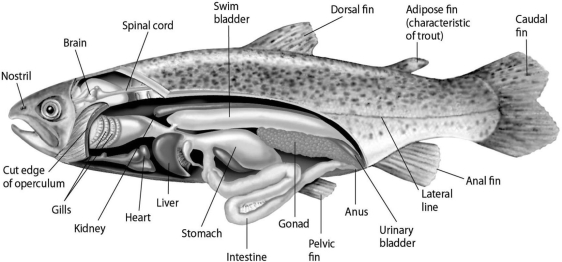 Figure 27.2
Fishes that have swim bladders can regulate their density and thus their buoyancy. There are two types of swim bladder: physostomous and physoclistous. The ancestral version is the physostomous version, in which the swim bladder is connected to the esophagus via a short tube (Figure 27.2). The fish fills this version by swimming to the surface, taking gulps of air, and directing them into the swim bladder. Air is removed from this version by "belching." The physoclistous version is more derived and has lost its connection to the esophagus. Instead, gas enters and leaves the swim bladder via special circulatory mechanisms within the wall of the swim bladder.
-How do a physoclistous fish and a physotomous fish compare in terms of the amount of energy each must use to maintain its position (depth) in the water column over the long term?
Figure 27.2
Fishes that have swim bladders can regulate their density and thus their buoyancy. There are two types of swim bladder: physostomous and physoclistous. The ancestral version is the physostomous version, in which the swim bladder is connected to the esophagus via a short tube (Figure 27.2). The fish fills this version by swimming to the surface, taking gulps of air, and directing them into the swim bladder. Air is removed from this version by "belching." The physoclistous version is more derived and has lost its connection to the esophagus. Instead, gas enters and leaves the swim bladder via special circulatory mechanisms within the wall of the swim bladder.
-How do a physoclistous fish and a physotomous fish compare in terms of the amount of energy each must use to maintain its position (depth) in the water column over the long term? (Multiple Choice)
4.9/5 (75)
(75) Internal fertilization, leathery amniotic eggs, and skin that resists drying are characteristics of which extant vertebrate group?
(Multiple Choice)
4.9/5 (77)
(77) Please use the following information to answer the question(s) below.
Placozoan evolutionary relationships to other animals are currently unclear, and different phylogenies can be created, depending on the characters used to infer relatedness. Placozoans are multicellular invertebrates with a simple structure of only two tissue layers and only four cell types. They have the smallest amount of DNA measured in any animal. In comparison, sponges have no tissues but about 20 cell types. One species of placozoans, Tp (Trichoplax adhaerens), produces a neuropeptide almost identical to one found in cnidarians. The genome of Tp, although the smallest of any known animal, shares many features of complex eumetazoan (even human!) genomes. The next three questions refer to the phylogenetic trees that follow. In the trees, the outgroup is a taxon that is outside the group of interest; members of the group of interest are more closely related to one another than to the outgroup. 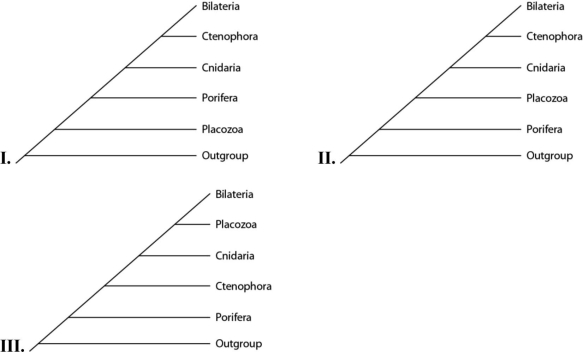 -Which tree(s) has (have) been created by emphasizing the structural simplicity of placozoans?
 (Multiple Choice)
4.8/5 (87)
(87) Cycliophorans have two types of larvae. One type of larva is produced when the digestive system of a female is impregnated by a male. The digestive system then collapses and develops into a larva, which swims away in search of a new host after the surrounding female dies. Which is the embryonic tissue that is apparently most important in forming this type of larva?
(Multiple Choice)
4.8/5 (76)
(76) Which statement is most consistent with the hypothesis that the Cambrian explosion was caused by the rise of predator-prey relationships?
(Multiple Choice)
4.9/5 (80)
(80) Evidence indicates that an ancestral finch species from South America arrived on the Galapágos Islands and formed many new species, adapting to the diverse environments on the islands. With the evolution of these new bird species on the Galapágos Islands, we would expect to find a corresponding
(Multiple Choice)
4.8/5 (81)
(81) Among the invertebrate phyla, phylum Arthropoda is unique in possessing members that have
(Multiple Choice)
4.8/5 (72)
(72) Please use the following information to answer the question(s) below. Figure 27.2
Fishes that have swim bladders can regulate their density and thus their buoyancy. There are two types of swim bladder: physostomous and physoclistous. The ancestral version is the physostomous version, in which the swim bladder is connected to the esophagus via a short tube (Figure 27.2). The fish fills this version by swimming to the surface, taking gulps of air, and directing them into the swim bladder. Air is removed from this version by "belching." The physoclistous version is more derived and has lost its connection to the esophagus. Instead, gas enters and leaves the swim bladder via special circulatory mechanisms within the wall of the swim bladder.
-Which graph properly depicts the relationship between the amount of gas in the swim bladder and the density of the fish? 
Figure 27.2
Fishes that have swim bladders can regulate their density and thus their buoyancy. There are two types of swim bladder: physostomous and physoclistous. The ancestral version is the physostomous version, in which the swim bladder is connected to the esophagus via a short tube (Figure 27.2). The fish fills this version by swimming to the surface, taking gulps of air, and directing them into the swim bladder. Air is removed from this version by "belching." The physoclistous version is more derived and has lost its connection to the esophagus. Instead, gas enters and leaves the swim bladder via special circulatory mechanisms within the wall of the swim bladder.
-Which graph properly depicts the relationship between the amount of gas in the swim bladder and the density of the fish? (Multiple Choice)
4.7/5 (73)
(73) Organisms at which of the following trophic levels increased the most because of the movement of animals onto land?
(Multiple Choice)
4.8/5 (68)
(68) Arthropods invaded land about 100 million years before vertebrates did so. This most clearly implies that
(Multiple Choice)
4.9/5 (75)
(75) In terms of food capture, which sponge cell is most similar to the cnidocyte of a cnidarian?
(Multiple Choice)
4.8/5 (72)
(72) Please use the following information to answer the question(s) below.
An elementary school science teacher decided to liven up the classroom with a saltwater aquarium. Knowing that saltwater aquaria can be quite a hassle, the teacher proceeded stepwise. First, the teacher conditioned the water. Next, the teacher decided to stock the tank with various marine invertebrates, including a sea star, a sponge, a sea urchin, a jellyfish, several hermit crabs, some sand dollars, and an ectoproct. Last, she added some vertebrates - a parrotfish and a clownfish. She arranged for daily feedings of copepods and feeder fish.
-One day, Tommy (a student in an undersupervised class of 40 fifth graders) got the urge to pet Nemo (the clownfish), who was swimming among the waving petals of a pretty underwater "flower" that had a big hole in the midst of the petals. Tommy giggled upon finding that these petals felt sticky. A few hours later, Tommy was in the nurse's office with nausea and cramps. Microscopic examination of his fingers would probably have revealed the presence of
(Multiple Choice)
5.0/5 (69)
(69) In which vertebrates is fertilization exclusively internal?
(Multiple Choice)
4.9/5 (75)
(75) Both animals and fungi are heterotrophic. What distinguishes animal heterotrophy from fungal heterotrophy is that only animals derive their nutrition from
(Multiple Choice)
4.9/5 (75)
(75) Please use the following information to answer the question(s) below.
The most recently discovered phylum in the animal kingdom (1995) is the phylum Cycliophora. It includes three species of tiny organisms that live in large numbers on the outsides of the mouthparts and appendages of lobsters. When in the feeding stage, a cycliophoran permanently attaches to the lobster via an adhesive disk and collects scraps of food from its host's feeding by capturing the scraps in a current created by a ring of cilia. Its body is sac-like and has a U-shaped intestine that brings the anus close to the mouth. Cycliophorans are eucoelomate (have a body cavity that is a coelom) and do not molt (though their host does).
-Which of these features is least useful in assigning the phylum Cycliophora to a clade of animals?
(Multiple Choice)
4.8/5 (74)
(74)  -In the traditional phylogeny (A), the phylum Platyhelminthes is depicted as a sister taxon to the rest of the protostome phyla and as having diverged earlier from the lineage that led to the rest of the protostomes. In the molecular phylogeny (B), Platyhelminthes is depicted as a lophotrochozoan phylum. What probably led to this change?
 (Multiple Choice)
4.9/5 (90)
(90) 
Filters
- Essay(0)
- Multiple Choice(0)
- Short Answer(0)
- True False(0)
- Matching(0)