



 Chat with AI
Exam 27: The Rise of Animal Diversity

Exam 1: Introduction: Evolution and the Foundations of Biology36 Questions
Exam 2: The Chemical Context of Life137 Questions
Exam 3: Carbon and the Molecular Diversity of Life136 Questions
Exam 4: A Tour of the Cell75 Questions
Exam 5: Membrane Transport and Cell Signaling97 Questions
Exam 6: An Introduction to Metabolism79 Questions
Exam 7: Cellular Respiration and Fermentation100 Questions
Exam 8: Photosynthesis72 Questions
Exam 9: The Cell Cycle56 Questions
Exam 10: Meiosis and Sexual Life Cycles62 Questions
Exam 11: Mendel and the Gene Idea63 Questions
Exam 12: The Chromosomal Basis of Inheritance46 Questions
Exam 13: The Molecular Basis of Inheritance67 Questions
Exam 14: Gene Expression: From Gene to Protein80 Questions
Exam 15: Regulation of Gene Expression50 Questions
Exam 16: Development, Stem Cells, and Cancer34 Questions
Exam 17: Viruses35 Questions
Exam 18: Genomes and Their Evolution29 Questions
Exam 19: Descent With Modification55 Questions
Exam 20: Phylogeny60 Questions
Exam 21: The Evolution of Populations70 Questions
Exam 22: The Origin of Species67 Questions
Exam 23: Broad Patterns of Evolution45 Questions
Exam 24: Early Life and the Diversification of Prokaryotes88 Questions
Exam 25: The Origin and Diversification of Eukaryotes71 Questions
Exam 26: The Colonization of Land by Plants and Fungi126 Questions
Exam 27: The Rise of Animal Diversity88 Questions
Exam 28: Plant Structure and Growth59 Questions
Exam 29: Resource Acquisition, Nutrition, and Transport in Vascular Plants110 Questions
Exam 30: Reproduction and Domestication of Flowering Plants67 Questions
Exam 31: Plant Responses to Internal and External Signals75 Questions
Exam 32: Homeostasis and Endocrine Signaling120 Questions
Exam 33: Animal Nutrition67 Questions
Exam 34: Circulation and Gas Exchange88 Questions
Exam 35: The Immune System91 Questions
Exam 36: Reproduction and Development118 Questions
Exam 37: Neurons, Synapses, and Signaling76 Questions
Exam 38: Nervous and Sensory Systems99 Questions
Exam 39: Motor Mechanisms and Behavior79 Questions
Exam 40: Population Ecology and the Distribution of Organisms93 Questions
Exam 41: Species Interactions60 Questions
Exam 42: Ecosystems and Energy90 Questions
Exam 43: Global Ecology and Conservation Biology72 Questions
Select questions type


Which of the following is true of members of the phylum Cnidaria?
(Multiple Choice)
4.9/5  (95)
(95) According to the evidence collected so far, the animal kingdom is
(Multiple Choice)
4.8/5 (90)
(90) If the current molecular evidence regarding animal origins is well substantiated in the future, then what will be true of any contrary evidence regarding the origin of animals derived from the fossil record?
(Multiple Choice)
4.7/5 (82)
(82) If all of the animals died in a large region of an ocean, we would expect an increase in the
(Multiple Choice)
4.8/5 (84)
(84) Which of the following could be considered the most recent common ancestor of living tetrapods?
(Multiple Choice)
4.7/5 (89)
(89) In the figure given below, the Deuterostomia clade is most closely related to which two main clades? 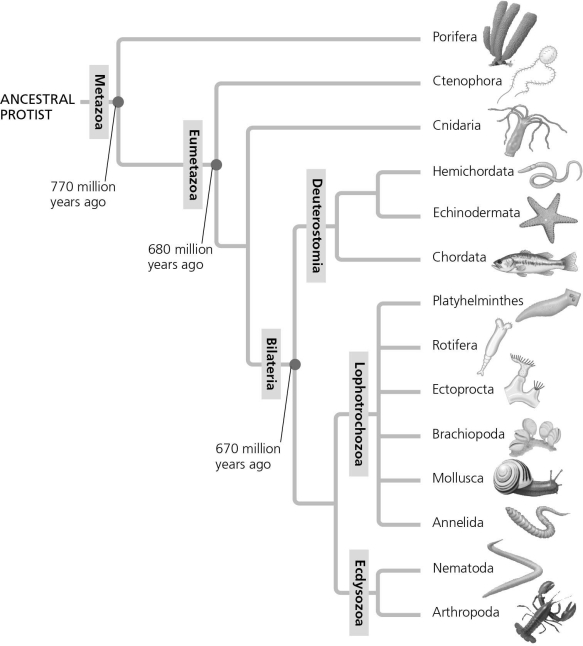
(Multiple Choice)
4.8/5 (82)
(82) Please use the following information to answer the question(s) below.
Placozoan evolutionary relationships to other animals are currently unclear, and different phylogenies can be created, depending on the characters used to infer relatedness. Placozoans are multicellular invertebrates with a simple structure of only two tissue layers and only four cell types. They have the smallest amount of DNA measured in any animal. In comparison, sponges have no tissues but about 20 cell types. One species of placozoans, Tp (Trichoplax adhaerens), produces a neuropeptide almost identical to one found in cnidarians. The genome of Tp, although the smallest of any known animal, shares many features of complex eumetazoan (even human!) genomes. The next three questions refer to the phylogenetic trees that follow. In the trees, the outgroup is a taxon that is outside the group of interest; members of the group of interest are more closely related to one another than to the outgroup.  -Which tree(s) has (have) been created by emphasizing a protein found in placozoans?
 (Multiple Choice)
4.8/5 (68)
(68) Humans widely use pesticides on plants as a means to control insect and plant pests. However, pesticides are not selective in what they kill, so they often kill beneficial insect and plant species as well. This unintentional consequence favors plant and insect species that are pesticide resistant. This scenario is an example of
(Multiple Choice)
4.7/5 (81)
(81) A trend first observed in the evolution of the earliest tetrapods was
(Multiple Choice)
4.8/5 (79)
(79) Please use the following information to answer the question(s) below.
Trichoplax adhaerens (Tp) is the only living species in the phylum Placozoa. Individuals are about 1 mm wide and only 27 μm high, are irregularly shaped, and consist of a total of about 2,000 cells, which are diploid (2n = 12). There are four types of cells, none of which is a nerve or muscle cell, and none of which has a cell wall. They move using cilia, and any "edge" can lead. Tp feeds on marine microbes, mostly unicellular green algae, by crawling atop the algae and trapping it between its ventral surface and the substrate. Enzymes are then secreted onto the algae, and the resulting nutrients are absorbed. Tp sperm cells have never been observed, nor have embryos past the 64-cell (blastula) stage.
-Tp's body symmetry seems to be most like that of
(Multiple Choice)
4.9/5 (76)
(76) The earliest known mineralized structures in vertebrates are associated with which function?
(Multiple Choice)
4.9/5 (75)
(75) Please use the following information to answer the question(s) below.
An elementary school science teacher decided to liven up the classroom with a saltwater aquarium. Knowing that saltwater aquaria can be quite a hassle, the teacher proceeded stepwise. First, the teacher conditioned the water. Next, the teacher decided to stock the tank with various marine invertebrates, including a sea star, a sponge, a sea urchin, a jellyfish, several hermit crabs, some sand dollars, and an ectoproct. Last, she added some vertebrates - a parrotfish and a clownfish. She arranged for daily feedings of copepods and feeder fish.
-Had the teacher wanted to point out organisms that move and feed using the same structural adaptation, the teacher should have chosen the
(Multiple Choice)
4.9/5 (74)
(74) The members of which clade in the phylum Cnidaria occur only as polyps?
(Multiple Choice)
4.9/5 (81)
(81) Using similarities in body symmetry and other anatomical features to assign an organism to a clade involves
1) cladistics based on body plan.
2) molecular-based phylogeny.
3) morphology-based phylogeny.
(Multiple Choice)
4.9/5 (79)
(79) Please use the following information to answer the question(s) below.
The most recently discovered phylum in the animal kingdom (1995) is the phylum Cycliophora. It includes three species of tiny organisms that live in large numbers on the outsides of the mouthparts and appendages of lobsters. When in the feeding stage, a cycliophoran permanently attaches to the lobster via an adhesive disk and collects scraps of food from its host's feeding by capturing the scraps in a current created by a ring of cilia. Its body is sac-like and has a U-shaped intestine that brings the anus close to the mouth. Cycliophorans are eucoelomate (have a body cavity that is a coelom) and do not molt (though their host does).
-What is true of the feeding stage of cycliophorans?
1) It is chemoheterotrophic.
2) It is sessile.
3) Its tube feet allow it to feed efficiently.
4) It has radial symmetry.
(Multiple Choice)
4.9/5 (61)
(61) Which extant chordates are postulated to be most like the earliest chordates in physical appearance?
(Multiple Choice)
4.7/5 (87)
(87) Please use the following information to answer the question(s) below.
Trichoplax adhaerens (Tp) is the only living species in the phylum Placozoa. Individuals are about 1 mm wide and only 27 μm high, are irregularly shaped, and consist of a total of about 2,000 cells, which are diploid (2n = 12). There are four types of cells, none of which is a nerve or muscle cell, and none of which has a cell wall. They move using cilia, and any "edge" can lead. Tp feeds on marine microbes, mostly unicellular green algae, by crawling atop the algae and trapping it between its ventral surface and the substrate. Enzymes are then secreted onto the algae, and the resulting nutrients are absorbed. Tp sperm cells have never been observed, nor have embryos past the 64-cell (blastula) stage.
-In which of the following ways is Tp similar to a typical animal?
1) Tp is multicellular.
2) Tp lacks muscle and nerve cells.
3) Tp has cilia.
4) Tp lacks cell walls.
5) Tp does not have observable sperm cells.
(Multiple Choice)
4.9/5 (81)
(81) The decline of cyanobacteria in the early Cambrian oceans was most likely related to
(Multiple Choice)
4.8/5 (64)
(64)  Table 27.1. Proposed Number of Hox Genes in Various Extant and Extinct Animals
-What conclusion is apparent from the data in Table 27.1?
Table 27.1. Proposed Number of Hox Genes in Various Extant and Extinct Animals
-What conclusion is apparent from the data in Table 27.1? (Multiple Choice)
5.0/5 (79)
(79) Arrange these taxonomic terms from most inclusive (most general) to least inclusive (most specific).
1) lobe-fins
2) amphibians
3) gnathostomes
4) osteichthyans
5) tetrapods
(Multiple Choice)
4.9/5 (76)
(76) 
Filters
- Essay(0)
- Multiple Choice(0)
- Short Answer(0)
- True False(0)
- Matching(0)