



 Chat with AI
Exam 29: Resource Acquisition, Nutrition, and Transport in Vascular Plants

Exam 1: Introduction: Evolution and the Foundations of Biology36 Questions
Exam 2: The Chemical Context of Life137 Questions
Exam 3: Carbon and the Molecular Diversity of Life136 Questions
Exam 4: A Tour of the Cell75 Questions
Exam 5: Membrane Transport and Cell Signaling97 Questions
Exam 6: An Introduction to Metabolism79 Questions
Exam 7: Cellular Respiration and Fermentation100 Questions
Exam 8: Photosynthesis72 Questions
Exam 9: The Cell Cycle56 Questions
Exam 10: Meiosis and Sexual Life Cycles62 Questions
Exam 11: Mendel and the Gene Idea63 Questions
Exam 12: The Chromosomal Basis of Inheritance46 Questions
Exam 13: The Molecular Basis of Inheritance67 Questions
Exam 14: Gene Expression: From Gene to Protein80 Questions
Exam 15: Regulation of Gene Expression50 Questions
Exam 16: Development, Stem Cells, and Cancer34 Questions
Exam 17: Viruses35 Questions
Exam 18: Genomes and Their Evolution29 Questions
Exam 19: Descent With Modification55 Questions
Exam 20: Phylogeny60 Questions
Exam 21: The Evolution of Populations70 Questions
Exam 22: The Origin of Species67 Questions
Exam 23: Broad Patterns of Evolution45 Questions
Exam 24: Early Life and the Diversification of Prokaryotes88 Questions
Exam 25: The Origin and Diversification of Eukaryotes71 Questions
Exam 26: The Colonization of Land by Plants and Fungi126 Questions
Exam 27: The Rise of Animal Diversity88 Questions
Exam 28: Plant Structure and Growth59 Questions
Exam 29: Resource Acquisition, Nutrition, and Transport in Vascular Plants110 Questions
Exam 30: Reproduction and Domestication of Flowering Plants67 Questions
Exam 31: Plant Responses to Internal and External Signals75 Questions
Exam 32: Homeostasis and Endocrine Signaling120 Questions
Exam 33: Animal Nutrition67 Questions
Exam 34: Circulation and Gas Exchange88 Questions
Exam 35: The Immune System91 Questions
Exam 36: Reproduction and Development118 Questions
Exam 37: Neurons, Synapses, and Signaling76 Questions
Exam 38: Nervous and Sensory Systems99 Questions
Exam 39: Motor Mechanisms and Behavior79 Questions
Exam 40: Population Ecology and the Distribution of Organisms93 Questions
Exam 41: Species Interactions60 Questions
Exam 42: Ecosystems and Energy90 Questions
Exam 43: Global Ecology and Conservation Biology72 Questions
Select questions type


Atmospheric nitrogen can be fixed by nitrogen-fixing bacteria. Arrange the following forms of nitrogen from the atmospheric N stage to the final form that enters the roots.
1) Ammonia
2) Nitrogen gas
3) Ammonium ion
4) Nitrite
5) Nitrate
(Multiple Choice)
4.9/5  (84)
(84) Which of the following would be the most effective strategy to remove toxic heavy metals from a soil?
(Multiple Choice)
4.8/5 (70)
(70) Which of the following was an essential adaptive feature for the evolution of plants from water to the land?
(Multiple Choice)
4.7/5 (68)
(68) If isolated plant cells with a water potential averaging -0.5 MPa are placed into a solution with a water potential of -0.3 MPa, which of the following would be the most likely outcome?
(Multiple Choice)
4.8/5 (76)
(76) Ignoring all other factors, what kind of day would result in the fastest delivery of water and minerals to the leaves of a tree?
(Multiple Choice)
4.9/5 (85)
(85) Two groups of tomatoes were grown in the laboratory, one with humus added to the soil and the other a control without humus. The leaves of the plants grown without humus were yellowish (less green) compared with those of the plants grown in humus-enriched soil. The best explanation for this difference is that
(Multiple Choice)
4.9/5 (91)
(91) You are weeding your garden when you accidentally expose some roots of your pea plants. You notice swellings (root nodules) on the roots and there is a reddish tinge to the ones you accidentally damaged. Most likely your pea plants
(Multiple Choice)
4.8/5 (71)
(71) Which of the following experimental procedures would most likely reduce transpiration while allowing the normal growth of a plant?
(Multiple Choice)
4.8/5 (72)
(72) What is the main force by which most of the water within xylem vessels moves toward the top of a tree?
(Multiple Choice)
4.9/5 (72)
(72) In west Texas, cotton has become an important crop in the last several decades. However, in this hot, dry part of the country there is little rainfall, so farmers irrigate their cotton fields. They must also regularly fertilize the cotton fields because the soil is very sandy. Figure 29.1 shows the record of annual productivity (measured in kilograms of cotton per hectare of land) since 1960 in a west Texas cotton field. Use these data to answer the following question(s). 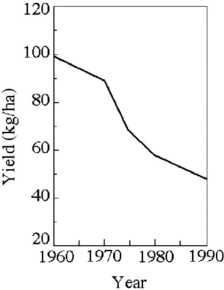 Figure 29.1
-Based on the information provided in Figure 29.1, what is the most likely cause of the decline in productivity?
Figure 29.1
-Based on the information provided in Figure 29.1, what is the most likely cause of the decline in productivity? (Multiple Choice)
4.7/5 (74)
(74) Given that early land plants most likely share a common ancestor with green algae, the earliest land plants were most likely
(Multiple Choice)
4.9/5 (93)
(93) 
Filters
- Essay(0)
- Multiple Choice(0)
- Short Answer(0)
- True False(0)
- Matching(0)