



 Chat with AI
Exam 32: Homeostasis and Endocrine Signaling

Exam 1: Introduction: Evolution and the Foundations of Biology36 Questions
Exam 2: The Chemical Context of Life137 Questions
Exam 3: Carbon and the Molecular Diversity of Life136 Questions
Exam 4: A Tour of the Cell75 Questions
Exam 5: Membrane Transport and Cell Signaling97 Questions
Exam 6: An Introduction to Metabolism79 Questions
Exam 7: Cellular Respiration and Fermentation100 Questions
Exam 8: Photosynthesis72 Questions
Exam 9: The Cell Cycle56 Questions
Exam 10: Meiosis and Sexual Life Cycles62 Questions
Exam 11: Mendel and the Gene Idea63 Questions
Exam 12: The Chromosomal Basis of Inheritance46 Questions
Exam 13: The Molecular Basis of Inheritance67 Questions
Exam 14: Gene Expression: From Gene to Protein80 Questions
Exam 15: Regulation of Gene Expression50 Questions
Exam 16: Development, Stem Cells, and Cancer34 Questions
Exam 17: Viruses35 Questions
Exam 18: Genomes and Their Evolution29 Questions
Exam 19: Descent With Modification55 Questions
Exam 20: Phylogeny60 Questions
Exam 21: The Evolution of Populations70 Questions
Exam 22: The Origin of Species67 Questions
Exam 23: Broad Patterns of Evolution45 Questions
Exam 24: Early Life and the Diversification of Prokaryotes88 Questions
Exam 25: The Origin and Diversification of Eukaryotes71 Questions
Exam 26: The Colonization of Land by Plants and Fungi126 Questions
Exam 27: The Rise of Animal Diversity88 Questions
Exam 28: Plant Structure and Growth59 Questions
Exam 29: Resource Acquisition, Nutrition, and Transport in Vascular Plants110 Questions
Exam 30: Reproduction and Domestication of Flowering Plants67 Questions
Exam 31: Plant Responses to Internal and External Signals75 Questions
Exam 32: Homeostasis and Endocrine Signaling120 Questions
Exam 33: Animal Nutrition67 Questions
Exam 34: Circulation and Gas Exchange88 Questions
Exam 35: The Immune System91 Questions
Exam 36: Reproduction and Development118 Questions
Exam 37: Neurons, Synapses, and Signaling76 Questions
Exam 38: Nervous and Sensory Systems99 Questions
Exam 39: Motor Mechanisms and Behavior79 Questions
Exam 40: Population Ecology and the Distribution of Organisms93 Questions
Exam 41: Species Interactions60 Questions
Exam 42: Ecosystems and Energy90 Questions
Exam 43: Global Ecology and Conservation Biology72 Questions
Select questions type


A cell with membrane-bound proteins that selectively binds to a specific hormone is called that hormone's
(Multiple Choice)
4.8/5  (89)
(89) During mammalian labor and delivery, the contraction of uterine muscles is enhanced by oxytocin. This is an example of
(Multiple Choice)
5.0/5 (75)
(75) The body's reaction to PTH (parathyroid hormone), a reduction in plasma levels of calcium, can be opposed by
(Multiple Choice)
4.9/5 (72)
(72) A researcher is conducting an experiment to identify an unknown hormone. The experiment consists of exposing cells to the hormone and determining where the hormone is after a period of time. The researcher collects the data in the table below. What could be the identity of the unknown hormone? 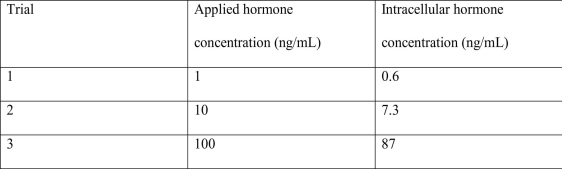
(Multiple Choice)
4.9/5 (73)
(73) The necropsy (post-mortem analysis) of a freshwater fish that died after accidentally being placed in salt water would likely show that
(Multiple Choice)
4.9/5 (71)
(71) The nitrogenous waste that requires the most energy to produce is
(Multiple Choice)
4.8/5 (88)
(88) For hormones that homeostatically regulate cellular functions,
(Multiple Choice)
4.7/5 (89)
(89) Excretory structures known as protonephridia are present in
(Multiple Choice)
4.8/5 (85)
(85) Juxtamedullary nephrons can concentrate salt effectively in the renal medulla because of their long
(Multiple Choice)
4.9/5 (96)
(96) In which of the following species should natural selection favor the highest proportion of nephrons with loops of Henle that extend deep into the renal medulla?
(Multiple Choice)
4.8/5 (66)
(66) Which nitrogenous waste requires hardly any water for its excretion?
(Multiple Choice)
4.9/5 (89)
(89) Which of the following pairs of organisms excrete nitrogenous wastes in the form of uric acid?
(Multiple Choice)
4.8/5 (87)
(87) An excretory system that is partly based on the filtration of fluid under high hydrostatic pressure is the
(Multiple Choice)
4.9/5 (81)
(81) Coordinating body functions via chemical signals is accomplished by
(Multiple Choice)
4.7/5 (70)
(70) 
Filters
- Essay(0)
- Multiple Choice(0)
- Short Answer(0)
- True False(0)
- Matching(0)