



 Chat with AI
Exam 32: Homeostasis and Endocrine Signaling

Exam 1: Introduction: Evolution and the Foundations of Biology36 Questions
Exam 2: The Chemical Context of Life137 Questions
Exam 3: Carbon and the Molecular Diversity of Life136 Questions
Exam 4: A Tour of the Cell75 Questions
Exam 5: Membrane Transport and Cell Signaling97 Questions
Exam 6: An Introduction to Metabolism79 Questions
Exam 7: Cellular Respiration and Fermentation100 Questions
Exam 8: Photosynthesis72 Questions
Exam 9: The Cell Cycle56 Questions
Exam 10: Meiosis and Sexual Life Cycles62 Questions
Exam 11: Mendel and the Gene Idea63 Questions
Exam 12: The Chromosomal Basis of Inheritance46 Questions
Exam 13: The Molecular Basis of Inheritance67 Questions
Exam 14: Gene Expression: From Gene to Protein80 Questions
Exam 15: Regulation of Gene Expression50 Questions
Exam 16: Development, Stem Cells, and Cancer34 Questions
Exam 17: Viruses35 Questions
Exam 18: Genomes and Their Evolution29 Questions
Exam 19: Descent With Modification55 Questions
Exam 20: Phylogeny60 Questions
Exam 21: The Evolution of Populations70 Questions
Exam 22: The Origin of Species67 Questions
Exam 23: Broad Patterns of Evolution45 Questions
Exam 24: Early Life and the Diversification of Prokaryotes88 Questions
Exam 25: The Origin and Diversification of Eukaryotes71 Questions
Exam 26: The Colonization of Land by Plants and Fungi126 Questions
Exam 27: The Rise of Animal Diversity88 Questions
Exam 28: Plant Structure and Growth59 Questions
Exam 29: Resource Acquisition, Nutrition, and Transport in Vascular Plants110 Questions
Exam 30: Reproduction and Domestication of Flowering Plants67 Questions
Exam 31: Plant Responses to Internal and External Signals75 Questions
Exam 32: Homeostasis and Endocrine Signaling120 Questions
Exam 33: Animal Nutrition67 Questions
Exam 34: Circulation and Gas Exchange88 Questions
Exam 35: The Immune System91 Questions
Exam 36: Reproduction and Development118 Questions
Exam 37: Neurons, Synapses, and Signaling76 Questions
Exam 38: Nervous and Sensory Systems99 Questions
Exam 39: Motor Mechanisms and Behavior79 Questions
Exam 40: Population Ecology and the Distribution of Organisms93 Questions
Exam 41: Species Interactions60 Questions
Exam 42: Ecosystems and Energy90 Questions
Exam 43: Global Ecology and Conservation Biology72 Questions
Select questions type


When stimulated by antidiuretic hormone (ADH), the reabsorption of water is increased along
(Multiple Choice)
4.8/5  (80)
(80) 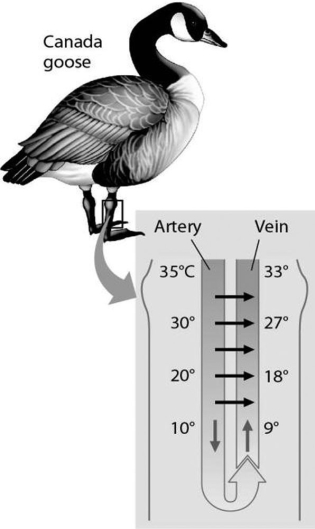 Figure 32.1
-The thin horizontal arrows in Figure 32.1 show that
Figure 32.1
-The thin horizontal arrows in Figure 32.1 show that (Multiple Choice)
4.8/5 (88)
(88) Materials are returned to the blood from the filtrate by which of the following processes?
(Multiple Choice)
4.9/5 (82)
(82) The increased contraction of the human uterus during labor and delivery is at least partially due to the actions of
(Multiple Choice)
4.9/5 (75)
(75) Which nitrogenous waste has the greatest number of nitrogen atoms?
(Multiple Choice)
4.7/5 (74)
(74) Iodine is added to table salt to help prevent deficiencies of an essential mineral needed for the proper function of the
(Multiple Choice)
4.8/5 (77)
(77) An exchange surface in direct contact with the external environment is found in the
(Multiple Choice)
4.8/5 (86)
(86) An example of a properly functioning homeostatic control system is seen when
(Multiple Choice)
4.8/5 (87)
(87) Seasonal changes in snake activity are due to the fact that the snake
(Multiple Choice)
4.9/5 (73)
(73) The transfer of fluid from the glomerulus to Bowman's capsule
(Multiple Choice)
5.0/5 (82)
(82) Prolactin stimulates mammary gland growth and development in mammals, and it regulates salt and water balance in freshwater fish. Many scientists think that this wide range of functions indicates that prolactin
(Multiple Choice)
4.8/5 (83)
(83) Compared to the seawater around them, most marine invertebrates are
(Multiple Choice)
4.8/5 (75)
(75) In a lactating mammal, the two hormones that promote milk synthesis and milk release, respectively, are
(Multiple Choice)
4.9/5 (77)
(77) 
Filters
- Essay(0)
- Multiple Choice(0)
- Short Answer(0)
- True False(0)
- Matching(0)