



 Chat with AI
Exam 35: The Immune System

Exam 1: Introduction: Evolution and the Foundations of Biology36 Questions
Exam 2: The Chemical Context of Life137 Questions
Exam 3: Carbon and the Molecular Diversity of Life136 Questions
Exam 4: A Tour of the Cell75 Questions
Exam 5: Membrane Transport and Cell Signaling97 Questions
Exam 6: An Introduction to Metabolism79 Questions
Exam 7: Cellular Respiration and Fermentation100 Questions
Exam 8: Photosynthesis72 Questions
Exam 9: The Cell Cycle56 Questions
Exam 10: Meiosis and Sexual Life Cycles62 Questions
Exam 11: Mendel and the Gene Idea63 Questions
Exam 12: The Chromosomal Basis of Inheritance46 Questions
Exam 13: The Molecular Basis of Inheritance67 Questions
Exam 14: Gene Expression: From Gene to Protein80 Questions
Exam 15: Regulation of Gene Expression50 Questions
Exam 16: Development, Stem Cells, and Cancer34 Questions
Exam 17: Viruses35 Questions
Exam 18: Genomes and Their Evolution29 Questions
Exam 19: Descent With Modification55 Questions
Exam 20: Phylogeny60 Questions
Exam 21: The Evolution of Populations70 Questions
Exam 22: The Origin of Species67 Questions
Exam 23: Broad Patterns of Evolution45 Questions
Exam 24: Early Life and the Diversification of Prokaryotes88 Questions
Exam 25: The Origin and Diversification of Eukaryotes71 Questions
Exam 26: The Colonization of Land by Plants and Fungi126 Questions
Exam 27: The Rise of Animal Diversity88 Questions
Exam 28: Plant Structure and Growth59 Questions
Exam 29: Resource Acquisition, Nutrition, and Transport in Vascular Plants110 Questions
Exam 30: Reproduction and Domestication of Flowering Plants67 Questions
Exam 31: Plant Responses to Internal and External Signals75 Questions
Exam 32: Homeostasis and Endocrine Signaling120 Questions
Exam 33: Animal Nutrition67 Questions
Exam 34: Circulation and Gas Exchange88 Questions
Exam 35: The Immune System91 Questions
Exam 36: Reproduction and Development118 Questions
Exam 37: Neurons, Synapses, and Signaling76 Questions
Exam 38: Nervous and Sensory Systems99 Questions
Exam 39: Motor Mechanisms and Behavior79 Questions
Exam 40: Population Ecology and the Distribution of Organisms93 Questions
Exam 41: Species Interactions60 Questions
Exam 42: Ecosystems and Energy90 Questions
Exam 43: Global Ecology and Conservation Biology72 Questions
Select questions type


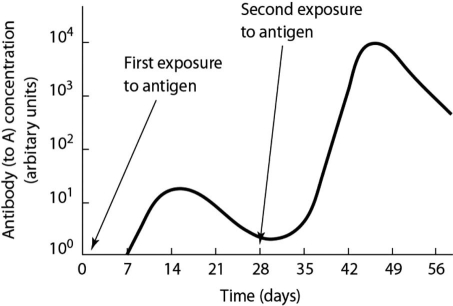 Figure 35.4
According to the graph in Figure 35.4, B cells will first produce effector cells
Figure 35.4
According to the graph in Figure 35.4, B cells will first produce effector cells (Multiple Choice)
4.9/5  (74)
(74) An immunoglobulin (Ig) molecule with regions symbolized as C, V, H, or L has a light chain made up of
(Multiple Choice)
4.8/5 (89)
(89) The ability of one person to produce over a million different antibody molecules does not require over a million different genes; rather, this wide range of antibody production is due to
(Multiple Choice)
4.8/5 (78)
(78) Please use the following information to answer the question(s) below.
An otherwise healthy student in your class is infected with EBV, the virus that causes infectious mononucleosis. The same student had been infected when she was a child, at which time she had merely experienced a mild sore throat and swollen lymph nodes in her neck. This time, although infected, she does not get sick.
-Which of these is not part of insect immunity?
(Multiple Choice)
4.7/5 (84)
(84) Please use the following information to answer the question(s) below.
An otherwise healthy student in your class is infected with EBV, the virus that causes infectious mononucleosis. The same student had been infected when she was a child, at which time she had merely experienced a mild sore throat and swollen lymph nodes in her neck. This time, although infected, she does not get sick.
-Which statement best describes the difference in responses of effector B cells (plasma cells) and cytotoxic T cells?
(Multiple Choice)
4.8/5 (75)
(75) According to Figure 35.5, approximately when did a second exposure to antigen occur? 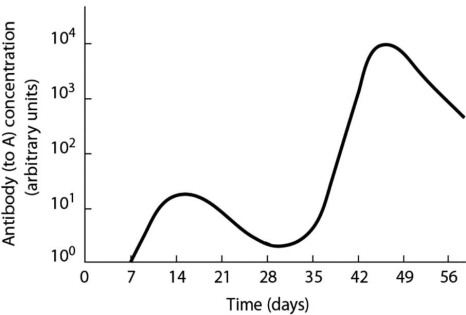 Figure 35.5
 (Multiple Choice)
5.0/5 (76)
(76) For the successful development of a vaccine to be used against a pathogen, it is necessary that
(Multiple Choice)
5.0/5 (78)
(78) There is a mutation such that mast cells cannot produce and secrete histamine. Which of the following outcomes is most likely to happen if an injury occurs?
(Multiple Choice)
4.8/5 (78)
(78) What is the main reason that HIV usually cannot be completely eliminated by the body's immune system?
(Multiple Choice)
4.8/5 (70)
(70) An immune response to a tissue graft will differ from an immune response to a bacterium because
(Multiple Choice)
4.9/5 (84)
(84) Cave art by early humans recognized the existence of the major signs of inflammation. The most inclusive set of symptoms of inflammation that might appear in such early human art is
(Multiple Choice)
4.8/5 (90)
(90) 
Filters
- Essay(0)
- Multiple Choice(0)
- Short Answer(0)
- True False(0)
- Matching(0)