



 Chat with AI
Exam 35: The Immune System

Exam 1: Introduction: Evolution and the Foundations of Biology36 Questions
Exam 2: The Chemical Context of Life137 Questions
Exam 3: Carbon and the Molecular Diversity of Life136 Questions
Exam 4: A Tour of the Cell75 Questions
Exam 5: Membrane Transport and Cell Signaling97 Questions
Exam 6: An Introduction to Metabolism79 Questions
Exam 7: Cellular Respiration and Fermentation100 Questions
Exam 8: Photosynthesis72 Questions
Exam 9: The Cell Cycle56 Questions
Exam 10: Meiosis and Sexual Life Cycles62 Questions
Exam 11: Mendel and the Gene Idea63 Questions
Exam 12: The Chromosomal Basis of Inheritance46 Questions
Exam 13: The Molecular Basis of Inheritance67 Questions
Exam 14: Gene Expression: From Gene to Protein80 Questions
Exam 15: Regulation of Gene Expression50 Questions
Exam 16: Development, Stem Cells, and Cancer34 Questions
Exam 17: Viruses35 Questions
Exam 18: Genomes and Their Evolution29 Questions
Exam 19: Descent With Modification55 Questions
Exam 20: Phylogeny60 Questions
Exam 21: The Evolution of Populations70 Questions
Exam 22: The Origin of Species67 Questions
Exam 23: Broad Patterns of Evolution45 Questions
Exam 24: Early Life and the Diversification of Prokaryotes88 Questions
Exam 25: The Origin and Diversification of Eukaryotes71 Questions
Exam 26: The Colonization of Land by Plants and Fungi126 Questions
Exam 27: The Rise of Animal Diversity88 Questions
Exam 28: Plant Structure and Growth59 Questions
Exam 29: Resource Acquisition, Nutrition, and Transport in Vascular Plants110 Questions
Exam 30: Reproduction and Domestication of Flowering Plants67 Questions
Exam 31: Plant Responses to Internal and External Signals75 Questions
Exam 32: Homeostasis and Endocrine Signaling120 Questions
Exam 33: Animal Nutrition67 Questions
Exam 34: Circulation and Gas Exchange88 Questions
Exam 35: The Immune System91 Questions
Exam 36: Reproduction and Development118 Questions
Exam 37: Neurons, Synapses, and Signaling76 Questions
Exam 38: Nervous and Sensory Systems99 Questions
Exam 39: Motor Mechanisms and Behavior79 Questions
Exam 40: Population Ecology and the Distribution of Organisms93 Questions
Exam 41: Species Interactions60 Questions
Exam 42: Ecosystems and Energy90 Questions
Exam 43: Global Ecology and Conservation Biology72 Questions
Select questions type


An invertebrate, such as an insect, has innate immunity activity in its intestine that likely includes
(Multiple Choice)
4.8/5  (81)
(81) Please use the following information to answer the question(s) below.
All cells have protein markers on their membranes, and the Rh antigen is found in the membranes of red blood cells. If a person possesses the Rh antigen on his or her red blood cells, it is indicated with a + sign. If a person does not possess the Rh antigen, it is indicated with a - sign. A, B, and O refer to the ABO blood groups. 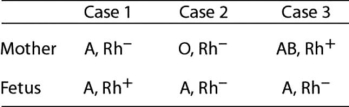 Figure 35.3
-Study the table in Figure 35.3. Giving the mother anti-Rh antibodies before delivering her baby would be a wise precaution in
Figure 35.3
-Study the table in Figure 35.3. Giving the mother anti-Rh antibodies before delivering her baby would be a wise precaution in (Multiple Choice)
4.8/5 (67)
(67) A fruit fly, internally infected by a potentially pathogenic fungus, is protected by
(Multiple Choice)
4.8/5 (75)
(75) Please use the following information to answer the question(s) below.
An otherwise healthy student in your class is infected with EBV, the virus that causes infectious mononucleosis. The same student had been infected when she was a child, at which time she had merely experienced a mild sore throat and swollen lymph nodes in her neck. This time, although infected, she does not get sick.
-Which of the following should be the same in identical twins?
(Multiple Choice)
4.9/5 (74)
(74) Select the pathway that would lead to the activation of cytotoxic T cells.
(Multiple Choice)
4.7/5 (67)
(67) A cell type that interacts with both the humoral and cell-mediated immune pathways is a
(Multiple Choice)
4.8/5 (85)
(85) An individual who has been bitten by a poisonous snake that has a fast-acting toxin would likely benefit from
(Multiple Choice)
4.7/5 (84)
(84) Please use the following information to answer the question(s) below.
An otherwise healthy student in your class is infected with EBV, the virus that causes infectious mononucleosis. The same student had been infected when she was a child, at which time she had merely experienced a mild sore throat and swollen lymph nodes in her neck. This time, although infected, she does not get sick.
-Which of the following statements is not true?
(Multiple Choice)
4.9/5 (76)
(76) Mutant fruit flies that make only one antimicrobial peptide (defensin or drosomycin) were tested for survival after infection with Neurospora crassa fungi or with Micrococcus luteus bacteria, and the results are shown in Figures 35.1 and 35.2. 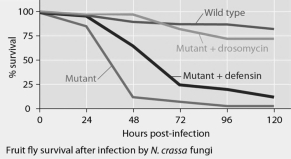
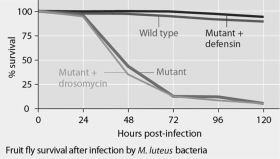 Figure 35.1 Figure 35.2
The results shown in the graphs in Figures 35.1 and 35.2 support the hypothesis that
Figure 35.1 Figure 35.2
The results shown in the graphs in Figures 35.1 and 35.2 support the hypothesis that (Multiple Choice)
4.9/5 (89)
(89) Suppose that there is a phagocytic cell in which the pH inside the lysosome is significantly higher than normal. What outcome regarding phagocytosis is most likely to occur?
(Multiple Choice)
4.8/5 (89)
(89) Bacterial infection in a previously uninfected house cat would most quickly activate its
(Multiple Choice)
4.8/5 (73)
(73) Through the evolution of antigenic variation, pathogens are able to
(Multiple Choice)
4.8/5 (84)
(84) In some insects, such as Drosophila, fungal cell wall elements can activate the protein Toll, which
(Multiple Choice)
4.8/5 (81)
(81) B cells that interact with helper T cells are stimulated to differentiate when
(Multiple Choice)
4.9/5 (87)
(87) The number of MHC protein combinations possible in a given population is enormous. However, an individual in that diverse population has a far more limited array of MHC molecules because
(Multiple Choice)
4.9/5 (68)
(68) Please use the following information to answer the question(s) below.
All cells have protein markers on their membranes, and the Rh antigen is found in the membranes of red blood cells. If a person possesses the Rh antigen on his or her red blood cells, it is indicated with a + sign. If a person does not possess the Rh antigen, it is indicated with a - sign. A, B, and O refer to the ABO blood groups. Figure 35.3
-Study the table in Figure 35.3. The mother could exhibit an anti-Rh factor reaction to the developing fetus in
Figure 35.3
-Study the table in Figure 35.3. The mother could exhibit an anti-Rh factor reaction to the developing fetus in (Multiple Choice)
4.7/5 (72)
(72) 
Filters
- Essay(0)
- Multiple Choice(0)
- Short Answer(0)
- True False(0)
- Matching(0)