



 Chat with AI
Exam 35: The Immune System

Exam 1: Introduction: Evolution and the Foundations of Biology36 Questions
Exam 2: The Chemical Context of Life137 Questions
Exam 3: Carbon and the Molecular Diversity of Life136 Questions
Exam 4: A Tour of the Cell75 Questions
Exam 5: Membrane Transport and Cell Signaling97 Questions
Exam 6: An Introduction to Metabolism79 Questions
Exam 7: Cellular Respiration and Fermentation100 Questions
Exam 8: Photosynthesis72 Questions
Exam 9: The Cell Cycle56 Questions
Exam 10: Meiosis and Sexual Life Cycles62 Questions
Exam 11: Mendel and the Gene Idea63 Questions
Exam 12: The Chromosomal Basis of Inheritance46 Questions
Exam 13: The Molecular Basis of Inheritance67 Questions
Exam 14: Gene Expression: From Gene to Protein80 Questions
Exam 15: Regulation of Gene Expression50 Questions
Exam 16: Development, Stem Cells, and Cancer34 Questions
Exam 17: Viruses35 Questions
Exam 18: Genomes and Their Evolution29 Questions
Exam 19: Descent With Modification55 Questions
Exam 20: Phylogeny60 Questions
Exam 21: The Evolution of Populations70 Questions
Exam 22: The Origin of Species67 Questions
Exam 23: Broad Patterns of Evolution45 Questions
Exam 24: Early Life and the Diversification of Prokaryotes88 Questions
Exam 25: The Origin and Diversification of Eukaryotes71 Questions
Exam 26: The Colonization of Land by Plants and Fungi126 Questions
Exam 27: The Rise of Animal Diversity88 Questions
Exam 28: Plant Structure and Growth59 Questions
Exam 29: Resource Acquisition, Nutrition, and Transport in Vascular Plants110 Questions
Exam 30: Reproduction and Domestication of Flowering Plants67 Questions
Exam 31: Plant Responses to Internal and External Signals75 Questions
Exam 32: Homeostasis and Endocrine Signaling120 Questions
Exam 33: Animal Nutrition67 Questions
Exam 34: Circulation and Gas Exchange88 Questions
Exam 35: The Immune System91 Questions
Exam 36: Reproduction and Development118 Questions
Exam 37: Neurons, Synapses, and Signaling76 Questions
Exam 38: Nervous and Sensory Systems99 Questions
Exam 39: Motor Mechanisms and Behavior79 Questions
Exam 40: Population Ecology and the Distribution of Organisms93 Questions
Exam 41: Species Interactions60 Questions
Exam 42: Ecosystems and Energy90 Questions
Exam 43: Global Ecology and Conservation Biology72 Questions
Select questions type


A patient complaining of watery, itchy eyes and sneezing after being given a flower bouquet as a birthday gift should first be treated with
(Multiple Choice)
4.9/5  (86)
(86) Which of the following cells are involved in cell-mediated immunity and also respond to class I MHC molecule-antigen complexes?
(Multiple Choice)
4.8/5 (91)
(91) Clonal selection of B cells activated by antigen exposure leads to production of
(Multiple Choice)
4.9/5 (75)
(75) The cell-mediated immunity that destroys virally infected cells involves
(Multiple Choice)
4.8/5 (86)
(86) Normal immune responses can be described as polyclonal because
(Multiple Choice)
4.9/5 (89)
(89) Among the last line of defenses against prolonged exposure to an extracellular pathogen is
(Multiple Choice)
4.9/5 (76)
(76) The ability of some viruses to remain inactive (latent) for a period of time is exemplified by
(Multiple Choice)
5.0/5 (80)
(80) Mutant fruit flies that make only one antimicrobial peptide (defensin or drosomycin) were tested for survival after infection with Micrococcus luteus bacteria and the results are shown in the figure below. What statement about these data is true? 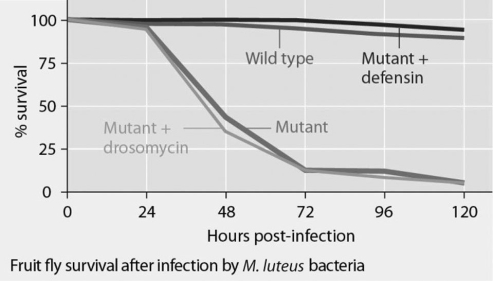 Figure 35.2
 (Multiple Choice)
4.8/5 (78)
(78) A bone marrow transplant may not be appropriate from a given donor (Jane) to a given recipient (Jane's cousin Bob), even though Jane has previously given blood for one of Bob's needed transfusions, because
(Multiple Choice)
5.0/5 (89)
(89) An example of a pathogen that undergoes rapid changes resulting in antigenic variation is
(Multiple Choice)
4.9/5 (81)
(81) Which type of immunity is present only when a newborn infant is fed by nursing and ends when nursing ends?
(Multiple Choice)
4.8/5 (78)
(78) Mammals have Toll-like receptors (TLRs) that can recognize a kind of macromolecule that is absent from vertebrates but present in/on certain groups of pathogens, including viral
(Multiple Choice)
4.9/5 (78)
(78) 
Filters
- Essay(0)
- Multiple Choice(0)
- Short Answer(0)
- True False(0)
- Matching(0)