



 Chat with AI
Exam 5: Membrane Transport and Cell Signaling

Exam 1: Introduction: Evolution and the Foundations of Biology36 Questions
Exam 2: The Chemical Context of Life137 Questions
Exam 3: Carbon and the Molecular Diversity of Life136 Questions
Exam 4: A Tour of the Cell75 Questions
Exam 5: Membrane Transport and Cell Signaling97 Questions
Exam 6: An Introduction to Metabolism79 Questions
Exam 7: Cellular Respiration and Fermentation100 Questions
Exam 8: Photosynthesis72 Questions
Exam 9: The Cell Cycle56 Questions
Exam 10: Meiosis and Sexual Life Cycles62 Questions
Exam 11: Mendel and the Gene Idea63 Questions
Exam 12: The Chromosomal Basis of Inheritance46 Questions
Exam 13: The Molecular Basis of Inheritance67 Questions
Exam 14: Gene Expression: From Gene to Protein80 Questions
Exam 15: Regulation of Gene Expression50 Questions
Exam 16: Development, Stem Cells, and Cancer34 Questions
Exam 17: Viruses35 Questions
Exam 18: Genomes and Their Evolution29 Questions
Exam 19: Descent With Modification55 Questions
Exam 20: Phylogeny60 Questions
Exam 21: The Evolution of Populations70 Questions
Exam 22: The Origin of Species67 Questions
Exam 23: Broad Patterns of Evolution45 Questions
Exam 24: Early Life and the Diversification of Prokaryotes88 Questions
Exam 25: The Origin and Diversification of Eukaryotes71 Questions
Exam 26: The Colonization of Land by Plants and Fungi126 Questions
Exam 27: The Rise of Animal Diversity88 Questions
Exam 28: Plant Structure and Growth59 Questions
Exam 29: Resource Acquisition, Nutrition, and Transport in Vascular Plants110 Questions
Exam 30: Reproduction and Domestication of Flowering Plants67 Questions
Exam 31: Plant Responses to Internal and External Signals75 Questions
Exam 32: Homeostasis and Endocrine Signaling120 Questions
Exam 33: Animal Nutrition67 Questions
Exam 34: Circulation and Gas Exchange88 Questions
Exam 35: The Immune System91 Questions
Exam 36: Reproduction and Development118 Questions
Exam 37: Neurons, Synapses, and Signaling76 Questions
Exam 38: Nervous and Sensory Systems99 Questions
Exam 39: Motor Mechanisms and Behavior79 Questions
Exam 40: Population Ecology and the Distribution of Organisms93 Questions
Exam 41: Species Interactions60 Questions
Exam 42: Ecosystems and Energy90 Questions
Exam 43: Global Ecology and Conservation Biology72 Questions
Select questions type


In receptor-mediated endocytosis, receptor molecules are initially localized on the outer surface of the plasma membrane. Where do the receptors end up following endocytosis?
(Multiple Choice)
4.8/5  (89)
(89) Which of the following would diffuse through the lipid bilayer of a plasma membrane most slowly, if at all?
(Multiple Choice)
4.8/5 (92)
(92) Which of the following would increase the electrochemical gradient across a membrane?
(Multiple Choice)
4.8/5 (86)
(86) Cystic fibrosis is a genetic disease in humans in which the CFTR protein, which functions as a chloride ion channel, is missing or nonfunctional in cell membranes. The CFTR protein belongs to what category of membrane proteins?
(Multiple Choice)
4.9/5 (90)
(90) If an animal cell suddenly lost the ability to produce GTP, what might happen to its signaling system?
(Multiple Choice)
4.9/5 (69)
(69) Which of the following is most likely true of a protein that cotransports glucose and sodium ions into the intestinal cells of an animal?
(Multiple Choice)
4.7/5 (85)
(85) Which of the following is one of the ways that the membranes of winter wheat are able to remain fluid when it is extremely cold?
(Multiple Choice)
4.8/5 (85)
(85) The sodium-potassium pump is called an electrogenic pump because it
(Multiple Choice)
4.9/5 (74)
(74)  Figure 5.3
The solutions in the arms of a U-tube (Figure 5.3) are separated at the bottom of the tube by a selectively permeable membrane. The membrane is permeable to sodium chloride but not to glucose. Side A is filled with a solution of 0.4 M glucose and 0.5 M sodium chloride (NaCl), and side B is filled with a solution containing 0.8 M glucose and 0.4 M sodium chloride. Initially, the volume in both arms is the same. Refer to the figure to answer the following questions.
-At the beginning of the experiment, side A in the figure
Figure 5.3
The solutions in the arms of a U-tube (Figure 5.3) are separated at the bottom of the tube by a selectively permeable membrane. The membrane is permeable to sodium chloride but not to glucose. Side A is filled with a solution of 0.4 M glucose and 0.5 M sodium chloride (NaCl), and side B is filled with a solution containing 0.8 M glucose and 0.4 M sodium chloride. Initially, the volume in both arms is the same. Refer to the figure to answer the following questions.
-At the beginning of the experiment, side A in the figure (Multiple Choice)
4.9/5 (82)
(82)  Figure 5.2
The solutions in the two arms of this U-tube (Figure 5.2) are separated by a membrane that is permeable to water and glucose but not to sucrose. Side A is half-filled with a solution of 2 M sucrose and 1 M glucose. Side B is half-filled with 1 M sucrose and 2 M glucose. Initially, the liquid levels are equal. Refer to the figure to answer the following question(s).
-After the system depicted in the figure reaches equilibrium, what changes are observed?
Figure 5.2
The solutions in the two arms of this U-tube (Figure 5.2) are separated by a membrane that is permeable to water and glucose but not to sucrose. Side A is half-filled with a solution of 2 M sucrose and 1 M glucose. Side B is half-filled with 1 M sucrose and 2 M glucose. Initially, the liquid levels are equal. Refer to the figure to answer the following question(s).
-After the system depicted in the figure reaches equilibrium, what changes are observed? (Multiple Choice)
4.9/5 (76)
(76) The fluid mosaic model of the membrane proposed that membranes
(Multiple Choice)
4.8/5 (76)
(76) At puberty, an adolescent female body changes in both structure and function of several organ systems, primarily under the influence of changing concentrations of estrogens and other steroid hormones. How can one hormone, such as estrogen, mediate so many effects?
(Multiple Choice)
4.8/5 (71)
(71)  Figure 5.4
Five dialysis bags, constructed from a semipermeable membrane that is impermeable to sucrose, were filled with various concentrations of sucrose and then placed in separate beakers containing an initial concentration of 0.6 M sucrose solution. At 10-minute intervals, the bags were massed (weighed) and the percent change in mass of each bag was graphed. Refer to Figure 5.4 to answer the following question(s).
-Which line or lines in the graph in the figure represent(s) bags that contain a solution that is hypertonic at 50 minutes?
Figure 5.4
Five dialysis bags, constructed from a semipermeable membrane that is impermeable to sucrose, were filled with various concentrations of sucrose and then placed in separate beakers containing an initial concentration of 0.6 M sucrose solution. At 10-minute intervals, the bags were massed (weighed) and the percent change in mass of each bag was graphed. Refer to Figure 5.4 to answer the following question(s).
-Which line or lines in the graph in the figure represent(s) bags that contain a solution that is hypertonic at 50 minutes? (Multiple Choice)
4.9/5 (70)
(70) 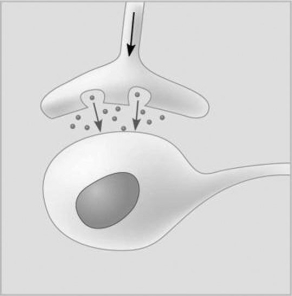 Figure 5.5
-In Figure 5.5, the dots in the space between the two structures represent which of the following?
Figure 5.5
-In Figure 5.5, the dots in the space between the two structures represent which of the following? (Multiple Choice)
4.8/5 (76)
(76) The phosphate transport system in bacteria imports phosphate into the cell even when the concentration of phosphate outside the cell is much lower than the cytoplasmic phosphate concentration. Phosphate import depends on a pH gradient across the membrane-more acidic outside the cell than inside the cell. Phosphate transport is an example of
(Multiple Choice)
4.8/5 (85)
(85) 
Filters
- Essay(0)
- Multiple Choice(0)
- Short Answer(0)
- True False(0)
- Matching(0)