



 Chat with AI
Exam 5: Membrane Transport and Cell Signaling

Exam 1: Introduction: Evolution and the Foundations of Biology36 Questions
Exam 2: The Chemical Context of Life137 Questions
Exam 3: Carbon and the Molecular Diversity of Life136 Questions
Exam 4: A Tour of the Cell75 Questions
Exam 5: Membrane Transport and Cell Signaling97 Questions
Exam 6: An Introduction to Metabolism79 Questions
Exam 7: Cellular Respiration and Fermentation100 Questions
Exam 8: Photosynthesis72 Questions
Exam 9: The Cell Cycle56 Questions
Exam 10: Meiosis and Sexual Life Cycles62 Questions
Exam 11: Mendel and the Gene Idea63 Questions
Exam 12: The Chromosomal Basis of Inheritance46 Questions
Exam 13: The Molecular Basis of Inheritance67 Questions
Exam 14: Gene Expression: From Gene to Protein80 Questions
Exam 15: Regulation of Gene Expression50 Questions
Exam 16: Development, Stem Cells, and Cancer34 Questions
Exam 17: Viruses35 Questions
Exam 18: Genomes and Their Evolution29 Questions
Exam 19: Descent With Modification55 Questions
Exam 20: Phylogeny60 Questions
Exam 21: The Evolution of Populations70 Questions
Exam 22: The Origin of Species67 Questions
Exam 23: Broad Patterns of Evolution45 Questions
Exam 24: Early Life and the Diversification of Prokaryotes88 Questions
Exam 25: The Origin and Diversification of Eukaryotes71 Questions
Exam 26: The Colonization of Land by Plants and Fungi126 Questions
Exam 27: The Rise of Animal Diversity88 Questions
Exam 28: Plant Structure and Growth59 Questions
Exam 29: Resource Acquisition, Nutrition, and Transport in Vascular Plants110 Questions
Exam 30: Reproduction and Domestication of Flowering Plants67 Questions
Exam 31: Plant Responses to Internal and External Signals75 Questions
Exam 32: Homeostasis and Endocrine Signaling120 Questions
Exam 33: Animal Nutrition67 Questions
Exam 34: Circulation and Gas Exchange88 Questions
Exam 35: The Immune System91 Questions
Exam 36: Reproduction and Development118 Questions
Exam 37: Neurons, Synapses, and Signaling76 Questions
Exam 38: Nervous and Sensory Systems99 Questions
Exam 39: Motor Mechanisms and Behavior79 Questions
Exam 40: Population Ecology and the Distribution of Organisms93 Questions
Exam 41: Species Interactions60 Questions
Exam 42: Ecosystems and Energy90 Questions
Exam 43: Global Ecology and Conservation Biology72 Questions
Select questions type


Glucose diffuses slowly through artificial phospholipid bilayers. The cells lining the small intestine, however, rapidly move large quantities of glucose from the glucose-rich food into their glucose-poor cytoplasm. Based on this information, which transport mechanism is most likely responsible for glucose transport in the intestinal cells?
(Multiple Choice)
4.9/5  (73)
(73) Which of the following is true of integral membrane proteins?
(Multiple Choice)
4.9/5 (79)
(79) Which of the following statements about diffusion is correct?
(Multiple Choice)
4.9/5 (77)
(77) A major group of G protein-coupled receptors contains seven transmembrane α helices. The amino end of the protein lies at the exterior of the plasma membrane. Loops of amino acids connect the helices either at the exterior face or on the cytosol face of the membrane. The loop on the cytosol side between helices 5 and 6 is usually substantially longer than the others.
The coupled G protein most likely interacts with this receptor
(Multiple Choice)
4.9/5 (75)
(75) 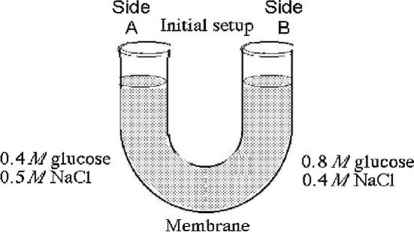 Figure 5.3
The solutions in the arms of a U-tube (Figure 5.3) are separated at the bottom of the tube by a selectively permeable membrane. The membrane is permeable to sodium chloride but not to glucose. Side A is filled with a solution of 0.4 M glucose and 0.5 M sodium chloride (NaCl), and side B is filled with a solution containing 0.8 M glucose and 0.4 M sodium chloride. Initially, the volume in both arms is the same. Refer to the figure to answer the following questions.
-If you examine side A in the figure after three days, the concentrations of glucose and NaCl should be
Figure 5.3
The solutions in the arms of a U-tube (Figure 5.3) are separated at the bottom of the tube by a selectively permeable membrane. The membrane is permeable to sodium chloride but not to glucose. Side A is filled with a solution of 0.4 M glucose and 0.5 M sodium chloride (NaCl), and side B is filled with a solution containing 0.8 M glucose and 0.4 M sodium chloride. Initially, the volume in both arms is the same. Refer to the figure to answer the following questions.
-If you examine side A in the figure after three days, the concentrations of glucose and NaCl should be (Multiple Choice)
4.7/5 (70)
(70) In which of the following ways could signal transduction most probably be explored in research to treat cancer?
(Multiple Choice)
4.9/5 (78)
(78) Why are lipids and proteins free to move laterally in membranes?
(Multiple Choice)
4.7/5 (83)
(83) How do unsaturated fatty acids help keep any membrane more fluid at lower temperatures?
(Multiple Choice)
4.7/5 (78)
(78) Lipid-soluble signaling molecules, such as aldosterone, cross the membranes of all cells but affect only target cells because
(Multiple Choice)
4.7/5 (81)
(81) The difference between pinocytosis and receptor-mediated endocytosis is that
(Multiple Choice)
4.9/5 (94)
(94) Phosphorylation cascades involving a series of protein kinases are useful for cellular signal transduction because
(Multiple Choice)
4.7/5 (80)
(80) Which of the following is true for the evolution of cell membranes?
(Multiple Choice)
5.0/5 (76)
(76) Which of the following is the first event that occurs following the binding of a ligand by a membrane receptor protein?
(Multiple Choice)
4.9/5 (84)
(84)  Figure 5.4
Five dialysis bags, constructed from a semipermeable membrane that is impermeable to sucrose, were filled with various concentrations of sucrose and then placed in separate beakers containing an initial concentration of 0.6 M sucrose solution. At 10-minute intervals, the bags were massed (weighed) and the percent change in mass of each bag was graphed. Refer to Figure 5.4 to answer the following question(s).
-Which line in the graph represents the bag that contained a solution isotonic to the 0.6 M solution at the beginning of the experiment?
Figure 5.4
Five dialysis bags, constructed from a semipermeable membrane that is impermeable to sucrose, were filled with various concentrations of sucrose and then placed in separate beakers containing an initial concentration of 0.6 M sucrose solution. At 10-minute intervals, the bags were massed (weighed) and the percent change in mass of each bag was graphed. Refer to Figure 5.4 to answer the following question(s).
-Which line in the graph represents the bag that contained a solution isotonic to the 0.6 M solution at the beginning of the experiment? (Multiple Choice)
4.7/5 (66)
(66) The movement of the hydrophobic gas nitrous oxide (N2O) (laughing gas) into a cell is an example of
(Multiple Choice)
4.8/5 (77)
(77) According to the fluid mosaic model of cell membranes, which of the following is a true statement about membrane phospholipids?
(Multiple Choice)
4.9/5 (76)
(76) 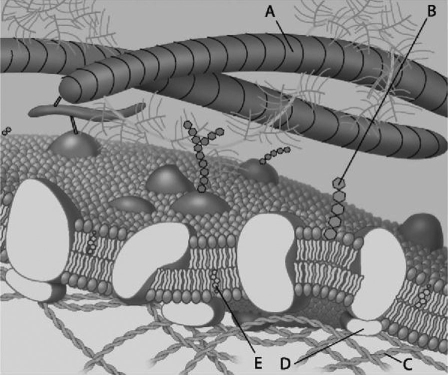 Figure 5.1
For the following questions, match the labeled component of the cell membrane in Figure 5.1 with its description.
-Which component in the figure helps membranes resist changes in fluidity at high and low temperatures?
Figure 5.1
For the following questions, match the labeled component of the cell membrane in Figure 5.1 with its description.
-Which component in the figure helps membranes resist changes in fluidity at high and low temperatures? (Multiple Choice)
4.9/5 (70)
(70) Figure 5.1
For the following questions, match the labeled component of the cell membrane in Figure 5.1 with its description.
-Which component in the figure is a glycolipid?
Figure 5.1
For the following questions, match the labeled component of the cell membrane in Figure 5.1 with its description.
-Which component in the figure is a glycolipid? (Multiple Choice)
4.9/5 (76)
(76) Familial hypercholesterolemia is characterized by extremely high levels of cholesterol in the blood, which results from
(Multiple Choice)
4.8/5 (77)
(77) The primary function of kinases in signal transduction is to
(Multiple Choice)
4.8/5 (87)
(87) 
Filters
- Essay(0)
- Multiple Choice(0)
- Short Answer(0)
- True False(0)
- Matching(0)