



 Chat with AI
Exam 5: Membrane Transport and Cell Signaling

Exam 1: Introduction: Evolution and the Foundations of Biology36 Questions
Exam 2: The Chemical Context of Life137 Questions
Exam 3: Carbon and the Molecular Diversity of Life136 Questions
Exam 4: A Tour of the Cell75 Questions
Exam 5: Membrane Transport and Cell Signaling97 Questions
Exam 6: An Introduction to Metabolism79 Questions
Exam 7: Cellular Respiration and Fermentation100 Questions
Exam 8: Photosynthesis72 Questions
Exam 9: The Cell Cycle56 Questions
Exam 10: Meiosis and Sexual Life Cycles62 Questions
Exam 11: Mendel and the Gene Idea63 Questions
Exam 12: The Chromosomal Basis of Inheritance46 Questions
Exam 13: The Molecular Basis of Inheritance67 Questions
Exam 14: Gene Expression: From Gene to Protein80 Questions
Exam 15: Regulation of Gene Expression50 Questions
Exam 16: Development, Stem Cells, and Cancer34 Questions
Exam 17: Viruses35 Questions
Exam 18: Genomes and Their Evolution29 Questions
Exam 19: Descent With Modification55 Questions
Exam 20: Phylogeny60 Questions
Exam 21: The Evolution of Populations70 Questions
Exam 22: The Origin of Species67 Questions
Exam 23: Broad Patterns of Evolution45 Questions
Exam 24: Early Life and the Diversification of Prokaryotes88 Questions
Exam 25: The Origin and Diversification of Eukaryotes71 Questions
Exam 26: The Colonization of Land by Plants and Fungi126 Questions
Exam 27: The Rise of Animal Diversity88 Questions
Exam 28: Plant Structure and Growth59 Questions
Exam 29: Resource Acquisition, Nutrition, and Transport in Vascular Plants110 Questions
Exam 30: Reproduction and Domestication of Flowering Plants67 Questions
Exam 31: Plant Responses to Internal and External Signals75 Questions
Exam 32: Homeostasis and Endocrine Signaling120 Questions
Exam 33: Animal Nutrition67 Questions
Exam 34: Circulation and Gas Exchange88 Questions
Exam 35: The Immune System91 Questions
Exam 36: Reproduction and Development118 Questions
Exam 37: Neurons, Synapses, and Signaling76 Questions
Exam 38: Nervous and Sensory Systems99 Questions
Exam 39: Motor Mechanisms and Behavior79 Questions
Exam 40: Population Ecology and the Distribution of Organisms93 Questions
Exam 41: Species Interactions60 Questions
Exam 42: Ecosystems and Energy90 Questions
Exam 43: Global Ecology and Conservation Biology72 Questions
Select questions type


Which of the following membrane activities requires energy from ATP hydrolysis?
(Multiple Choice)
4.8/5  (67)
(67)  Figure 5.1
For the following questions, match the labeled component of the cell membrane in Figure 5.1 with its description.
-Which component in the figure is cholesterol?
Figure 5.1
For the following questions, match the labeled component of the cell membrane in Figure 5.1 with its description.
-Which component in the figure is cholesterol? (Multiple Choice)
4.9/5 (87)
(87) When a neuron responds to a particular neurotransmitter by opening gated ion channels, the neurotransmitter is serving as which part of the signal pathway?
(Multiple Choice)
4.9/5 (74)
(74) A protein that spans the phospholipid bilayer one or more times is
(Multiple Choice)
4.9/5 (87)
(87) Proteins that allow the diffusion of ions across membranes in the direction of their concentration gradients are most likely
(Multiple Choice)
4.8/5 (63)
(63) A bacterium engulfed by a white blood cell through phagocytosis will be digested by enzymes contained in
(Multiple Choice)
4.9/5 (82)
(82) Figure 5.1
For the following questions, match the labeled component of the cell membrane in Figure 5.1 with its description.
-Which component in the figure is a peripheral protein?
Figure 5.1
For the following questions, match the labeled component of the cell membrane in Figure 5.1 with its description.
-Which component in the figure is a peripheral protein? (Multiple Choice)
4.9/5 (84)
(84) Sutherland discovered that the signaling molecule epinephrine
(Multiple Choice)
4.9/5 (93)
(93)  Figure 5.4
Five dialysis bags, constructed from a semipermeable membrane that is impermeable to sucrose, were filled with various concentrations of sucrose and then placed in separate beakers containing an initial concentration of 0.6 M sucrose solution. At 10-minute intervals, the bags were massed (weighed) and the percent change in mass of each bag was graphed. Refer to Figure 5.4 to answer the following question(s).
-Which line in the graph represents the bag with the highest initial concentration of sucrose?
Figure 5.4
Five dialysis bags, constructed from a semipermeable membrane that is impermeable to sucrose, were filled with various concentrations of sucrose and then placed in separate beakers containing an initial concentration of 0.6 M sucrose solution. At 10-minute intervals, the bags were massed (weighed) and the percent change in mass of each bag was graphed. Refer to Figure 5.4 to answer the following question(s).
-Which line in the graph represents the bag with the highest initial concentration of sucrose? (Multiple Choice)
4.8/5 (68)
(68) Immediately following binding of a growth factor, an activated receptor would most likely stimulate
(Multiple Choice)
4.9/5 (84)
(84) Transport of potassium ions into an animal cell by the sodium-potassium pump requires
(Multiple Choice)
4.9/5 (72)
(72) You are working on a team that is designing a new drug. In order for this drug to work, it must enter the cytoplasm of specific target cells. Which of the following would be a factor that determines whether the molecule selectively enters the target cells?
(Multiple Choice)
5.0/5 (79)
(79) Based on the figure below, which of these experimental treatments would increase the rate of sucrose transport into a plant cell? 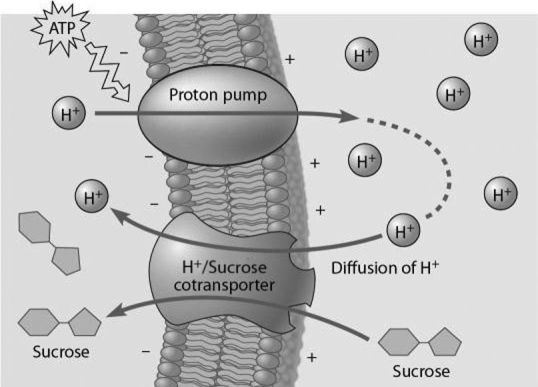
(Multiple Choice)
4.9/5 (86)
(86) 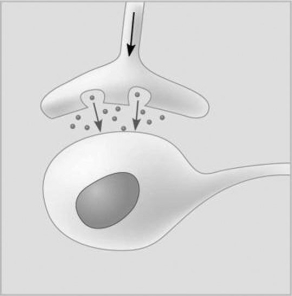 Figure 5.5
-Which of the following types of signaling is represented in Figure 5.5?
Figure 5.5
-Which of the following types of signaling is represented in Figure 5.5? (Multiple Choice)
4.9/5 (74)
(74) The secretion of a signal molecule by a cell into the local environment, followed by a response by a number of cells in the immediate vicinity, is an example of
(Multiple Choice)
4.8/5 (77)
(77) In general, a signal transmitted via a phosphorylation cascade
(Multiple Choice)
4.9/5 (81)
(81) Which of the following enzymes adds a phosphate group to target proteins?
(Multiple Choice)
4.8/5 (85)
(85) 
Filters
- Essay(0)
- Multiple Choice(0)
- Short Answer(0)
- True False(0)
- Matching(0)