



 Chat with AI
Exam 5: Membrane Transport and Cell Signaling

Exam 1: Introduction: Evolution and the Foundations of Biology36 Questions
Exam 2: The Chemical Context of Life137 Questions
Exam 3: Carbon and the Molecular Diversity of Life136 Questions
Exam 4: A Tour of the Cell75 Questions
Exam 5: Membrane Transport and Cell Signaling97 Questions
Exam 6: An Introduction to Metabolism79 Questions
Exam 7: Cellular Respiration and Fermentation100 Questions
Exam 8: Photosynthesis72 Questions
Exam 9: The Cell Cycle56 Questions
Exam 10: Meiosis and Sexual Life Cycles62 Questions
Exam 11: Mendel and the Gene Idea63 Questions
Exam 12: The Chromosomal Basis of Inheritance46 Questions
Exam 13: The Molecular Basis of Inheritance67 Questions
Exam 14: Gene Expression: From Gene to Protein80 Questions
Exam 15: Regulation of Gene Expression50 Questions
Exam 16: Development, Stem Cells, and Cancer34 Questions
Exam 17: Viruses35 Questions
Exam 18: Genomes and Their Evolution29 Questions
Exam 19: Descent With Modification55 Questions
Exam 20: Phylogeny60 Questions
Exam 21: The Evolution of Populations70 Questions
Exam 22: The Origin of Species67 Questions
Exam 23: Broad Patterns of Evolution45 Questions
Exam 24: Early Life and the Diversification of Prokaryotes88 Questions
Exam 25: The Origin and Diversification of Eukaryotes71 Questions
Exam 26: The Colonization of Land by Plants and Fungi126 Questions
Exam 27: The Rise of Animal Diversity88 Questions
Exam 28: Plant Structure and Growth59 Questions
Exam 29: Resource Acquisition, Nutrition, and Transport in Vascular Plants110 Questions
Exam 30: Reproduction and Domestication of Flowering Plants67 Questions
Exam 31: Plant Responses to Internal and External Signals75 Questions
Exam 32: Homeostasis and Endocrine Signaling120 Questions
Exam 33: Animal Nutrition67 Questions
Exam 34: Circulation and Gas Exchange88 Questions
Exam 35: The Immune System91 Questions
Exam 36: Reproduction and Development118 Questions
Exam 37: Neurons, Synapses, and Signaling76 Questions
Exam 38: Nervous and Sensory Systems99 Questions
Exam 39: Motor Mechanisms and Behavior79 Questions
Exam 40: Population Ecology and the Distribution of Organisms93 Questions
Exam 41: Species Interactions60 Questions
Exam 42: Ecosystems and Energy90 Questions
Exam 43: Global Ecology and Conservation Biology72 Questions
Select questions type


A patient has had a serious accident and lost a lot of blood. In an attempt to replenish body fluids, distilled water - equal to the volume of blood lost - is transferred directly into one of his veins. What will be the most probable result of this transfusion?
(Multiple Choice)
4.9/5  (75)
(75) Which of the following correctly describes the relationship between an enzyme and its function?
(Multiple Choice)
4.9/5 (81)
(81) 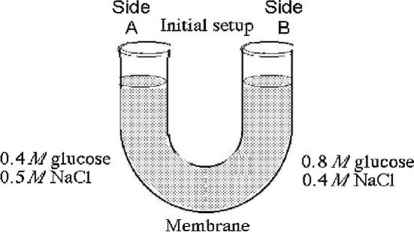 Figure 5.3
The solutions in the arms of a U-tube (Figure 5.3) are separated at the bottom of the tube by a selectively permeable membrane. The membrane is permeable to sodium chloride but not to glucose. Side A is filled with a solution of 0.4 M glucose and 0.5 M sodium chloride (NaCl), and side B is filled with a solution containing 0.8 M glucose and 0.4 M sodium chloride. Initially, the volume in both arms is the same. Refer to the figure to answer the following questions.
-If you examine side A in the figure after three days, you should find
Figure 5.3
The solutions in the arms of a U-tube (Figure 5.3) are separated at the bottom of the tube by a selectively permeable membrane. The membrane is permeable to sodium chloride but not to glucose. Side A is filled with a solution of 0.4 M glucose and 0.5 M sodium chloride (NaCl), and side B is filled with a solution containing 0.8 M glucose and 0.4 M sodium chloride. Initially, the volume in both arms is the same. Refer to the figure to answer the following questions.
-If you examine side A in the figure after three days, you should find (Multiple Choice)
4.8/5 (75)
(75) Which of the following tend to lack hydrophobic regions on their surface?
(Multiple Choice)
4.8/5 (93)
(93) A primary function of polysaccharides attached to glycoproteins and glycolipids of animal cell membranes is to
(Multiple Choice)
4.9/5 (82)
(82) Submerging a red blood cell in a hypertonic solution will result in
(Multiple Choice)
4.9/5 (75)
(75) Which of the following are localized on the exterior of a phospholipid bilayer?
(Multiple Choice)
4.9/5 (79)
(79) 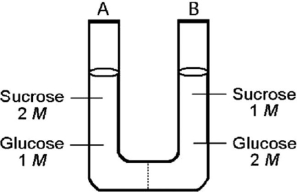 Figure 5.2
The solutions in the two arms of this U-tube (Figure 5.2) are separated by a membrane that is permeable to water and glucose but not to sucrose. Side A is half-filled with a solution of 2 M sucrose and 1 M glucose. Side B is half-filled with 1 M sucrose and 2 M glucose. Initially, the liquid levels are equal. Refer to the figure to answer the following question(s).
-Initially, in terms of tonicity in the figure, the solution in side A with respect to that in side B is
Figure 5.2
The solutions in the two arms of this U-tube (Figure 5.2) are separated by a membrane that is permeable to water and glucose but not to sucrose. Side A is half-filled with a solution of 2 M sucrose and 1 M glucose. Side B is half-filled with 1 M sucrose and 2 M glucose. Initially, the liquid levels are equal. Refer to the figure to answer the following question(s).
-Initially, in terms of tonicity in the figure, the solution in side A with respect to that in side B is (Multiple Choice)
4.9/5 (86)
(86) Which of the following factors would tend to increase membrane fluidity?
(Multiple Choice)
4.7/5 (80)
(80) Following activation of a receptor, which sequence below represents the correct order in which components will be involved in a signaling pathway that utilizes the second messenger cAMP?
(Multiple Choice)
4.8/5 (79)
(79) Which of the following characteristics is unique to plant hormones?
(Multiple Choice)
5.0/5 (87)
(87) Which of the following would diffuse through the lipid bilayer of a plasma membrane most rapidly?
(Multiple Choice)
5.0/5 (67)
(67) Which of the following is the greatest advantage of having multiple steps in a transduction pathway?
(Multiple Choice)
4.7/5 (84)
(84) The primary function of phosphatases in signal transduction is to
(Multiple Choice)
4.9/5 (86)
(86) A primary function of cholesterol in the plasma membranes of some animals is to
(Multiple Choice)
4.9/5 (88)
(88) Which of the following is the most likely fate of animal cells that lack receptors for local paracrine signal molecules?
(Multiple Choice)
4.7/5 (84)
(84) Approximately what proportion of human genes are thought to encode protein kinases?
(Multiple Choice)
4.7/5 (79)
(79) Which of the following provides the most likely explanation for why cell membranes are asymmetrical?
(Multiple Choice)
4.9/5 (90)
(90) 
Filters
- Essay(0)
- Multiple Choice(0)
- Short Answer(0)
- True False(0)
- Matching(0)