



 Chat with AI
Exam 7: Differential Equations

Exam 1: Functions and Models118 Questions
Exam 2: Limits and Derivatives127 Questions
Exam 3: Differentiation Rules248 Questions
Exam 4: Applications of Differentiation273 Questions
Exam 5: Integrals239 Questions
Exam 6: Applications of Integration189 Questions
Exam 7: Differential Equations154 Questions
Exam 8: Infinite Sequences and Series341 Questions
Exam 9: Vectors and the Geometry of Space269 Questions
Exam 10: Vector Functions111 Questions
Exam 11: Partial Derivatives294 Questions
Exam 12: Multiple Integrals270 Questions
Exam 13: Vector Calculus240 Questions
Select questions type


(a) Determine the solution of the differential equation where .(b) Use the solution from part (a) to calculate .(c) Use Euler's Method with the given step sizes to estimate the value of for the equation given in part (a).(i) (ii) (iii) (d) Sketch from part (b) and each of the Euler approximations from part (c) on the same coordinate plane.
(Essay)
4.9/5  (76)
(76) Consider the differential equation .(a) Find the general solution to the differential equation.(b) Find the solution that satisfies the initial condition .
(Essay)
5.0/5 (76)
(76) Make a rough sketch of a directional field for the autonomous differential equation where is the function graphed below. 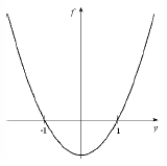
(Essay)
4.9/5 (85)
(85) The radioactive isotope Bismuth-210 has a half-life of 5 days. How many days does it take for 87.5% of a given amount to decay?
(Multiple Choice)
4.8/5 (82)
(82) Consider the predator-prey system , where x and y are in millions of creatures and t represents time in years.(a) Find equilibrium solutions for this system.(b) Explain why it is reasonable to approximate this predator-prey system as , if the initial conditions are x(0) = 0.001 and y(0) = 0.002.(c) Describe what this approximate system tells about the rate of change of each of the specie populations x(t) and y(t) near (0, 0).(d) Find the solution for the approximate system given in part (b).(e) Sketch x (t) and y (t) as determined in part (d) on the same coordinate plane.(f) Sketch a phase trajectory through (0.001; 0.002) for the predator-prey system. Describe in words what happens to each population of species and the interaction between them.
(Essay)
4.8/5 (77)
(77) Solve the initial-value problem , . Then use your solution to evaluate .
(Multiple Choice)
4.8/5 (73)
(73) In each of the given systems, x and y are populations of two different species which are solutions to the differential equations. For each system, describe how the species interact with one another (for example, do they compete for the same resources, or cooperate for mutual benefit?) and suggest a pair of species that might interact in a manner consistent with the given system of equations.(a) (d) (b) (e) (c) (f)
(Essay)
4.9/5 (84)
(84) Solve the differential equation , . From your solution, and the value of .
(Multiple Choice)
4.7/5 (70)
(70) A direction field is given below. Which of the following represents its differential equation? 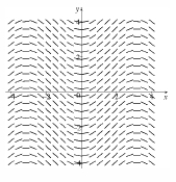
(Multiple Choice)
4.8/5 (64)
(64) Solve the differential equation subject to the initial condition . From your solution, and the value of the limit .
(Multiple Choice)
4.9/5 (75)
(75) A tank contains 500 liters of brine with 10 kg of dissolved salt. Pure water enters the tank at a rate of 10 liters per minute. The well-mixed solution drains from the tank 8 liters per minute. Determine the differential equation that the amount of salt in the tank at time must satisfy.
(Essay)
4.8/5 (79)
(79) Suppose a population growth is modeled by the logistic equation . What is the relative growth rate?
(Multiple Choice)
4.9/5 (74)
(74) A direction field for a differential equation is given below: 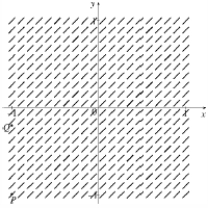 (a) Sketch the graphs of the solutions that have initial condition and initial condition .
(b) Determine whether the differential equation is autonomous. Explain your answer.
(a) Sketch the graphs of the solutions that have initial condition and initial condition .
(b) Determine whether the differential equation is autonomous. Explain your answer. (Essay)
4.8/5 (86)
(86) Radium has a half-life of 1600 years. How many years does it take for 90% of a given amount of radium to decay?
(Multiple Choice)
4.8/5 (92)
(92) It takes money 20 years to triple at a certain rate of interest. How long does it take for money to double at this rate?
(Short Answer)
4.7/5 (66)
(66) A tank contains 1000 liters of pure water. Brine that contains 0.05 kg of salt per liter of water enters the tank at a rate of 8 liters per minute. Brine that contains 0.04 kg of salt per liter of water enters the tank at a rate of 5 liters per minute. The well-mixed solution drains from the tank at a rate of 13 liters per minute. How much salt is in the tank after:
(a) minutes?
(b) half an hour?
(c) a very long time?
(Essay)
4.8/5 (67)
(67) Consider the differential equation .(a) Find the general solution to the differential equation.(b) Find the solution that satisfies the initial condition .
(Essay)
4.7/5 (82)
(82) Which of the following is a solution of the differential equation
(Multiple Choice)
4.9/5 (77)
(77) Which of the following is a solution of the differential equation that satisfies the initial conditions , , ?
(Multiple Choice)
4.8/5 (73)
(73) A phase portrait of a predator-prey system is given below in which F represents the population of foxes (in thousands) and R the population of rabbits (in thousands).  (a) Referring to the graph, what is a reasonable non-zero equilibrium solution for the system?
(b) Write down a possible system of differential equations which could have been used to produce the given graph.(c) Describe how each population changes as time passes, using the initial condition P indicated on the graph.(d) Use your description in part (c) to make a rough sketch of the graph of R and F as functions of time.
(a) Referring to the graph, what is a reasonable non-zero equilibrium solution for the system?
(b) Write down a possible system of differential equations which could have been used to produce the given graph.(c) Describe how each population changes as time passes, using the initial condition P indicated on the graph.(d) Use your description in part (c) to make a rough sketch of the graph of R and F as functions of time. (Essay)
4.9/5 (85)
(85) 
Filters
- Essay(0)
- Multiple Choice(0)
- Short Answer(0)
- True False(0)
- Matching(0)