



 Chat with AI
Exam 7: Differential Equations

Exam 1: Functions and Models118 Questions
Exam 2: Limits and Derivatives127 Questions
Exam 3: Differentiation Rules248 Questions
Exam 4: Applications of Differentiation273 Questions
Exam 5: Integrals239 Questions
Exam 6: Applications of Integration189 Questions
Exam 7: Differential Equations154 Questions
Exam 8: Infinite Sequences and Series341 Questions
Exam 9: Vectors and the Geometry of Space269 Questions
Exam 10: Vector Functions111 Questions
Exam 11: Partial Derivatives294 Questions
Exam 12: Multiple Integrals270 Questions
Exam 13: Vector Calculus240 Questions
Select questions type


An object cools at a rate (measured in ) equal to times the difference between its temperature and that of the surrounding air. Suppose the object takes 10 minutes to cool from 60 C to 40 C in a room kept at 20 C. Find the value of .
(Multiple Choice)
4.8/5  (84)
(84) Suppose that we model populations of aphids and ladybugs with the system of differential equations: Find the equilibrium solution.
(Multiple Choice)
4.8/5 (81)
(81) In paleontology, the phenomenon of radioactive decay is commonly used to date fossil remains. This method uses the fact that the rate of decay of an element will be proportional to the amount of the radioactive element that exists at time .(a) Determine a differential equation that must satisfy.(b) What can you say about as ?
(c) Find a solution to your differential equation.(d) How long will it take for half of the original amount of the radioactive element to decay?
(Essay)
4.9/5 (75)
(75) A lettuce leaf collected from the salad bar at the college cafeteria contains as much carbon-14 as a freshly cut lettuce leaf. How old is it? (Use 5700 years for the half-life of C.)
(Short Answer)
4.8/5 (82)
(82) Which of the given differential equations matches the given direction field? 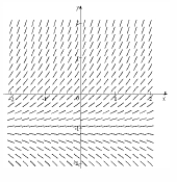
(Multiple Choice)
5.0/5 (80)
(80) In biology, it is often assumed that the number of people that will contract a certain disease is directly proportional to the product of the number of people who are currently infected with the disease at a particular time and the number of people who, at the same time, are not yet infected but who are susceptible to it. Assume that the total population, , in the study is a constant.(a) What does mean?
(b) Determine a differential equation that must satisfy.(c) What happens to as ?
(Essay)
4.8/5 (84)
(84) In a model of epidemics, the number of infected individuals in a population at a time is a solution of the logistic differential equation , where y is the number of infected individuals in the community and t is the time in days.(a) Describe the population for this situation.(b) Assume that 10 people were infected at the initial time t = 0. Find the solution for the differential equation.(c) How many days will it take for half of the population to be infected?
(Essay)
4.7/5 (79)
(79) Suppose that we model populations (in millions) of predators and preys with the system of differential equations: =2x-1.2xy =-y+0.9xy Find the expression for .
(Multiple Choice)
4.8/5 (67)
(67) Which of the given differential equations matches the given direction field? 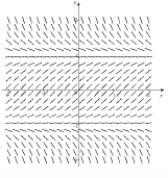
(Multiple Choice)
4.8/5 (81)
(81) Suppose a population growth is modeled by the logistic equation with P(0) = 10. Find the formula for the population after t years.
(Multiple Choice)
4.9/5 (77)
(77) Consider the differential equation .(a) What are the equilibrium solutions?
(b) Sketch the direction field for the given differential equation.
(Essay)
4.7/5 (79)
(79) A model of the seasonal changes in daylight hours is given by , where and are constants.(a) Determine the general solution for this differential equation.(b) Discuss the practical meaning of the solution of this equation.
(Essay)
4.9/5 (62)
(62) In a model of epidemics, let , in thousands, be the number of infected individuals in the
population at time , in days. If we assume that the infection spreads to all those who are
susceptible, one possible solution for is given by where is a positive
constant which measures the rate of infection and P , in thousands, is the total population in
this situation.(a) Determine the solution of this differential equation if .(b) Discuss what means.(c) As the time increases without bound, what happens to ? (That is, what does mean?)
(d) Sketch the solution of the differential equation in part (a).
(Essay)
4.8/5 (78)
(78) Which of the following is a solution of the differential equation
(Multiple Choice)
4.7/5 (69)
(69) Suppose that a population of bacteria grows according to the logistic equation , where P is the population measured in thousands and t is time measured in days.(a) What is the carrying capacity? What is the value of k?
(b) A direction field for this equation is given below. Where are the slopes close to 0? Where are the slope values the largest? Where are the solutions increasing? Where are the solutions decreasing?  (c) Use the direction field to sketch solutions for initial populations of 10, 30, 50, and 70. What do these solutions have in common? How do they differ? Which solutions have inflection points? At what population levels do they occur?
(d) What are the equilibrium solutions? How are the other solutions related to these solutions?
(c) Use the direction field to sketch solutions for initial populations of 10, 30, 50, and 70. What do these solutions have in common? How do they differ? Which solutions have inflection points? At what population levels do they occur?
(d) What are the equilibrium solutions? How are the other solutions related to these solutions? (Essay)
4.8/5 (83)
(83) Which of the given differential equations matches the given direction field? 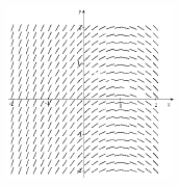
(Multiple Choice)
4.8/5 (89)
(89) According to Newton's Law of Heating, the temperature of a cold object increases at a rate proportional to the difference between and the temperature of its surroundings.(a) Write down this law as a differential equation.(b) Assume the room temperature is 70 F. If it takes 10 minutes for a can of soda to warm up from 30 F to 35 F, and how long it takes to warm up a can of soda from 30 F to 40 F.
(Essay)
4.8/5 (80)
(80) Suppose , . Use Euler's method with step size to approximate .
(Multiple Choice)
4.9/5 (86)
(86) 
Filters
- Essay(0)
- Multiple Choice(0)
- Short Answer(0)
- True False(0)
- Matching(0)