



 Chat with AI
Exam 7: Differential Equations

Exam 1: Functions and Models118 Questions
Exam 2: Limits and Derivatives127 Questions
Exam 3: Differentiation Rules248 Questions
Exam 4: Applications of Differentiation273 Questions
Exam 5: Integrals239 Questions
Exam 6: Applications of Integration189 Questions
Exam 7: Differential Equations154 Questions
Exam 8: Infinite Sequences and Series341 Questions
Exam 9: Vectors and the Geometry of Space269 Questions
Exam 10: Vector Functions111 Questions
Exam 11: Partial Derivatives294 Questions
Exam 12: Multiple Integrals270 Questions
Exam 13: Vector Calculus240 Questions
Select questions type


A function y (x) satisfies the differential equation .(a) What are the constant solutions of the equation?
(b) For what values of is increasing?
(c) The equation shows that is independent of . Using this observation, what can you say about the relationship of the graphs of the non-constant solutions of the equation?
(Essay)
4.9/5  (91)
(91) A bacteria population grows at a rate proportional to its size. The initial count was 400 and 1600 after 1 hour. In how many minutes does the population double?
(Multiple Choice)
5.0/5 (83)
(83) A bacteria culture starts with 200 bacteria and triples in size every half hour. After 2 hours, how many bacteria are there?
(Multiple Choice)
4.8/5 (70)
(70) Suppose a population growth is modeled by the logistic equation with P(0) = 10. Find the population after 50 years.
(Multiple Choice)
4.7/5 (85)
(85) An outbreak of a previously unknown influenza occurred on the campus of the University of Northern South Dakota at Roscoe during the first semester. Due to the contagious nature of the disease, the campus was quarantined and the disease was allowed to run its course. The table below shows the total number P of infected students for the first four weeks of the outbreak on this campus of 2,500 students. t (days) 0 2 4 6 8 10 12 14 16 18 20 22 24 26 28 P 100 121 146 176 212 254 304 361 428 503 589 683 787 899 1017 Logistic Exponential (a) Find a logistic model for the data. Complete the table with predicted values using this model.(b) Find an exponential model for these data. Complete the table with predicted values using this model.(c) Compare your findings in parts (a) and (b) above. For what values would you consider both models to be a good fit for the data? Which model provides the best fit for the data? Justify your choice.
(Essay)
4.9/5 (75)
(75) In an idealized experiment, the following results were obtained for a population of bacteria during a 7 hour period. The initial population is 1000 bacteria. Time (hours) 0.5 1.0 1.5 2.0 2.5 3.0 3.5 Number of Bacteria 1 1 3.2\times1 1 3.2\times1 1 3.2\times1 Time (hours) 4.0 4.5 5.0 5.5 6.0 6.5 7.0 Number of Bacteria 1 3.2\times1 1 3.2\times1 1 3.2\times1 1 (a) Identify the period where there is no change in the number of bacteria. (This is called the period of adaptation.)
(b) Identify the period of growth.(c) Assume that the growth rate of bacteria is proportional to the population. Find an exponential model for the data during the period of growth.(d) Add an additional line to the table using your population model to generate the entries for the given time values. Compare these entries with the given data and explain any discrepancy.
(Essay)
4.8/5 (87)
(87) A direction field for a differential equation is given below. Use a straightedge to draw the graphs of the Euler approximations to the solution curve over the interval that passes through . Use as step sizes , , and . 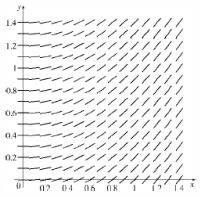
(Essay)
4.8/5 (78)
(78) $2000 is invested at 3% annual interest. Find the value at the end of 10 years if:
(a) the interest compounds annually.(b) the interest compounds continuously.
(Short Answer)
4.9/5 (91)
(91) Find the solution to the differential equation that satisfies the initial condition .
(Essay)
4.7/5 (76)
(76) Which of the given differential equations matches the given direction field? 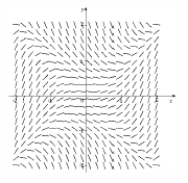
(Multiple Choice)
4.9/5 (89)
(89) (a) Show that every member of the family of functions is a solution of the differential equation .(b) Find a solution of the differential equation that satisfies the initial condition .(c) Find a solution of the differential equation that satisfies the initial condition .
(Essay)
4.9/5 (71)
(71) Which of the following equations is satisfied by the function ?
(Multiple Choice)
4.8/5 (79)
(79) Which of the following is a solution of the differential equation
(Multiple Choice)
4.8/5 (72)
(72) A tank is filled with 200 gallons of brine in which is dissolved 5 pounds of salt. Brine containing 0.1 pound of salt per gallon enters the tank at a rate of 2 gallons per minute, and the well-stirred mixture is drawn from the talk at the same rate.(a) Find the amount of salt in the tank at time .(b) How much salt is present in the tank after 20 minutes?
(c) How much salt is present after a long time? What is the concentration then?
(Essay)
4.8/5 (79)
(79) 
Filters
- Essay(0)
- Multiple Choice(0)
- Short Answer(0)
- True False(0)
- Matching(0)