



 Chat with AI
Exam 7: Differential Equations

Exam 1: Functions and Models118 Questions
Exam 2: Limits and Derivatives127 Questions
Exam 3: Differentiation Rules248 Questions
Exam 4: Applications of Differentiation273 Questions
Exam 5: Integrals239 Questions
Exam 6: Applications of Integration189 Questions
Exam 7: Differential Equations154 Questions
Exam 8: Infinite Sequences and Series341 Questions
Exam 9: Vectors and the Geometry of Space269 Questions
Exam 10: Vector Functions111 Questions
Exam 11: Partial Derivatives294 Questions
Exam 12: Multiple Integrals270 Questions
Exam 13: Vector Calculus240 Questions
Select questions type


Find the orthogonal trajectories of the family of curves . Then draw several members
of each family on the same coordinate plane.
(Essay)
4.8/5  (62)
(62) Solve the differential equation , . From your solution, and the value of .
(Multiple Choice)
4.8/5 (75)
(75) Which of the following equations is satisfied by the function ?
(Multiple Choice)
5.0/5 (86)
(86) Consider the differential equation .(a) Find the general solution to the differential equation.(b) Find the solution with the initial-value .(c) Find the solution with the initial-value .
(Essay)
4.8/5 (78)
(78) A tank is filled with 100 L (liter) of water. Brine containing 0.4 kg of salt per liter is poured into the tank at 5 L per minute, and the well-stirred mixture leaves the tank at the same rate.(a) Write the differential equation that the amount of salt, in the tank must satisfy.(b) Find the amount of salt in the tank at any time, .(c) How much salt is present after 20 min?
(d) What is the concentration of solution in the tank after a long time?
(Essay)
4.8/5 (73)
(73) Suppose a population growth is modeled by the logistic equation . Solve this differential equation with the initial condition P(0) = 20.
(Essay)
4.8/5 (74)
(74) The population of two species is modeled by the system of equations .(a) Find an expression for .(b) A possible direction field for the differential equation in part (a) is given below:  Use this graph to sketch a phase portrait with each of P, Q, R, and S as an initial condition. Describe the behavior of the trajectories near the nonzero equilibrium solutions.(c) Graph x and y as function of t. What happens to the population of the two species as the time t increases without bound?
 (Essay)
4.9/5 (68)
(68) Suppose , . Use Euler's method with step size to approximate .
(Multiple Choice)
4.9/5 (82)
(82) Find the equation of a curve that passes through the point and whose slope at a point is .
(Essay)
4.7/5 (82)
(82) Which of the following is a solution of the differential equation ?
(Multiple Choice)
4.8/5 (85)
(85) A direction field is given below. Which of the following represents its differential equation? 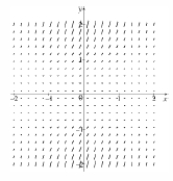
(Multiple Choice)
4.9/5 (86)
(86) A direction field for a differential equation is given below. Use a straightedge to draw the graphs of the Euler approximations to the solution curve over the interval that passes through . Use as step sizes , , and . 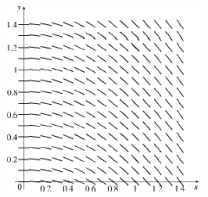
(Essay)
4.8/5 (83)
(83) In the presence of air resistance for an object in free fall, the velocity is the solution of the
differential equation where is the constant of acceleration due to earth's gravity and is a positive constant.(a) Find the solution for the equation that satisfies the initial value that .(b) As time, , increases without bound, what is the limiting velocity. (Note: the limiting velocity during free fall is called the terminal velocity.)
(c) Sketch your solution from part (a).
(Essay)
4.9/5 (84)
(84) Suppose that a population grows according to a logistic model.(a) Write the differential equation for this situation with k = 0.01 and carrying capacity of 60 thousand.(b) Solve the differential equation in part (a) with the initial condition t = 0 (hours) and population P = 1 thousand.(c) Find the population for t = 10 hours, t = 100 hours, and t = 1000 hours.(d) After how many hours does the population reach 2 thousand? 30 thousand? 55 thousand?
(e) As the time t increases without bound, what happens to the population?
(f) Sketch the graph of the solution of the differential equation.
(Essay)
4.9/5 (73)
(73) Suppose , . Use Euler's method with step size to approximate .
(Multiple Choice)
4.8/5 (80)
(80) A population is modeled by the differential equation where is the population at time .(a) What are the equilibrium solutions?
(b) For what values of is the population increasing?
(c) For what values of is the population decreasing?
(d) Use the information from above to sketch the direction field for the given differential equation.
(Essay)
4.7/5 (79)
(79) Consider the differential equation .(a) What are the equilibrium solutions?
(b) Sketch the direction field for the given differential equation.
(Essay)
4.8/5 (82)
(82) A direction field for a differential equation is given below: 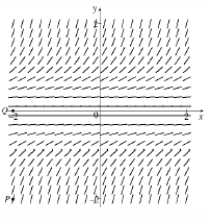 (a) Sketch the graphs of the solutions that have initial condition and initial condition .
(b) Determine whether the differential equation is autonomous. Explain your answer.
(a) Sketch the graphs of the solutions that have initial condition and initial condition .
(b) Determine whether the differential equation is autonomous. Explain your answer. (Essay)
4.9/5 (83)
(83) Suppose a hail ball melts at a rate proportional to its surface area. If from to minutes its radius decreases from cm to cm, how long does it take to melt completely?
(Essay)
4.9/5 (83)
(83) 
Filters
- Essay(0)
- Multiple Choice(0)
- Short Answer(0)
- True False(0)
- Matching(0)