



 Chat with AI
Exam 7: Differential Equations

Exam 1: Functions and Models118 Questions
Exam 2: Limits and Derivatives127 Questions
Exam 3: Differentiation Rules248 Questions
Exam 4: Applications of Differentiation273 Questions
Exam 5: Integrals239 Questions
Exam 6: Applications of Integration189 Questions
Exam 7: Differential Equations154 Questions
Exam 8: Infinite Sequences and Series341 Questions
Exam 9: Vectors and the Geometry of Space269 Questions
Exam 10: Vector Functions111 Questions
Exam 11: Partial Derivatives294 Questions
Exam 12: Multiple Integrals270 Questions
Exam 13: Vector Calculus240 Questions
Select questions type


Suppose a population growth is modeled by the logistic equation with P(0) = 10. Find the population after 500 years.
(Multiple Choice)
4.8/5  (79)
(79) A thermometer is taken outside from a room where the temperature is 72 F. Outdoors, the temperature is 48 F. After one minute, the thermometer reads 55 F. After how many minutes does the thermometer read 50 F?
(Multiple Choice)
4.9/5 (65)
(65) A bacteria culture starts with 200 bacteria and triples in size every half hour. The population of the bacteria after hours is:
(Multiple Choice)
4.8/5 (90)
(90) Assume that the rate of growth of a population of fruit flies is proportional to the size of the population at each instant of time. If 100 fruit flies are present initially and 200 are present after 5 days, how many will be present after 10 days?
(Short Answer)
4.8/5 (79)
(79) Which of the following is a solution of the differential equation
(Multiple Choice)
4.8/5 (81)
(81) Suppose that a certain population grows according to an exponential model.(a) Write the differential equation for this situation with a relative growth rate of k = 0.01. Produce a solution for the initial condition t = 0 (in hours) and population P = 1 (in thousands).(b) Find the population when t = 10 hours, t = 100 hours, and t = 1000 hours.(c) After how many hours does the population reach 2 thousand? 30 thousand? 55 thousand?
(d) As the time t increases without bound, what happens to the population?
(e) Sketch the graph of the solution of the differential equation.
(Essay)
4.8/5 (71)
(71) Suppose , . Use Euler's method with step size to approximate .
(Multiple Choice)
4.9/5 (72)
(72) The following data approximate the results obtained by subjecting Hela-S cells to 250 kvp x-rays: Dose (rads) 0 100 150 200 250 300 400 450 500 550 600 Fraction Surviving 1 0.5 0.4 0.3 0.17 0.13 0.03 0.02 0.01 0.006 0.005 Assume that these data fit an exponential model.(a) Find the appropriate exponential model.(b) Add another line to the table using your population model for the given doses of radiation.(c) Compare the model entries to the given data and explain any discrepancy.
(Essay)
4.7/5 (79)
(79) Consider the differential equation .(a) What are the equilibrium solutions?
(b) For what values of is increasing?
(c) For what values of is decreasing?
(d) Use the information from above to sketch the direction field for the given differential equation.
(Essay)
4.8/5 (83)
(83) Suppose a population growth is modeled by the logistic differential equation with the carrying capacity 2000 and the relative growth rate k = 0.06 per year. If the initial population is P(0) = 500, and P(10).
(Multiple Choice)
4.8/5 (85)
(85) Which of the following is a solution of the differential equation
(Multiple Choice)
4.7/5 (75)
(75) Find the orthogonal trajectories of the family of curves . Then draw several members of each family on the same coordinate plane.
(Essay)
4.8/5 (77)
(77) A tank contains 10 gallons of water and 4 pounds of a chemical, , per gallon. To decrease the concentration of , pure water is added to the container at a rate of 2 gallons per minute, and the well stirred mixture is drawn from the tank at the same rate.(a) Find the amount of chemical in the tank at time .(b) How much chemical is present after 10 minutes?
(c) How long does it take for the concentration of chemical to be reduced to 0.1 pound per gallon?
(Essay)
4.8/5 (88)
(88) A bacteria culture starts with 200 bacteria and in 1 hour contains 400 bacteria. How many hours does it take to reach 2000 bacteria?
(Multiple Choice)
4.7/5 (74)
(74) A ball is thrown directly upward from the ground with an initial speed ft/s.(a) Determine the differential equation that the position function satisfies.(b) What are the initial conditions?
(c) How high does the ball rise?
(Essay)
4.9/5 (76)
(76) The graph of a direction field for the differential equation is given below:  (a) Sketch a solution curve that satisfies the given condition, but without solving the differential equation:
(i) (ii) (iii)
(b) Solve the differential equation for each of the conditions in part (a). Compare your answers to the curves you produced in part (a).
(c) What is the relationship between the curves (i) and (ii) in part (a)? Explain why this occurs.
(a) Sketch a solution curve that satisfies the given condition, but without solving the differential equation:
(i) (ii) (iii)
(b) Solve the differential equation for each of the conditions in part (a). Compare your answers to the curves you produced in part (a).
(c) What is the relationship between the curves (i) and (ii) in part (a)? Explain why this occurs. (Essay)
4.8/5 (78)
(78) Make a rough sketch of a directional field for the autonomous differential equation where is the function graphed below. 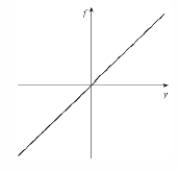
(Essay)
4.9/5 (83)
(83) In 1970, the Brown County groundhog population was 100. By 1980, there were 900 groundhogs in Brown County. If the rate of population growth of these animals is proportional to the population size, how many groundhogs might one expect to see in 1995?
(Short Answer)
4.9/5 (82)
(82) (a) Solve the differential equation , with b = 2 and k = 0.1, and = 1.(b) Sketch a graph of the solution you produced for part (a) and discuss the major characteristics of this monomolecular growth curve.
(Essay)
4.9/5 (82)
(82) 
Filters
- Essay(0)
- Multiple Choice(0)
- Short Answer(0)
- True False(0)
- Matching(0)